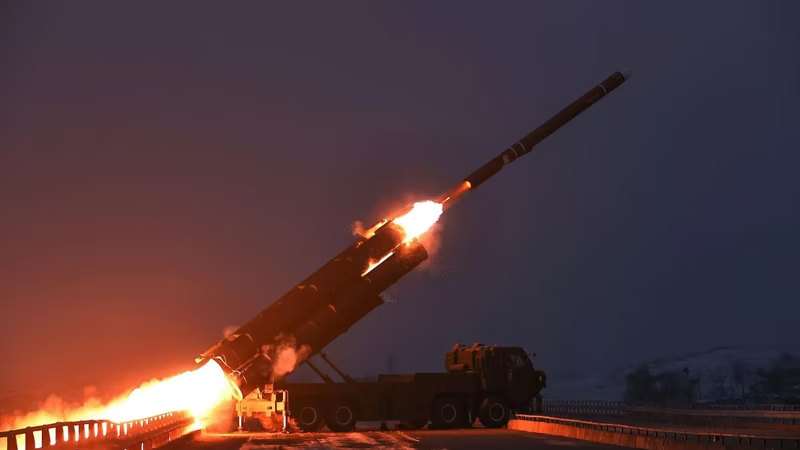
In a move that has sent shockwaves through global security circles, North Korea has just conducted another provocative military demonstration—this time launching two long-range cruise missiles under the direct watch of leader Kim Jong Un. The test, framed by Pyongyang as a necessary act of “self-defense,” is being interpreted by analysts worldwide as a stark escalation in its nuclear readiness posture.
Coming just days after the regime revealed significant progress on its first nuclear-powered submarine, these latest missile launches aren’t just routine drills—they’re a calculated signal to the U.S., South Korea, and Japan that Pyongyang’s deterrence capabilities are expanding rapidly and without restraint.
Table of Contents
- What Happened During the Missile Test?
- Kim Jong Un’s “Unlimited, Sustained Development” Warning
- How the Nuclear Submarine Fits Into This Strategy
- Regional and Global Reactions
- What This Means for Global Security
- Conclusion: A New Phase of Deterrence or Dangers?
What Happened During the Missile Test?
According to state media reports from North Korea’s KCNA, the country successfully launched two long-range cruise missiles on December 28, 2025. The missiles reportedly flew for more than 2,000 kilometers (roughly 1,240 miles) before accurately hitting their simulated targets .
Unlike ballistic missiles, which follow a high arc trajectory and are easier to detect and intercept, cruise missiles fly low to the ground and can weave through terrain, making them far more difficult for radar systems to track. This characteristic makes them particularly dangerous for surprise strikes against military or civilian infrastructure.
Key details of the test:
- Date: December 28, 2025
- Missile Type: Long-range cruise missiles
- Range: Over 2,000 km
- Supervisor: Kim Jong Un, on-site at the launch facility
- Stated Purpose: “Verification of nuclear combat readiness” and “self-defense capabilities”
This is not the first time North Korea has tested such systems, but the timing—just before the new year and amid stalled denuclearization talks—raises serious questions about Pyongyang’s true intentions.
Kim Jong Un’s “Unlimited, Sustained Development” Warning
Kim Jong Un didn’t just observe the launch—he delivered a chilling declaration. He called the test a demonstration of North Korea’s commitment to “unlimited, sustained development” of its defense capabilities .
Translation? Pyongyang has no plans to slow down its weapons program. In fact, it’s signaling that every perceived threat—whether from joint U.S.-South Korea military drills, diplomatic pressure, or economic sanctions—will be met with an accelerated arms buildup.
His presence at the site is also symbolic. By personally overseeing the drill, Kim reinforces his image as the nation’s supreme military strategist and sends a message of resolve both domestically and internationally.
How the Nuclear Submarine Fits Into This Strategy
This missile test didn’t occur in a vacuum. It follows closely on the heels of North Korea’s announcement that it has made “major progress” on its first nuclear-powered submarine .
Why does that matter? A nuclear-powered sub can stay submerged for months, making it a nearly undetectable platform for launching nuclear missiles. When combined with long-range cruise missiles capable of carrying warheads, this creates a terrifying second-strike capability—ensuring that even if North Korea suffers a first strike, it could retaliate with devastating force.
Experts at the Arms Control Association warn that such advancements could destabilize the delicate balance of power in Northeast Asia and trigger a regional arms race. South Korea and Japan may feel compelled to enhance their own missile defense or even reconsider nuclear options—a dangerous spiral.
Regional and Global Reactions
Unsurprisingly, the test has drawn swift condemnation:
- South Korea’s Joint Chiefs of Staff confirmed the launch and convened an emergency security meeting, calling the act “a serious provocation that undermines peace on the Korean Peninsula” .
- Japan’s Prime Minister labeled the test “utterly unacceptable” and pledged close coordination with the U.S. and South Korea .
- The U.S. State Department reiterated its “ironclad commitment” to the defense of its allies and called on North Korea to return to dialogue .
Despite years of “maximum pressure” campaigns and diplomatic overtures—from Trump’s summits to Biden’s extended deterrence pledges—Pyongyang continues to advance its arsenal with little regard for international opinion.
What This Means for Global Security
The implications of this latest North Korea missile test go far beyond the Korean Peninsula:
- Miscalculation Risk: As both sides increase military activities, the chance of an accidental clash or misinterpreted signal grows exponentially.
- Alliance Reinforcement: The U.S. is likely to deepen trilateral cooperation with South Korea and Japan, possibly including more frequent joint drills and advanced weapons deployments.
- Diplomatic Stalemate: With North Korea now declaring its nuclear status as “irreversible,” the window for denuclearization talks appears permanently closed—forcing the world to manage a nuclear-armed North Korea indefinitely.
For more context on evolving defense postures in Asia, see our deep dive on [INTERNAL_LINK:asia-military-alliances-2025].
Conclusion: A New Phase of Deterrence or Dangers?
The December 28 missile test is more than a technical exercise—it’s a geopolitical statement. North Korea is no longer just seeking recognition or sanctions relief. It is building a credible, diversified nuclear triad (land, air, and soon, sea-based) to ensure its survival through deterrence.
While Pyongyang frames this as defensive, the international community sees it as a growing threat. The challenge now is not to reverse North Korea’s program—that ship has sailed—but to prevent escalation, avoid miscalculation, and maintain open channels of communication, however tenuous.
As we enter 2026, one thing is clear: the era of a nuclear North Korea is here to stay, and the world must adapt—carefully and strategically.
Sources
- “North Korea tests 2 long-range cruise missiles, Kim Jong Un calls it ‘unlimited, sustained development,’” Times of India, December 29, 2025.
- “North Korea reveals progress on first nuclear-powered submarine,” Reuters, December 2025.
- South Korean Joint Chiefs of Staff official statement, December 28, 2025.
- Japanese Ministry of Foreign Affairs press release, December 28, 2025.
- U.S. Department of State briefing transcript, December 28, 2025.