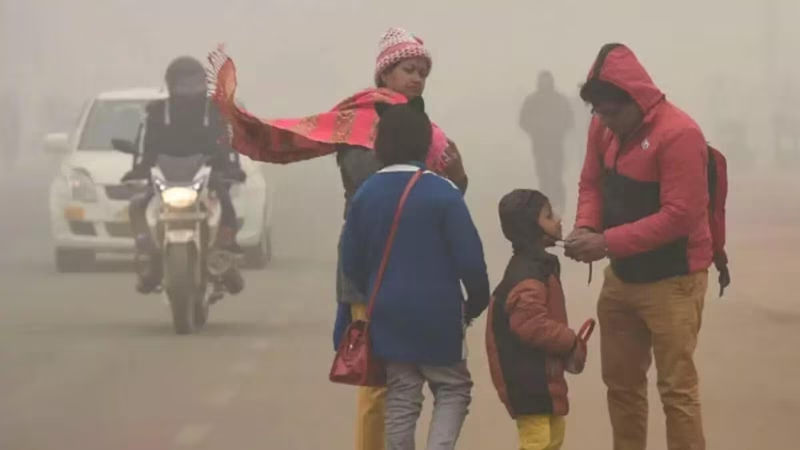
A biting cold wave has gripped North India, disrupting daily life and forcing mass school closures across multiple states. With temperatures dipping dangerously low—and sub-zero conditions in the Himalayas—state governments have taken emergency measures to safeguard children’s health. Uttar Pradesh has shut all schools until January 1, 2026, while Bihar, Jharkhand, and Himachal Pradesh have either closed campuses or shifted to partial operations. Meanwhile, schools in South and East India remain unaffected, highlighting the stark regional divide in weather impact.
This isn’t just a weather event—it’s a public health and education crisis unfolding in real time. For parents, teachers, and students, the sudden shift raises questions about learning continuity, exam schedules, and winter safety. In this comprehensive update, we break down the state-wise situation, explain the science behind this cold spell, and offer practical advice for families navigating the freeze.
Table of Contents
- Cold Wave Hits North India: What’s Causing the Freeze?
- State-wise School Closures Due to Cold Wave
- Health Risks of Extreme Cold for Children
- Impact on Academic Calendar and Exams
- How South India Remains Unaffected
- Expert Tips to Keep Kids Safe During Cold Wave
- What Parents and Teachers Should Do Next
- Conclusion: Adapting to Climate Extremes in Education
- Sources
Cold Wave Hits North India: What’s Causing the Freeze?
The current cold wave is the result of a high-pressure system over northwest India combined with strong westerly disturbances bringing moisture from the Mediterranean. According to the India Meteorological Department (IMD), many districts in the Indo-Gangetic Plain are experiencing “severe” cold wave conditions—defined as minimum temperatures below 4°C or 6.5°C below normal for two consecutive days.
In Himachal Pradesh and parts of Uttarakhand, heavy snowfall has blanketed roads and villages, cutting off remote schools entirely. The IMD has issued cold wave alerts for at least another week, with dense fog compounding travel hazards.
State-wise School Closures Due to Cold Wave
Here’s a breakdown of official announcements as of December 29, 2025:
- Uttar Pradesh: All government and private schools closed until January 1, 2026. The order applies to all grades, with online classes discouraged due to connectivity issues in rural areas.
- Bihar: Schools shut in 12 cold-prone districts (including Patna, Gaya, and Muzaffarpur). In other areas, morning assemblies are canceled, and classes start after 10 AM.
- Jharkhand: Partial closure in Ranchi, Hazaribagh, and Dumka. Schools operating with reduced hours and mandatory winter clothing policies.
- Himachal Pradesh: Winter holidays extended until January 5 due to snowfall. Landslides have blocked key routes in Shimla and Kullu districts.
- Rajasthan: Already on scheduled winter break (Dec 15–Jan 10), so no additional disruption.
- South & East India (Tamil Nadu, Karnataka, West Bengal, Odisha): Normal operations continue; no cold wave alerts issued.
Health Risks of Extreme Cold for Children
Young children are especially vulnerable to cold-related illnesses. Pediatricians warn of rising cases of:
- Hypothermia: When core body temperature drops below 35°C.
- Frostbite: Tissue damage from freezing, especially on fingers and ears.
- Respiratory infections: Cold air aggravates asthma and increases susceptibility to flu and pneumonia.
“Children lose body heat faster than adults,” says Dr. Anjali Mehta, a pediatrician at AIIMS Delhi. “Exposure during early morning commutes is particularly risky.”
Impact on Academic Calendar and Exams
With board exams scheduled for February–March 2026, lost instructional days are a major concern. The Uttar Pradesh Basic Education Board is considering:
- Condensing syllabi for Classes 1–8.
- Rescheduling unit tests for January.
- Using radio and Doordarshan broadcasts for remote learning in select districts.
However, equity remains an issue—students without devices or electricity may fall further behind. As explored in our [INTERNAL_LINK:digital-divide-in-rural-education] report, infrastructure gaps widen during climate emergencies.
How South India Remains Unaffected
Geography is destiny here. South India’s proximity to the equator and the moderating influence of the Indian Ocean keep winter temperatures mild—typically between 18°C and 28°C. Meanwhile, North India’s flat plains allow cold Arctic winds (called “Western Disturbances”) to sweep unimpeded from Central Asia.
This climatic asymmetry means national education policies can’t be one-size-fits-all. A school in Chennai doesn’t need snow tires; one in Dehradun might.
Expert Tips to Keep Kids Safe During Cold Wave
Even during holidays, children need protection:
- Layer clothing: Use cotton inner layers, woolen middle, and windproof outerwear.
- Avoid early mornings: Limit outdoor play before 10 AM when fog and cold peak.
- Hydrate and nourish: Warm soups, milk, and nuts boost immunity.
- Check heating devices: Avoid kerosene heaters in closed rooms due to carbon monoxide risk.
For authoritative guidance, refer to the World Health Organization’s cold weather health tips.
What Parents and Teachers Should Do Next
- Monitor official channels: Follow state education department notifications on Twitter and SMS alerts.
- Prepare learning kits: Include printed worksheets, storybooks, and offline activities.
- Advocate for flexibility: Urge schools to waive attendance rules during extreme weather.
Conclusion: Adapting to Climate Extremes in Education
The cold wave sweeping North India isn’t just a seasonal inconvenience—it’s a stress test for the country’s education resilience. As climate change intensifies weather extremes, reactive closures must evolve into proactive climate-adaptive schooling. Until then, protecting children from the freeze remains the top priority—because no lesson is worth a child’s health.
Sources
- Times of India: School holidays 2025: Cold wave forces closures in UP, Bihar, Jharkhand and Himachal Pradesh
- India Meteorological Department (IMD): Cold Wave Bulletin, December 2025
- World Health Organization: Cold Weather and Health
- State Education Department Notifications (UP, Bihar, Jharkhand, HP), December 28–29, 2025