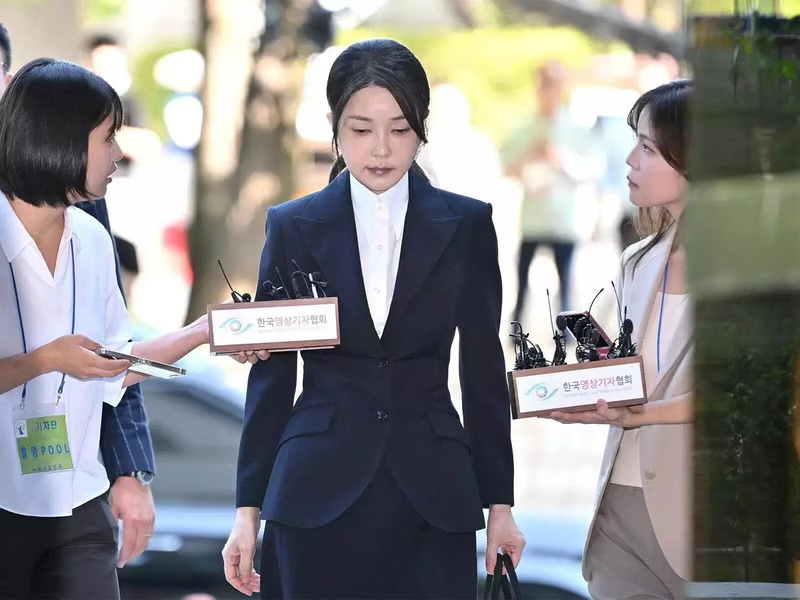
In a scandal that’s rocking South Korea’s political establishment, prosecutors have formally accused former First Lady Kim Keon-hee—wife of President Yoon Suk Yeol—of accepting lavish bribes totaling 377.25 million won (approximately **$263,000**). The alleged gifts, received from business executives and political figures, include high-end jewellery, a designer handbag, fine art, and other luxury items. Even more damning, investigators claim she used her proximity to power to **interfere in state affairs**, blurring the line between ceremonial role and political influence.
This explosive development marks one of the most serious allegations against a South Korean First Lady in decades and threatens to destabilize President Yoon’s administration just as it faces mounting domestic challenges. With public trust in government already fragile, the case raises urgent questions about accountability, transparency, and the unchecked influence of presidential spouses.
Table of Contents
- Who Is South Korea First Lady Kim Keon-hee?
- Details of the Bribery Allegations
- Alleged Meddling in State Affairs
- South Korea’s History of Presidential Scandals
- Legal and Political Fallout for President Yoon
- Public Reaction and Media Frenzy
- What Happens Next in the Investigation?
- Conclusion: A Nation Watching Its First Family
- Sources
Who Is South Korea First Lady Kim Keon-hee?
Kim Keon-hee, a former television journalist, married President Yoon Suk Yeol in 2012. Known for her polished public image and fashion sense, she initially garnered praise for modernizing the traditionally low-profile role of South Korea’s First Lady. However, her past has drawn scrutiny—particularly her reported links to shamanistic rituals and unverified claims about her academic background.
Unlike predecessors who focused on social welfare or cultural diplomacy, Kim has maintained a higher media profile, often accompanying the president on international trips and engaging directly with policy-adjacent topics—a visibility that now appears to have backfired.
Details of the Bribery Allegations
According to South Korean prosecutors, the bribes accepted by the South Korea first lady include:
- A limited-edition **Cartier bracelet** valued at over 50 million won.
- A **Chanel or Hermès handbag** (exact brand redacted in initial filings) worth approximately 15 million won.
- Multiple pieces of **fine art** gifted by corporate donors seeking favorable regulatory treatment.
- Cash equivalents disguised as “consulting fees” or “gift certificates.”
Prosecutors allege these gifts were not mere tokens of goodwill but **quid pro quo** exchanges. At least three mid-sized conglomerates under investigation for tax evasion and labor violations are said to have sent representatives to deliver these items directly to Kim’s private residence.
Alleged Meddling in State Affairs
Beyond accepting gifts, Kim is accused of **exerting undue influence** over government appointments and policy decisions. Investigators cite text messages and witness testimonies suggesting she recommended individuals for key posts in cultural and media institutions—roles typically filled through merit-based civil service processes.
In one instance, a former aide testified that Kim lobbied for a close associate to be appointed as head of a national broadcasting advisory board—a move that allegedly bypassed standard vetting procedures. Such interference, if proven, would violate South Korea’s strict anti-corruption laws, including the **Kim Young-ran Act**, which prohibits public officials and their families from receiving gifts over 1 million won.
South Korea’s History of Presidential Scandals
This is not the first time South Korea’s presidential palace has been engulfed in scandal. The country has a turbulent political legacy:
- Park Geun-hye (2017): Impeached and jailed for corruption involving confidante Choi Soon-sil.
- Lee Myung-bak (2018): Convicted of bribery and embezzlement, sentenced to 17 years.
- Roh Tae-woo (1990s): Jailed for taking $650 million in bribes during his presidency.
Given this context, the public is especially sensitive to any hint of impropriety. As noted by the BBC’s in-depth profile on South Korean political culture, the presidency is both revered and distrusted—a paradox that fuels rapid swings between hope and outrage.
Legal and Political Fallout for President Yoon
While President Yoon has not been directly implicated, the scandal casts a long shadow over his leadership. Opposition parties are already calling for a **parliamentary inquiry** and demanding his public apology. More critically, his approval ratings—already hovering near 40%—are expected to plummet.
Legally, Kim could face charges under South Korea’s Criminal Act and the Improper Solicitation and Graft Act. Penalties include **up to 10 years in prison** and heavy fines. For President Yoon, the bigger risk is political: erosion of his reformist image and weakened mandate ahead of crucial local elections in 2026.
Public Reaction and Media Frenzy
South Korean social media has erupted with hashtags like #ReturnTheBags and #FirstLadyGate. Memes mocking luxury brand logos have gone viral, while editorials in The Hankyoreh and JoongAng Ilbo question whether the presidential office has become “a boutique for power brokers.”
Women’s rights groups have expressed particular disappointment, noting that Kim’s alleged actions undermine efforts to professionalize the First Lady role beyond ceremonial duties.
What Happens Next in the Investigation?
Prosecutors are expected to:
- Seize and authenticate the luxury items as evidence.
- Subpoena corporate executives who allegedly provided the bribes.
- Request access to Kim’s private communications and financial records.
- Determine whether President Yoon had any knowledge of or involvement in the transactions.
A formal indictment could come within weeks. Meanwhile, civil society organizations are pushing for stronger ethics laws governing presidential families—similar to reforms proposed after the Park Geun-hye scandal.
Conclusion: A Nation Watching Its First Family
The allegations against the South Korea first lady are more than a personal scandal—they’re a stress test for the country’s democratic institutions. At a time when trust in elites is waning globally, South Korea’s response will signal whether it can hold even its most powerful figures accountable. For now, all eyes are on Seoul, where luxury gifts may cost far more than their price tags.
Sources
- Times of India: South Korea’s first lady accused of taking bribes over $200,000
- BBC News: Why South Korean presidents so often end up in jail
- Yonhap News Agency: Prosecution Statements on Kim Keon-hee Investigation (December 2025)
- South Korean Ministry of Justice: Kim Young-ran Act Guidelines