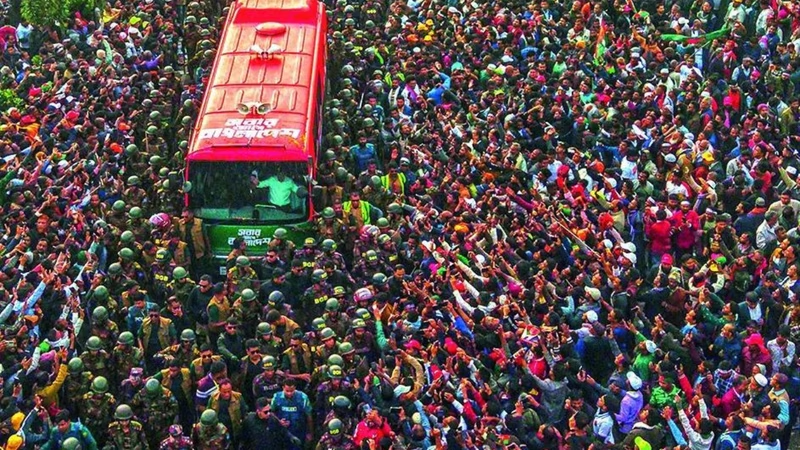
Bangladesh’s political landscape is heating up ahead of its next general election—and the cracks are showing even within its newest opposition force. The National Citizen Party (NCP), a student-led political outfit forged in the fire of the ‘2024 July Uprising’, is now facing a serious internal crisis. The trigger? A proposed electoral alliance with Jamaat-e-Islami (JeI), the Islamist party with a deeply controversial past linked to war crimes during Bangladesh’s 1971 Liberation War.
According to recent reports, **thirty NCP members** have openly opposed the alliance, calling it a betrayal of the party’s secular, reformist ideals. This rift has already led to high-profile resignations—and more defections may be on the horizon as members consider joining rival parties or running as independents. For a nation already grappling with democratic backsliding and polarized politics, this Bangladesh election drama could reshape the opposition’s credibility and unity.
Table of Contents
- Who Is the National Citizen Party (NCP)?
- Why the Jamaat Alliance Is So Controversial
- The Internal Revolt: Resignations and Defections
- What This Means for the Bangladesh Election
- Historical Context: Jamaat and Bangladesh’s Political Memory
- Can the Opposition Unite Without Compromise?
- Conclusion: A Test for Bangladesh’s New Generation of Leaders
- Sources
Who Is the National Citizen Party (NCP)?
The NCP emerged in early 2024 as a direct offshoot of the ‘July Uprising’—a massive youth-led protest movement demanding fair elections, an end to authoritarianism, and institutional reform. Composed largely of university students, academics, and civil society activists, the NCP positioned itself as a third force between Sheikh Hasina’s ruling Awami League and the traditional opposition Bangladesh Nationalist Party (BNP).
From day one, the party championed secularism, transparency, and a break from Bangladesh’s cyclical two-party dominance. Its rise was seen as a hopeful sign of generational change in a political system long criticized for dynastic control and patronage politics.
Why the Jamaat Alliance Is So Controversial
Jamaat-e-Islami, Bangladesh’s largest Islamist party, has never been legally banned—but it remains deeply polarizing. During the 1971 war of independence from Pakistan, Jamaat leaders collaborated with the Pakistani army and were accused of committing atrocities against Bengali nationalists, intellectuals, and minorities.
In the 2010s, a special International Crimes Tribunal convicted several top Jamaat leaders of war crimes, leading to executions and life sentences. Though the party claims it’s reformed, many Bangladeshis—especially secularists, liberals, and youth—view any association with Jamaat as morally and politically unacceptable.
For the NCP, whose identity is rooted in progressive, anti-authoritarian values, aligning with Jamaat isn’t just strategic—it’s ideological heresy. As one resigning member told reporters: “We fought for justice, not for deals with those who opposed our nation’s birth.”
The Internal Revolt: Resignations and Defections
The backlash was swift. Thirty founding members signed a joint statement condemning the proposed alliance. Within days, at least **five senior leaders resigned**, including two regional coordinators and a spokesperson.
Analysts say more exits are imminent. Some members are reportedly in talks with the BNP’s youth wing, while others plan to contest as independent candidates under the banner of “July Uprising Independents.” This fragmentation weakens the NCP’s already limited electoral machinery just months before voting.
The split also raises questions about who truly controls the NCP’s decision-making. Critics allege that a small faction—possibly influenced by veteran politicians with ties to older opposition networks—is pushing the Jamaat deal for short-term electoral gain, ignoring grassroots sentiment.
What This Means for the Bangladesh Election
A fractured NCP plays directly into the hands of the ruling Awami League. A united, credible third front could have pressured both major parties to adopt more inclusive platforms. Now, the opposition appears divided and morally compromised.
Moreover, the Bangladesh election is already under international scrutiny. The U.S. State Department and the European Union have repeatedly called for free, fair, and inclusive polls. An alliance involving Jamaat could trigger sanctions or diplomatic rebukes, further isolating Bangladesh’s political process.
For ordinary voters—especially young Bangladeshis who rallied behind the July Uprising—the NCP’s dilemma is deeply disillusioning. As one Dhaka University student put it: “We didn’t risk our lives to see our leaders make backroom deals with the past.”
Historical Context: Jamaat and Bangladesh’s Political Memory
Understanding this crisis requires grasping Bangladesh’s unresolved historical trauma. The 1971 war isn’t just history—it’s living memory. Every December 16 (Victory Day), the nation commemorates the martyrs, and Jamaat’s role remains a raw nerve.
The Awami League has long used anti-Jamaat rhetoric to consolidate its secular base. In contrast, the BNP has historically partnered with Jamaat for electoral support—a move that cost it significant urban and youth votes in the 2010s.
Now, the NCP risks repeating the BNP’s mistake. For more on Bangladesh’s complex political history, the BBC’s country profile on Bangladesh provides essential background on its parties and conflicts.
Can the Opposition Unite Without Compromise?
This moment poses a critical question: Can Bangladesh’s opposition build a broad coalition without sacrificing core principles?
Possible paths forward include:
- Forming a secular alliance with smaller leftist and liberal parties instead of Jamaat.
- Demanding electoral reforms first—like restoring a neutral caretaker government—before entering any coalition.
- Running independently to preserve moral authority, even if it means limited seats.
Each option carries risk. But as the NCP’s crisis shows, short-term electoral math may not outweigh long-term credibility—especially in a democracy where public trust is already fragile.
Conclusion: A Test for Bangladesh’s New Generation of Leaders
The NCP’s internal revolt over a Jamaat alliance is more than a party dispute—it’s a defining moment for Bangladesh’s political future. As the Bangladesh election approaches, the country’s youth-led movements must decide whether to chase power through compromise or hold firm to the values that ignited their uprising. Their choice will not only shape the ballot but also the soul of a nation still wrestling with its past.
Sources
- Times of India: Bangladesh: Division in student-led NCP over alliance with Jamaat for polls
- BBC News: Bangladesh country profile – Timeline
- International Crimes Tribunal, Bangladesh: Official records and verdict summaries (2010–2016)
- Human Rights Watch: Reports on political violence and electoral integrity in Bangladesh (2023–2025)