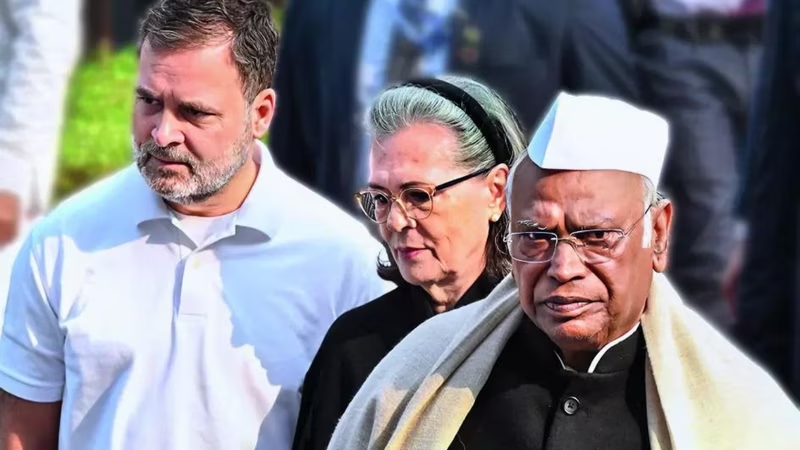
At a time when many have written its political obituary, the Indian National Congress chose its 140th foundation day not for nostalgia—but for declaration. In a coordinated show of unity and conviction, party leaders from Mallikarjun Kharge to Rahul Gandhi delivered a powerful message: the Congress isn’t just a political party. It’s an enduring ideology.
“Congress is an ideology, and ideologies never die,” declared party president Mallikarjun Kharge in a stirring address that echoed across state units and social media feeds . The line—equal parts historical assertion and political defiance—cut through the noise of a fragmented opposition and a dominant BJP narrative.
But this wasn’t just a rhetorical flourish. On the historic occasion marking 140 years since A.O. Hume convened the first session in Bombay in 1885, the Congress rolled out a renewed call to arms: rebuild from the grassroots, defend the Constitution, and fight for the restoration of MGNREGA—a lifeline for India’s rural poor now under threat .
Table of Contents
- A Historic Day with a Modern Mission
- Congress 140th foundation day: Kharge’s Ideological Stand
- Rahul Gandhi and the “Soul of India”
- MGNREGA as a Battle Cry for Grassroots Mobilization
- Can an Old Party Reignite a Mass Movement?
- The Challenges Ahead for Congress in 2025
- Conclusion: Ideology vs. Electoral Reality
- Sources
A Historic Day with a Modern Mission
December 28, 1885—140 years ago—marked the birth of the Indian National Congress in Gokuldas Tejpal Sanskrit College, Bombay. Founded as a platform for dialogue between educated Indians and the British Raj, it evolved into the engine of India’s freedom struggle.
Today, the party faces a different kind of struggle: relevance in a post-2014 political landscape dominated by BJP’s centralized narrative and digital machinery. Yet rather than retreat, Congress leaders used the Congress 140th foundation day to reframe their identity—not as a failing institution, but as the custodian of India’s foundational values: secularism, social justice, and constitutional democracy.
Congress 140th foundation day: Kharge’s Ideological Stand
Mallikarjun Kharge, the party’s first non-Gandhi president in over two decades, chose symbolism over sentiment. Speaking with the gravitas of a veteran parliamentarian, he framed the Congress not as a relic but as a living philosophy.
“Dictatorship, injustice, and falsehood are on the rise,” Kharge warned. “But truth, courage, and the Constitution—these are our weapons. And we will fight.”
His speech was a direct counter to the BJP’s portrayal of Congress as “dynastic” and “out of touch.” By anchoring the party in ideology—not personality—Kharge attempted to recast its image as timeless rather than tired.
Rahul Gandhi and the “Soul of India”
Rahul Gandhi, speaking at a separate event, added a poetic layer to the ideological argument. “The Congress is not just a party—it is the voice of India’s soul,” he said .
For Gandhi, the foundation day was an opportunity to link emotional resonance with political purpose. He urged workers to “go to every village, every home,” and build a movement rooted in empathy and equity. This aligns with his recent “Bharat Jodo Nyay Yatra” strategy, which seeks to stitch together marginalized communities through a narrative of justice.
While critics dismiss such language as vague idealism, supporters see it as a necessary counterbalance to the BJP’s muscular nationalism.
MGNREGA as a Battle Cry for Grassroots Mobilization
Beyond rhetoric, the Congress gave its ideology a concrete policy anchor: the demand for the full restoration of MGNREGA (Mahatma Gandhi National Rural Employment Guarantee Act).
Once a flagship UPA-era program, MGNREGA has seen declining allocations and delayed wage payments under the current regime. For Congress, reviving it is both a moral imperative and a strategic one:
- It appeals directly to rural laborers—over 50 million households depend on it annually .
- It showcases Congress’s legacy in social welfare.
- It offers a tangible contrast to BJP’s urban-centric development model.
Party leaders urged workers to organize rallies and awareness camps around MGNREGA, turning policy into protest—and protest into a mass movement.
Can an Old Party Reignite a Mass Movement?
History shows the Congress has reinvented itself before—post-1969 split, post-Emergency, and post-2004. But 2025 poses unique challenges:
- Fragmented Opposition: Regional allies like TMC, DMK, and AAP have their own ambitions.
- Digital Deficit: BJP’s online dominance dwarfs Congress’s digital outreach.
- Leadership Perception: Despite Kharge’s credibility, the party remains associated with the Gandhi family in public imagination.
Still, experts note that ideological clarity can be a powerful unifier. “When a party stops chasing trends and starts defending values, it regains authenticity,” says political analyst Dr. Ayesha Khan .
For deeper insights into India’s opposition dynamics, see our analysis on [INTERNAL_LINK:indian-national-congress-future-strategy].
The Challenges Ahead for Congress in 2025
2025 is a critical year—with assembly elections in key states like Haryana and Maharashtra, and national momentum building toward 2029. The Congress 140th foundation day message must now translate into action:
- Recruiting youth leaders beyond dynastic circles
- Building a data-driven communication strategy
- Delivering consistent messaging across states
Without organizational follow-through, even the most resonant ideology risks becoming a museum piece.
Conclusion: Ideology vs. Electoral Reality
“Ideologies never die”—but parties can. On its Congress 140th foundation day, the party staked its future on a bold bet: that in an age of polarization, India still craves the values of pluralism, equity, and constitutional fidelity.
Whether this ideological reawakening can translate into electoral revival remains to be seen. But one thing is clear: the Congress isn’t fading quietly. It’s choosing to fight—not just for power, but for the soul of Indian democracy.
Sources
- Times of India: Mallikarjun Kharge: Congress an ideology and ideologies never die
- Ministry of Rural Development, Government of India: MGNREGA Official Portal
- PRS Legislative Research: Analysis of Social Welfare Schemes in India