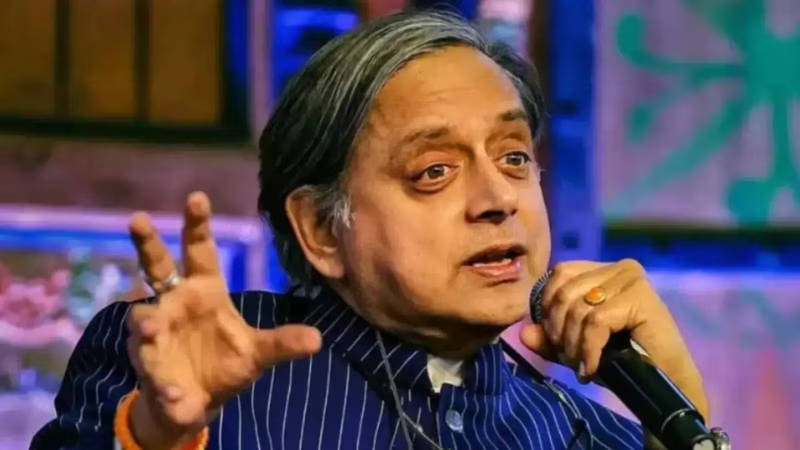
The Indian National Congress is facing one of its most critical junctures—and the debate on how to revive it is now spilling into public view. Fresh off controversial remarks by veteran leader Digvijaya Singh praising the BJP-RSS’s organizational discipline, Congress heavyweight Shashi Tharoor has stepped in with a clear message: the party urgently needs internal renewal.
This rare convergence between two ideologically distinct leaders—Tharoor the modernizer and Singh the old guard—has reignited a long-standing but often suppressed conversation within the party: Can Congress rebuild itself without compromising its secular DNA? And more provocatively, should it take organizational cues from its fiercest rivals?
Table of Contents
- Digvijaya Singh’s Controversial Praise for BJP-RSS Structure
- Congress party strengthening: Tharoor’s Strategic Endorsement
- Salman Khurshid Pushes Back: ‘We Don’t Need RSS Lessons’
- The Deeper Ideological Divide Within Congress
- What Does Effective Party Reform Actually Look Like?
- Conclusion: The Path Forward for Congress
- Sources
Digvijaya Singh’s Controversial Praise for BJP-RSS Structure
It all began with a candid interview. Digvijaya Singh, a former Madhya Pradesh Chief Minister and Congress General Secretary, recently lauded the RSS-BJP’s “discipline and organizational strength”—a comment that sent shockwaves through the party’s ranks .
While Singh was quick to clarify that he remains “firmly opposed to the ideology of the BJP and RSS,” his acknowledgment of their operational efficiency struck a nerve. In a political landscape where the BJP dominates both national narrative and grassroots machinery, Singh’s remarks were less about admiration and more about a stark reality check.
“We must strengthen our own organization,” he insisted, urging Congress to rebuild from the booth level upward—a direct jab at the party’s current top-heavy and often disconnected leadership structure.
Congress party strengthening: Tharoor’s Strategic Endorsement
Enter Shashi Tharoor. Known for his eloquent advocacy of institutional reform and democratic values, Tharoor has now publicly backed Singh’s call. “A strong, vibrant, and disciplined Congress is absolutely essential for a healthy democracy,” Tharoor stated, emphasizing that a weak opposition only emboldens authoritarian tendencies .
Tharoor stopped short of endorsing any RSS-style methods, but his alignment with Singh on the need for structural overhaul is significant. It signals a growing consensus among Congress leaders—across generations—that the party’s electoral decline isn’t just about leadership or messaging, but about a crumbling organizational foundation.
His stance resonates with younger party workers who feel sidelined by dynastic politics and bureaucratic inertia. For them, Congress party strengthening isn’t just a slogan—it’s a survival imperative.
Salman Khurshid Pushes Back: ‘We Don’t Need RSS Lessons’
Not everyone is on board. Veteran Congress leader and former Law Minister Salman Khurshid swiftly countered the narrative, declaring: “The Congress doesn’t need to learn from the RSS. Our values are fundamentally different.”
Khurshid’s pushback underscores a deep ideological fault line. While Singh and Tharoor focus on operational effectiveness, Khurshid warns against blurring the lines between organizational discipline and ideological compromise. “We can be organized without being regimented,” he argued, stressing that Congress’s strength lies in its pluralism, not in mimicry .
The Deeper Ideological Divide Within Congress
This debate isn’t new—but it’s becoming unavoidable. The Congress party has long struggled to balance its legacy as India’s freedom-fighting, secular institution with the harsh realities of 21st-century electoral politics.
Two competing visions are emerging:
- The Pragmatist Camp (led by figures like Singh and Tharoor): Believes that without a robust, tech-savvy, and disciplined organizational structure—similar in efficiency (not ideology) to the BJP—the party will remain electorally irrelevant.
- The Ideological Purist Camp (represented by Khurshid and others): Fears that any structural borrowing from the RSS ecosystem risks normalizing its methods and diluting Congress’s core identity.
This tension reflects a broader crisis of identity in India’s oldest political party—one that must evolve without erasing its soul.
What Does Effective Party Reform Actually Look Like?
So, what would genuine Congress party strengthening entail—without crossing ideological red lines?
Experts and insiders suggest a multi-pronged approach:
- Grassroots Democratization: Revive internal elections for district and state units to empower local leaders.
- Digital Infrastructure: Build a centralized data and communication platform to rival the BJP’s IT cell.
- Youth Integration: Create fast-track pathways for young professionals and activists to take on real responsibility.
- Ideological Clarity Campaigns: Launch public education initiatives that reaffirm Congress’s secular, inclusive values—not just as slogans, but as policy frameworks.
As political scientist Dr. Sandeep Shastri notes, “Organizational strength and ideological integrity are not mutually exclusive. The challenge is to marry them effectively” .
For more on India’s political realignment, see our analysis on [INTERNAL_LINK:indian-opposition-alliance-strategy].
Conclusion: The Path Forward for Congress
The debate sparked by Digvijaya Singh and amplified by Shashi Tharoor isn’t just about structure—it’s about survival. The call for Congress party strengthening is a wake-up call that can no longer be ignored.
While Salman Khurshid’s caution against ideological mimicry is valid, the party must also accept that values alone don’t win elections. A disciplined, responsive, and modern organization is non-negotiable in today’s political arena.
Ultimately, Congress’s revival won’t come from copying its rivals—but from rediscovering its own voice with a new, resilient structure to back it up. The time for introspection is over. The time for action is now.
Sources
- Times of India: After Digvijaya Singh, Shashi Tharoor too says party needs to be strengthened
- Indian Express: Can Congress reinvent itself? The internal reform dilemma
- PRS Legislative Research: Understanding India’s Political Party Structures