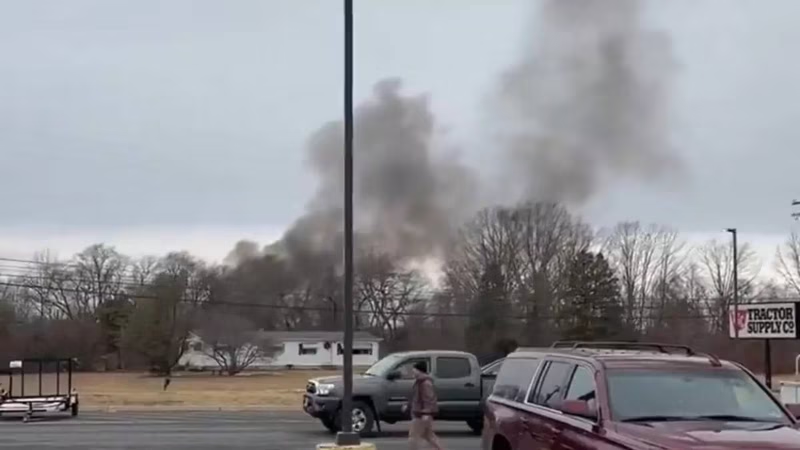
A quiet afternoon in Hammonton, New Jersey, turned into a scene of chaos and tragedy when two helicopters collided mid-air and plunged to the ground in a fiery crash. The incident, captured on video by stunned bystanders, shows thick black smoke rising from a wooded area near the town—an image that has since gone viral and sparked national concern.
Emergency services rushed to the scene, working tirelessly to extricate survivors from the mangled wreckage. While one fatality has been confirmed, the full extent of injuries and the identities of those on board remain unclear as of Monday, December 29, 2025. With the Federal Aviation Administration (FAA) launching an immediate investigation, this helicopter collision has raised urgent questions about air traffic coordination, pilot visibility, and safety protocols in increasingly crowded low-altitude airspace.
Table of Contents
- Helicopter Collision: Incident Summary
- What Happened in Hammonton, New Jersey?
- Emergency Response and Casualties
- Video Evidence and Public Reaction
- FAA and NTSB Launch Joint Investigation
- Possible Causes of the Helicopter Collision
- History of Helicopter Crashes in the U.S.
- What This Means for U.S. Airspace Safety
- Conclusion: A Tragic Reminder of Aviation Risks
- Sources
Helicopter Collision: Incident Summary
On the afternoon of December 29, 2025, two helicopters—believed to be civilian models—collided in mid-air over Hammonton, a town in Atlantic County, New Jersey. One aircraft reportedly burst into flames on impact, while the other crashed nearby. The FAA confirmed the incident involved two helicopters operating under Visual Flight Rules (VFR), which do not require air traffic control clearance in certain airspace classes .
What Happened in Hammonton, New Jersey?
According to local authorities, the crash occurred near the intersection of Route 30 and Vine Street, an area surrounded by dense woods and residential zones. Multiple 911 calls flooded emergency lines within seconds of the impact, describing a loud explosion and a fireball in the sky.
“It sounded like thunder, but then we saw black smoke—massive plumes,” said a local resident who captured the aftermath on their smartphone . The footage, now circulating widely online, shows emergency vehicles converging on the site while a thick column of smoke looms over the treeline.
Emergency Response and Casualties
Atlantic County emergency crews, including fire, EMS, and police, responded within minutes. A triage area was set up on-site, and at least one survivor was extricated from the wreckage and transported to a nearby trauma center in critical condition.
As of the latest update:
- 1 fatality confirmed by local law enforcement
- At least 1 patient in critical condition
- Number of occupants per helicopter still under verification
Authorities have cordoned off a wide perimeter and urged the public to avoid the area to allow investigators and rescue teams to work safely.
Video Evidence and Public Reaction
The user-generated video, posted to social media within minutes, has drawn millions of views. Aviation safety experts warn against speculation based on visuals alone, but the footage does confirm the severity of the impact and the intensity of the post-crash fire—suggesting limited survivability.
Public reaction has been one of shock and sorrow, with many calling for a transparent and thorough investigation. The hashtag #HammontonCrash began trending on X (formerly Twitter), as concerned citizens and aviation enthusiasts shared information and condolences.
FAA and NTSB Launch Joint Investigation
The Federal Aviation Administration (FAA) and the National Transportation Safety Board (NTSB) have both confirmed they are investigating the cause of the helicopter collision. The NTSB, which leads major transportation accident probes in the U.S., has dispatched a “Go Team” to the site.
Investigators will examine:
- Flight paths and altitudes of both helicopters
- Pilot certifications and flight logs
- Weather and visibility conditions at the time
- Possible mechanical failure or communication errors
- Recordings from onboard systems (if any)
For real-time updates on U.S. aviation incidents, the [EXTERNAL_LINK:https://www.ntsb.gov] provides official reports and safety alerts.
Possible Causes of the Helicopter Collision
While it’s far too early to assign blame, aviation analysts point to several common factors in mid-air collisions:
- “See-and-Avoid” Failure: Under VFR, pilots are responsible for spotting other aircraft. Dense foliage, glare, or cockpit workload can impair visibility.
- Airspace Congestion: Southern New Jersey sees frequent helicopter traffic for medical, law enforcement, and private use.
- Lack of ADS-B Mandate: While many helicopters now carry Automatic Dependent Surveillance–Broadcast (ADS-B) transponders, it’s not universally required for all VFR flights below 10,000 feet.
History of Helicopter Crashes in the U.S.
This incident adds to a troubling, though statistically rare, pattern. In 2020, a mid-air collision between a helicopter and a small plane over Arizona killed all on board. In 2023, a medical helicopter crash in Tennessee claimed three lives due to poor weather .
According to NTSB data, mid-air collisions account for less than 1% of all general aviation accidents but are often catastrophic due to high closure speeds and limited ejection options .
What This Means for U.S. Airspace Safety
This crash may reignite debates about modernizing low-altitude airspace, especially with the rise of drone deliveries and air taxi prototypes. Could mandatory ADS-B for all helicopters prevent future tragedies? Should certain corridors require controlled flight rules?
For now, the focus remains on rescue and investigation—but the policy implications could be far-reaching. Learn more about U.S. aviation safety in our feature on [INTERNAL_LINK:future-of-urban-air-mobility].
Conclusion: A Tragic Reminder of Aviation Risks
The helicopter collision in Hammonton is a stark and heartbreaking reminder that even in an age of advanced technology, human and systemic factors can lead to devastating outcomes. As families grieve and investigators piece together the final moments of flight, the nation watches—and waits—for answers that could prevent the next tragedy.
One thing is certain: in the skies over America, safety must always come before convenience.
Sources
- The Times of India: “US: 1 dead as two helicopters collide mid-air; video shows thick smoke”
- Federal Aviation Administration (FAA): Preliminary Statement on Hammonton Incident (Dec 29, 2025)
- National Transportation Safety Board (NTSB): U.S. Aviation Accident Database
- NTSB Safety Recommendations on General Aviation Mid-Air Collisions (2022)
- Atlantic County Office of Emergency Services: Press Briefing Transcript