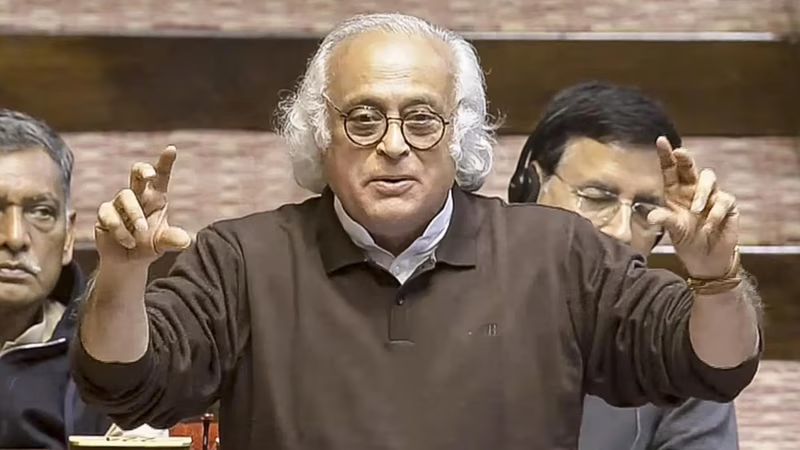
Just hours before the Supreme Court was set to hear a landmark case on the future of India’s oldest mountain range, veteran environmentalist and Congress leader Jairam Ramesh fired a legal and ecological salvo at the Union Environment Ministry. In a sharply worded public statement, Ramesh posed four pointed questions challenging the government’s newly proposed Aravalli definition—a move many fear could open the floodgates to mining and real estate development in ecologically fragile zones .
This isn’t just bureaucratic disagreement. It’s a high-stakes confrontation over the very identity of the Aravalis—and whether centuries-old hills will be reduced to real estate parcels. With the Supreme Court as the ultimate arbiter, the nation’s environmental future may hinge on how this definition is interpreted.
Table of Contents
- What Is the Controversial Aravalli Definition?
- Jairam Ramesh’s Four-Point Charge Against the Ministry
- The Ecological Stakes: Why Every Hill Matters
- Mining Leases and the CEC Report: A Troubling Legacy
- Supreme Court Hearing: What to Expect
- Political and Environmental Fallout
- Conclusion: Will the Aravalis Be Redefined or Protected?
- Sources
What Is the Controversial Aravalli Definition?
For decades, the Aravalli range—stretching across Rajasthan, Haryana, Delhi, and Gujarat—has been protected under various notifications, particularly the 1992 Aravali Notification that banned mining in designated areas. But ambiguity over what constitutes the “Aravalli” has long plagued enforcement.
The current controversy stems from a new, allegedly narrower interpretation being pushed by certain state and central agencies. Critics like Ramesh argue this definition excludes smaller but ecologically critical hill formations, effectively declassifying them from protection. If accepted, it could redraw the conservation map—and erase legal safeguards overnight .
Jairam Ramesh’s Four-Point Charge Against the Ministry
In a detailed public note addressed to Environment Minister Bhupender Yadav, Ramesh raised four pivotal concerns that cut to the heart of the issue:
- Contradiction with FSI Data: He cited the Forest Survey of India’s (FSI) own reports, which confirm that even low-elevation Aravalli hillocks play a crucial role in checking desertification and groundwater recharge .
- Rejection of Historical Definitions: Ramesh pointed out that past government documents, including those from the Ministry itself, used a broader, more inclusive definition of the range.
- Ignored CEC Recommendations: He highlighted a 2019 Central Empowered Committee (CEC) report that identified numerous illegal mining leases within the Aravalis—leases that could be legitimized under the new definition.
- Lack of Scientific Basis: Ramesh demanded the scientific rationale behind the new definition, noting its apparent alignment with real estate and mining interests rather than ecological science.
The Ecological Stakes: Why Every Hill Matters
The Aravalis aren’t just scenic backdrops—they are India’s ecological shield. According to the FSI, the range acts as a natural barrier against the eastward creep of the Thar Desert. Even modest hillocks, often dismissed as “non-forested” or “degraded,” serve as critical catchment areas for rainwater, feeding aquifers that supply water to cities like Gurgaon, Faridabad, and Jaipur .
Removing protections based on height or tree cover, experts warn, is a catastrophic mistake. “Ecological function isn’t determined by aesthetics,” says Dr. Mahesh Patil, a geoscientist specializing in arid zones. “A 30-meter hill can be more hydrologically vital than a 300-meter barren peak.”
Mining Leases and the CEC Report: A Troubling Legacy
Perhaps the most damning evidence Ramesh cited is the 2019 CEC report submitted to the Supreme Court. That report documented over 600 mining leases in Haryana’s Aravalli zones—many granted without proper environmental clearances or in direct violation of the 1992 notification .
By adopting a restrictive Aravalli definition, critics argue, the government could retroactively validate these illegal operations. This would not only undermine the rule of law but also set a dangerous precedent for environmental governance across India.
Supreme Court Hearing: What to Expect
The Supreme Court, which has been the primary guardian of the Aravalis since the 1990s, is now poised to settle this definitional dispute once and for all. The Court has previously held that the Aravalli range must be interpreted in its “natural and geographical entirety”—not through a lens of administrative convenience .
Legal experts anticipate the bench will demand the government produce the scientific and legal basis for its new definition. If it fails to do so, the Court may reaffirm its earlier, more expansive interpretation—restoring full protection to the entire range.
Political and Environmental Fallout
This clash isn’t just about hills and trees; it’s a proxy battle over India’s development model. On one side are voices advocating for ecological prudence and long-term sustainability. On the other are powerful interests pushing for land conversion in one of the most urbanized corridors of North India.
For more on the legal history of environmental protection in India, see our explainer on [INTERNAL_LINK:supreme-court-environmental-judgments].
Conclusion: Will the Aravalis Be Redefined or Protected?
The controversy over the Aravalli definition is more than a semantic debate—it’s a test of India’s commitment to its ecological heritage. Jairam Ramesh’s intervention has forced the issue into the national spotlight just as the Supreme Court prepares to rule.
Will the Aravalis be defined by their ecological function—or by the profit margins of developers? The answer, expected soon from the highest court in the land, will shape the environmental future of Northern India for generations to come.
Sources
- The Times of India: “Aravalli row: Jairam Ramesh questions ministry’s stance; SC to hear case today”
- Forest Survey of India (FSI): “Ecological Significance of Aravalli Range” (2023 Report)
- Supreme Court of India: Central Empowered Committee (CEC) Report on Aravalli Mining, 2019
- Supreme Court Judgments: M.C. Mehta vs. Union of India (Aravalli Series, Writ Petition (Civil) No. 89 of 1994)
- Ministry of Environment, Forest and Climate Change: Aravalli Notification, 1992