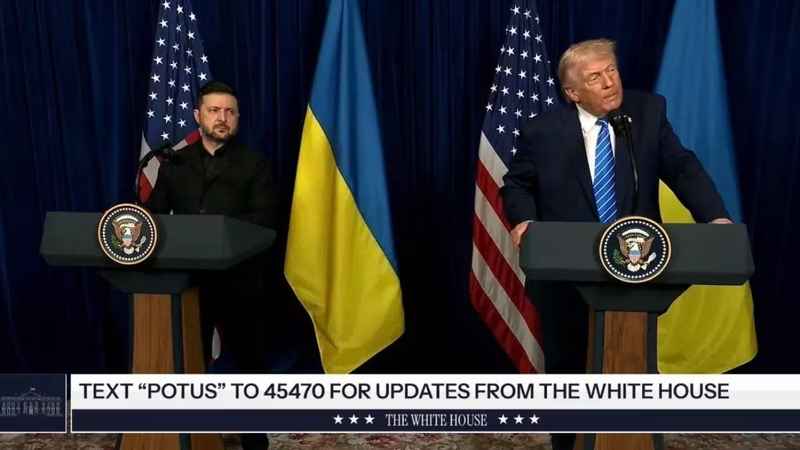
It was a moment that seemed ripped from political satire—except it was all too real. During a high-profile meeting at his Mar-a-Lago estate, former U.S. President Donald Trump told Ukrainian President Volodymyr Zelenskyy: “Russia wanted Ukraine to succeed.”
The room fell silent. Zelenskyy, a leader who has spent the last three years defending his nation from a full-scale Russian invasion that has killed tens of thousands and displaced millions, could barely suppress a look of disbelief. A faint, almost incredulous smile crossed his face—captured in footage that has since gone viral .
This single Trump Russia Ukraine comment has sparked international outrage, geopolitical confusion, and deep concern among U.S. allies. How could a former—and potential future—commander-in-chief make such a claim in the presence of a leader whose country is being systematically bombed by the very nation he describes as benevolent?
Table of Contents
- The Mar-a-Lago Meeting: Setting the Stage
- Breaking Down Trump’s Controversial Statement
- Decoding Zelenskyy’s Silent Reaction
- What Is Trump’s “Peace Plan” for Ukraine?
- Trump’s Shifting Stance on Russia and Ukraine
- How Allies and Adversaries Are Reacting
- Implications for the 2025 U.S. Election and Ukraine Aid
- Final Thoughts: Diplomacy or Delusion?
- Sources
The Mar-a-Lago Meeting: Setting the Stage
The meeting between Trump and Zelenskyy on December 27, 2025, was framed as a diplomatic outreach ahead of the U.S. presidential race. With Congress debating another $60 billion aid package for Ukraine, Zelenskyy sought bipartisan support—but what he got was a rhetorical bombshell .
Trump, who has long positioned himself as a dealmaker who can “end the war in 24 hours,” used the meeting to promote his vision of swift peace talks. But his assertion that Russia “offered Ukraine low-cost energy and wanted them to succeed” flew in the face of well-documented history.
Breaking Down Trump’s Controversial Statement
Let’s be clear: Russia’s actions since 2014 tell a radically different story.
- In 2014, Russia annexed Crimea and backed separatists in Donbas.
- In 2022, it launched a full-scale invasion, targeting civilian infrastructure, including power grids.
- Putin has repeatedly denied Ukraine’s right to exist as a sovereign nation.
Given this context, Trump’s claim isn’t just inaccurate—it’s dangerously revisionist. Experts warn that such rhetoric echoes Kremlin propaganda, which often frames the invasion as a “special operation” to “liberate” Ukraine from supposed Western control .
Decoding Zelenskyy’s Silent Reaction
Zelenskyy didn’t confront Trump publicly. Instead, his subtle smirk and raised eyebrows spoke volumes. As a former comedian turned wartime leader, he’s mastered the art of diplomatic restraint—but his body language conveyed skepticism, even amusement.
Later, Ukrainian officials downplayed the moment, calling it a “frank exchange.” But behind closed doors, sources suggest Kyiv is deeply concerned about a potential second Trump term, fearing a halt to military aid and forced concessions to Moscow .
What Is Trump’s “Peace Plan” for Ukraine?
Trump has repeatedly claimed he could end the war “in 24 hours,” though he’s never detailed how. Analysts speculate his approach would involve:
- Pressuring Ukraine to cede occupied territories.
- Offering Putin sanctions relief in exchange for a ceasefire.
- Reducing or cutting off U.S. military aid to force negotiations.
Critics argue this isn’t peace—it’s appeasement that rewards aggression. As NATO Secretary-General Jens Stoltenberg has warned, “Peace cannot mean surrender” .
Trump’s Shifting Stance on Russia and Ukraine
This isn’t the first time Trump has made pro-Russia remarks:
- In 2018, he sided with Putin over U.S. intelligence on election interference.
- In 2019, he withheld military aid to pressure Zelenskyy into investigating the Bidens—leading to his first impeachment.
- In 2023, he called Putin a “genius” for invading Ukraine.
His latest comment fits a pattern of undermining Ukraine’s sovereignty while elevating Putin’s image—a stance that alarms both Democrats and traditional Republicans.
How Allies and Adversaries Are Reacting
European leaders are watching closely. German Chancellor Olaf Scholz warned that “any U.S. withdrawal from Ukraine would be catastrophic for European security” . Meanwhile, Russian state media celebrated Trump’s remarks as “proof of Western hypocrisy.”
For more on transatlantic relations, see our coverage at [INTERNAL_LINK:us-europe-ukraine-policy].
Implications for the 2025 U.S. Election and Ukraine Aid
With Trump leading in polls, Ukraine’s future may hinge on November’s outcome. A second Trump term could mean:
- Immediate freeze on new military aid.
- Pressure on NATO allies to reduce support.
- Direct talks with Putin—without Ukrainian representation.
For Zelenskyy, the stakes couldn’t be higher. His nation’s survival may depend not just on the battlefield, but on American ballots.
Final Thoughts: Diplomacy or Delusion?
Trump’s claim that “Russia wanted Ukraine to succeed” isn’t just factually wrong—it’s a dangerous distortion that could reshape global security. While his desire for peace is understandable, peace built on false premises and historical denial risks legitimizing invasion and emboldening autocrats worldwide.
As Zelenskyy’s quiet reaction reminded us: some truths don’t need words. They’re written in rubble, graves, and the eyes of a leader who knows exactly what Russia’s “success” would mean for his people.