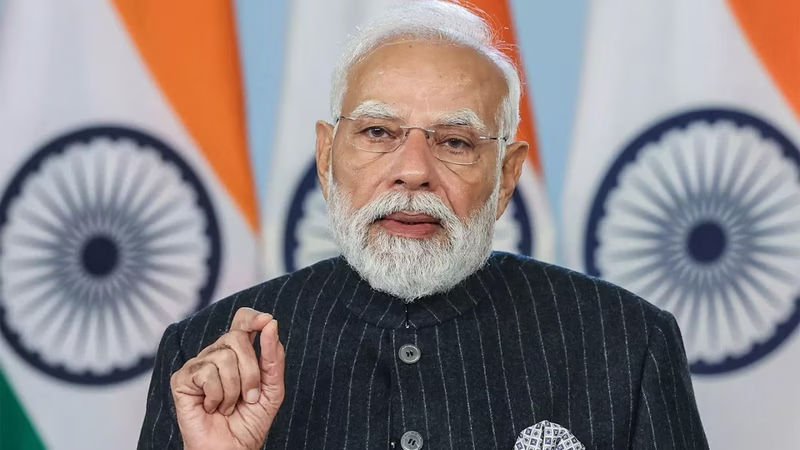
At a pivotal moment for India’s internal security, Prime Minister Narendra Modi has sounded a clear and urgent alarm. Speaking to the country’s Chief Secretaries at their Fifth National Conference in New Delhi, the PM delivered a powerful message: the battle against Maoism is far from over, and the threat of a Maoism relapse in recently liberated areas is a critical concern that demands immediate, coordinated action .
Table of Contents
- The PM’s Stark Warning on Maoism Relapse
- Development as the Ultimate Weapon Against Insurgency
- The Critical Role of Rehabilitation for Surrendered Cadres
- What Are ‘Deregulation Cells’ and Why Do They Matter?
- The Current State of the Maoist Insurgency in 2025
- The Way Forward: A Blueprint for Lasting Peace
- Sources
The PM’s Stark Warning on Maoism Relapse
Prime Minister Modi’s directive was unambiguous. He urged the Chief Secretaries of all states to ensure that the hard-won gains against the Maoist insurgency are not lost . Having pushed the rebels out of their strongholds, the government now faces the delicate task of ensuring these areas do not become fertile ground for their return. The PM’s warning acknowledges a common historical pattern: when the security forces withdraw, a governance vacuum can quickly be filled by old ideologies if not proactively addressed.
Development as the Ultimate Weapon Against Insurgency
The Prime Minister’s strategy is clear: security operations alone are not enough. The long-term solution lies in holistic development. He emphasized the need to accelerate infrastructure projects—roads, schools, hospitals—and welfare schemes in these vulnerable districts . This approach aims to address the root causes of the insurgency, which have often been linked to poverty, social exclusion, and a lack of basic services. By bringing the state’s presence into every remote hamlet through tangible development, the government seeks to build trust and offer a better, more hopeful future to the local population.
The Critical Role of Rehabilitation for Surrendered Cadres
A key pillar of this strategy is the rehabilitation of former Maoist cadres who have surrendered. The PM stressed the importance of ensuring these individuals are successfully reintegrated into the mainstream of society . This involves more than just a one-time surrender package; it requires sustained support for their education, vocational training, and employment. The goal is to prevent them from being lured back into the fold by their former comrades, which has been a recurring challenge in past counter-insurgency efforts.
What Are ‘Deregulation Cells’ and Why Do They Matter?
In the same meeting, the Prime Minister introduced another critical initiative: the creation of “deregulation cells” in state administrations . These specialized units are designed to identify and eliminate archaic, redundant, or obstructive laws and regulations that hinder both public service delivery and private enterprise .
The logic is simple yet powerful. Excessive red tape and a complex web of outdated rules create frustration, stifle economic growth, and can inadvertently push citizens towards unofficial or even illegal channels. By streamlining regulations and improving the ‘ease of living’ and ‘ease of doing business,’ these cells aim to make governance more efficient and citizen-friendly. This initiative is already being piloted in states like Uttar Pradesh and the Union Territory of Ladakh, where dedicated teams are working to clear regulatory bottlenecks [[17], [16]].
The Current State of the Maoist Insurgency in 2025
The context for the PM’s warning is a significant, though not total, victory. The Maoist ‘red corridor’ has dramatically shrunk from its peak of nearly 180 districts to just a handful of active areas, with government data showing a sharp decline in violent incidents [[24], [23]]. In 2025 alone, over 580 cadres have surrendered in Odisha, and security forces have dealt major blows to the rebel leadership [[21], [19]].
However, the threat has not vanished. Recent intelligence reports and incidents, such as the CRPF foiling a Maoist plot in Chhattisgarh just days before the PM’s address, are stark reminders that the enemy is still capable of striking . The fear of a Maoism relapse is not paranoia; it’s a pragmatic assessment of a resilient, albeit weakened, adversary.
The Way Forward: A Blueprint for Lasting Peace
Prime Minister Modi’s two-pronged approach—combining compassionate, accelerated development in vulnerable areas with a systemic overhaul of bureaucratic red tape—represents a sophisticated and forward-looking strategy. It moves beyond a purely militaristic solution to tackle the deeper socio-economic and governance issues that have historically fueled the insurgency.
The success of this plan now rests on the shoulders of the Chief Secretaries and their administrations. They are the linchpins in translating the Prime Minister’s vision from policy on paper to reality on the ground. The challenge is immense, but the stakes are nothing less than the long-term peace and prosperity of India’s most marginalized regions. For more on national security strategies, see our in-depth analysis at [INTERNAL_LINK:national-security].