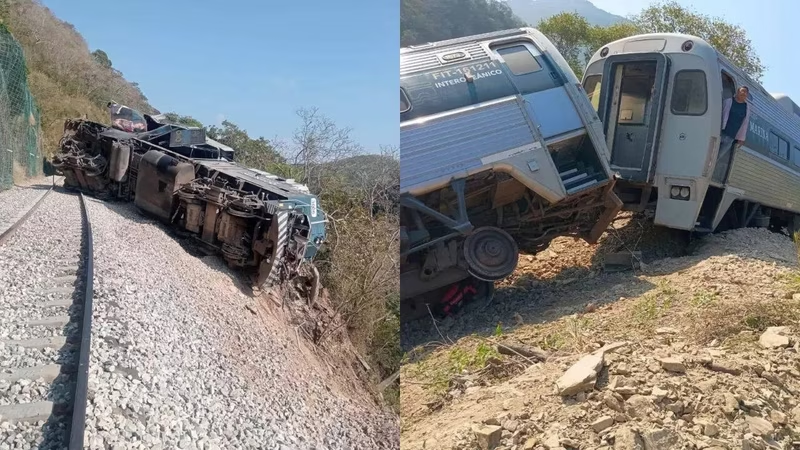
In a heartbreaking turn of events, Mexico’s much-touted Interoceanic Train—a flagship infrastructure project meant to reshape regional trade—met with catastrophe this week. A derailment near the town of Nizanda in Oaxaca state has claimed at least 13 lives and left 98 others injured, casting a dark shadow over the government’s grand vision for the Isthmus of Tehuantepec .
Passengers captured harrowing scenes on their phones as carriages crumpled and overturned, sending plumes of dust into the air and triggering a frantic local rescue effort. The Mexico train derailment has now become the deadliest incident involving the Interoceanic Train since it began limited passenger operations just months ago—and it’s raising urgent questions about oversight, safety protocols, and the breakneck pace of national infrastructure expansion.
Table of Contents
- What Happened: The Nizanda Derailment in Detail
- Mexico Train Derailment: Victims and Emergency Response
- The Interoceanic Train: A Symbol of National Ambition
- Safety Concerns and Past Incident Reports
- Economic and Geopolitical Stakes of the Isthmus Project
- What Next for Mexico’s Rail Future?
- Conclusion: Balancing Progress and Public Safety
- Sources
What Happened: The Nizanda Derailment in Detail
The accident occurred on the afternoon of December 27, 2025, on a remote stretch of track near Nizanda, a small community in southern Mexico’s Oaxaca state. The Interoceanic Train, traveling between the Pacific port of Salina Cruz and the Gulf port of Coatzacoalcos, suddenly derailed, causing multiple passenger cars to overturn .
Witnesses described scenes of utter chaos. One passenger told local media, “The train started shaking violently, then there was a loud crash. Everything went dark.” Videos posted on social media show twisted metal, dust clouds, and locals rushing to pull survivors from the wreckage before emergency crews arrived .
Preliminary reports suggest the train was carrying over 300 passengers at the time—many of them local residents using the newly inaugurated passenger service for affordable intercity travel.
Mexico Train Derailment: Victims and Emergency Response
As of December 29, 2025, authorities have confirmed 13 fatalities and 98 injured, with several in critical condition. The injured were transported to hospitals in Oaxaca City and nearby Ixtepec, with the Mexican military deploying medical teams and helicopters to assist in the evacuation.
The federal government declared three days of national mourning. President Andrés Manuel López Obrador expressed his condolences and ordered a full investigation, though he stopped short of assigning blame. “Our hearts are with the families,” he said in a morning press conference. “Every effort is being made to support the victims.”
Local NGOs and community groups have also stepped in, providing food, blankets, and temporary shelter to stranded passengers—a stark reminder of how rural communities often bear the brunt of infrastructure failures.
The Interoceanic Train: A Symbol of National Ambition
Launched in December 2024 with great fanfare, the Interoceanic Train is the centerpiece of Mexico’s “Isthmus of Tehuantepec Development Project”—a $7.5 billion initiative aimed at creating an alternative trade route to the Panama Canal by connecting the Pacific and Gulf coasts across the narrowest stretch of southern Mexico .
The project includes not just the railway, but industrial parks, ports, and energy infrastructure, all designed to attract foreign investment and boost regional employment. Officials hailed it as a “national renaissance” and a path to lift historically marginalized Indigenous and Afro-Mexican communities out of poverty .
However, critics have long warned that the project’s aggressive timeline—rushed to meet political deadlines—could compromise safety standards, especially on aging tracks repurposed with minimal upgrades.
Safety Concerns and Past Incident Reports
This is not the first time the Interoceanic corridor has raised red flags. In mid-2025, a freight train on the same line derailed while carrying construction materials, though no injuries were reported. At the time, union representatives cited “inadequate track maintenance and outdated signaling systems” as key risks .
Rail safety experts point to deeper systemic issues:
- Use of legacy rail segments originally built in the 1940s, with limited modernization.
- Insufficient staff training for high-speed passenger operations.
- Lack of independent regulatory oversight—operations are managed directly by a state-owned entity under the Ministry of the Navy.
According to a 2024 report by the International Transport Forum (ITF), a body under the OECD, Mexico ranks among the lowest in Latin America for rail infrastructure investment per kilometer, despite its growing ambitions .
Economic and Geopolitical Stakes of the Isthmus Project
Beyond domestic impact, the Isthmus corridor is seen as a geopolitical counterweight to China’s influence in Latin America and an alternative to U.S.-dominated shipping lanes. The U.S. government has quietly supported the initiative under its “nearshoring” strategy, aiming to shorten supply chains for North American manufacturers .
But the Mexico train derailment could dent investor confidence. Already, logistics firms are reportedly reviewing their participation in associated industrial parks, citing “operational risk.” For a project banking on speed and reliability, such setbacks could prove costly.
What Next for Mexico’s Rail Future?
In the wake of the disaster, calls are growing for an independent safety audit of the entire Interoceanic network. Opposition lawmakers are demanding transparency about maintenance logs and speed limits on the Nizanda segment.
For now, passenger services remain suspended indefinitely, though freight operations may resume selectively after inspections. The government has promised “corrective actions,” but many wonder if this tragedy will finally force a shift from political symbolism to technical rigor in Mexico’s rail renaissance.
Conclusion: Balancing Progress and Public Safety
The Mexico train derailment near Nizanda is more than a transportation accident—it’s a wake-up call. While national development projects like the Interoceanic Train hold immense promise, they must never come at the cost of human lives. As recovery efforts continue, Mexico faces a critical choice: double down on accountability, or risk repeating history. For now, the families of the 13 lost souls deserve answers—and a commitment that such a tragedy will never happen again. Learn more about global rail safety standards at [INTERNAL_LINK:rail_safety_global_standards].
Sources
- Times of India: At least 13 killed as Interoceanic Train derails in southern Mexico
- El Universal: Detallan rescate tras descarrilamiento en Nizanda
- International Transport Forum (OECD): Rail Infrastructure Investment in Latin America, 2024 Report
- Government of Mexico: Isthmus of Tehuantepec Development Project Overview