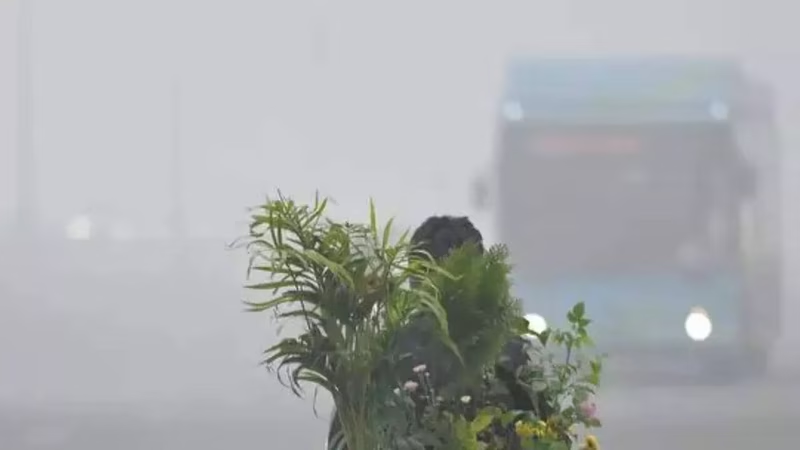
Delhi Air Pollution Severe: A City Choking in Real Time
Delhi isn’t just smoggy—it’s in crisis. As of December 28, 2025, the national capital’s Air Quality Index (AQI) has skyrocketed to **403**, officially entering the “severe” category. The sky is a hazy orange-brown, visibility has dropped to under 200 meters in many areas, and an **orange alert** has been issued by the Commission for Air Quality Management (CAQM) .
This isn’t just another bad air day. With flights delayed, schools urged to shift online, and hospitals reporting a 35% surge in respiratory cases, the situation demands urgent attention. For vulnerable groups—children, the elderly, and those with asthma or heart conditions—the air is now actively dangerous to breathe.
Table of Contents
- What Does AQI 403 Mean for Your Health?
- Why Is Delhi Air Pollution Severe Right Now?
- Current Measures and Orange Alert Details
- Transport and Visibility Disruptions
- How to Protect Yourself and Your Family
- Long-Term Solutions vs. Short-Term Fixes
- Conclusion: Don’t Wait for the Next Crisis
- Sources
What Does AQI 403 Mean for Your Health?
An AQI between 401–500 is classified as “Severe” by India’s air quality standards—and it’s not just a number. At this level, even healthy adults may experience serious health effects:
- Immediate symptoms: Coughing, throat irritation, shortness of breath, burning eyes.
- High-risk groups: Children, seniors, and people with COPD, asthma, or cardiovascular disease face elevated risks of hospitalization.
- Long-term exposure: Linked to reduced lung development in kids and increased risk of stroke and heart attack in adults .
Dr. Anjali Sharma, a pulmonologist at AIIMS Delhi, warns: “We’re seeing patients come in with oxygen saturation levels dropping just from walking to their car. This is a public health emergency.”
Why Is Delhi Air Pollution Severe Right Now?
Several factors have converged to create this toxic cocktail:
- Stubble burning: Despite bans, satellite data from ISRO shows over 2,800 fire incidents in Punjab and Haryana in the last week .
- Meteorological conditions: Calm winds and low temperatures are trapping pollutants close to the ground—a phenomenon known as “inversion.”
- Festive and industrial emissions: Residual Diwali fireworks, diesel generators, and construction dust continue to add to the burden.
- Dense fog: Moisture in the air binds with particulate matter (PM2.5), creating a thick, toxic smog that’s hard to disperse.
Experts from IIT Kanpur note that PM2.5 levels in parts of Delhi have exceeded **300 µg/m³**—more than 12 times the WHO’s safe limit of 25 µg/m³ .
Current Measures and Orange Alert Details
Under the Graded Response Action Plan (GRAP), an orange alert triggers the following emergency protocols:
- All construction activity (except govt. hospitals and metro) suspended.
- Entry of polluting trucks restricted unless carrying essential goods.
- Public transport augmented; odd-even vehicle scheme under consideration.
- Schools advised to switch to online classes for younger grades.
However, enforcement remains inconsistent. “We’ve seen trucks with Delhi registrations still plying, and diesel generators running in markets,” says environmental activist Vimlendra Sharan .
Transport and Visibility Disruptions
The smog-fog combo has severely impacted mobility:
- Indira Gandhi International Airport: Over 45 flights delayed; visibility below 400 meters during morning hours.
- Railways: Several Delhi-bound trains held at peripheral stations; speed restrictions imposed on key routes.
- Roads: Multiple accidents reported on NH-44 and Ring Road due to near-zero visibility.
Commuters are advised to avoid non-essential travel and use real-time apps like Safar or UMANG for updates.
How to Protect Yourself and Your Family
If you’re in Delhi right now, take these steps immediately:
- Stay indoors: Keep windows and doors shut. Use air purifiers with HEPA filters.
- Avoid outdoor exercise: Even walking can increase pollutant intake by 5–10x.
- Wear an N95 mask: Cloth or surgical masks offer almost no protection against PM2.5.
- Hydrate and eat antioxidant-rich foods: Jaggery, citrus fruits, and turmeric milk may help reduce inflammation.
- Monitor real-time AQI: Use apps like AirVisual or SAFAR-Air (by MoEFCC) .
For more detailed guidance, see our essential checklist on [INTERNAL_LINK:how-to-survive-delhi-smog].
Long-Term Solutions vs. Short-Term Fixes
While emergency measures are critical, experts stress that Delhi’s chronic pollution requires systemic change:
- Stubble management: Scale up Happy Seeder subsidies and bio-decomposer use in neighboring states.
- Public transport overhaul: Accelerate electric bus fleets and last-mile connectivity.
- Green buffers: Expand urban forests like the Aravalli belt to act as pollution sinks.
“We can’t keep treating symptoms while ignoring the disease,” says Dr. Sagnik Dey of IIT Delhi. “Winter smog is predictable. Preparedness must be too.”
Conclusion: Don’t Wait for the Next Crisis
The **Delhi air pollution severe** episode of December 2025 is a stark warning. With climate change intensifying temperature inversions and crop cycles remaining unchanged, such crises will only grow more frequent and intense. Personal protection is vital—but collective action, policy enforcement, and regional cooperation are the only true antidotes.
Your health can’t wait. Neither can the city.
Sources
- Times of India: Delhi air pollution slips into ‘severe’ category
- Central Pollution Control Board (CPCB) – AQI Guidelines
- SAFAR-Air: System of Air Quality and Weather Forecasting (MoEFCC & IITM)
- World Health Organization (WHO): Air Quality and Health
- Commission for Air Quality Management (CAQM) – GRAP Protocol