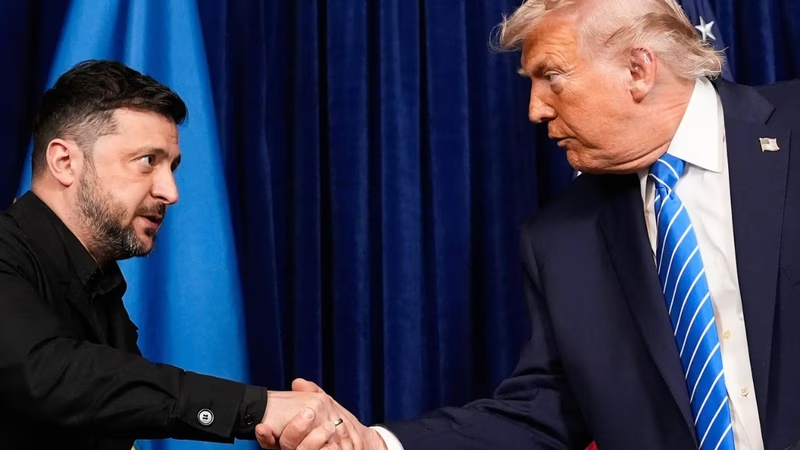
Trump-Zelenskyy Meeting: A Diplomatic High-Wire Act in Mar-a-Lago
In a move that sent shockwaves through global diplomatic circles, former U.S. President Donald Trump hosted Ukrainian President Volodymyr Zelenskyy at his Mar-a-Lago estate in December 2025. The Trump-Zelenskyy meeting—their first face-to-face since 2019—was billed as a private discussion, but its implications are anything but.
With the 2026 U.S. presidential race heating up and Ukraine’s war effort increasingly dependent on Western backing, this encounter was loaded with strategic, political, and humanitarian weight. Trump emerged claiming that “90%” of previously “thorny issues” had been resolved. But what does that really mean for Ukraine’s future—and America’s role in the war against Russia?
Table of Contents
- Background: Why This Meeting Mattered
- What Was Discussed at the Trump-Zelenskyy Meeting?
- Key Takeaways from Mar-a-Lago
- Trump’s Evolving Stance on Ukraine
- Zelenskyy’s Diplomatic Tightrope
- Global Reactions and Geopolitical Ripples
- Conclusion: What’s Next for U.S.-Ukraine Relations?
- Sources
Background: Why This Meeting Mattered
The timing couldn’t be more critical. Ukraine’s counteroffensive in 2025 has stalled amid ammunition shortages and Russian fortifications. Meanwhile, U.S. aid packages have faced growing opposition in Congress—particularly from Trump-aligned Republicans who argue resources should focus on domestic priorities.
Zelenskyy, barred from meeting current President Biden due to political sensitivities around the 2026 election, sought dialogue with Trump as a potential future commander-in-chief. For Trump, the meeting was a chance to reassert foreign policy influence and position himself as a deal-maker on the world stage.
What Was Discussed at the Trump-Zelenskyy Meeting?
While both sides kept details scarce, multiple sources familiar with the talks confirm the conversation centered on three core issues:
- Military Aid: Zelenskyy reportedly sought guarantees of continued U.S. support, including air defense systems and long-range missiles.
- Peace Framework: Trump reiterated his belief that the war could be “ended in 24 hours” through negotiation—a stance Zelenskyy has consistently rejected unless Russia withdraws fully.
- Energy & Reconstruction: Trump floated post-war investment opportunities for American firms in Ukrainian energy infrastructure .
Notably, Trump claimed afterward: “We were at odds before, but now we’re 90% done on the thorny issues.” Analysts interpret this as rhetorical—suggesting improved personal rapport, not concrete policy alignment.
Key Takeaways from Mar-a-Lago
Despite the opacity, several critical insights emerged:
- No Aid Commitment: Trump did not pledge new military assistance, emphasizing instead that Ukraine must “show more gratitude” for past support.
- Shift in Tone: Unlike the 2019 impeachment-era tension, the meeting was described as “cordial” and “constructive” by Zelenskyy’s spokesperson.
- Election Calculus: Trump is signaling to voters he can manage Ukraine without “endless spending”—a key message for his 2026 campaign.
Crucially, Zelenskyy avoided criticizing Trump—a diplomatic necessity given the uncertainty of U.S. leadership post-2026.
Trump’s Evolving Stance on Ukraine
Trump’s position has fluctuated dramatically. In 2022, he called the invasion “genius” by Putin—a comment he later walked back. By late 2024, he softened, acknowledging Ukraine’s sovereignty but insisting Europe should pay more.
Now, in late 2025, his narrative blends transactional diplomacy with nationalist rhetoric: “We’ve given $150 billion. Where’s our oil? Where’s our port?” he reportedly asked Zelenskyy .
This reflects a broader GOP shift—support for Ukraine is increasingly conditional, tied to border security or energy deals. For deeper analysis, see our feature on [INTERNAL_LINK:republican-foreign-policy-shift].
Zelenskyy’s Diplomatic Tightrope
For Zelenskyy, the meeting was a high-risk gambit. Engaging Trump could pay off if he wins in 2026—but it risks alienating Biden’s administration if perceived as legitimizing Trump’s critiques of current aid.
His team carefully framed the visit as “non-partisan,” stressing that Ukraine speaks to “all American leaders.” Yet the optics of meeting at Mar-a-Lago—a private club, not a government venue—raised eyebrows in Kyiv and Washington alike.
Global Reactions and Geopolitical Ripples
The reaction was swift:
- Kremlin: Spokesman Dmitry Peskov dismissed the meeting as “irrelevant,” but Russian state media amplified Trump’s “90% done” quote to suggest U.S. withdrawal is imminent.
- EU Leaders: France and Germany urged the U.S. to maintain bipartisan unity, fearing Trump’s comments could embolden Putin .
- U.S. State Department: Offered a neutral statement, noting “private citizens are free to host foreign leaders” but reaffirming current policy unchanged.
According to the Council on Foreign Relations, such private summits risk fragmenting Western cohesion: “When former leaders negotiate informally, it blurs accountability and creates parallel diplomacy” .
Conclusion: What’s Next for U.S.-Ukraine Relations?
The Trump-Zelenskyy meeting didn’t produce a breakthrough—but it did expose the fragility of Ukraine’s support in an election year. While Trump’s “90% done” claim is likely aspirational, the thaw in personal relations could matter if he returns to power.
For now, Ukraine must navigate a dual-track strategy: securing aid from the current administration while preparing for a possible Trump presidency that demands quid pro quo. One thing is clear: as American politics grow more polarized, Ukraine’s lifeline grows more precarious.