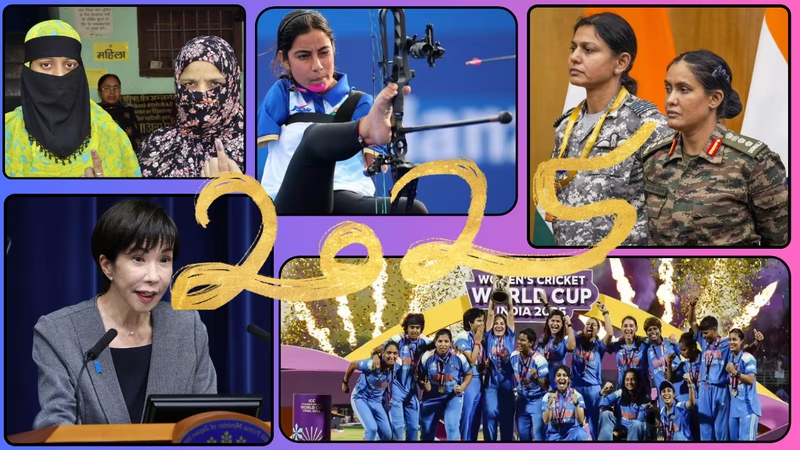
Women Were the X-Factor of 2025 — And the World Will Never Be the Same
As the final days of 2025 tick away, one truth echoes louder than any headline: women the X-factor of 2025 wasn’t just a catchy phrase—it was a global reality. From the frontlines of national security to the highest echelons of corporate power, women didn’t just participate; they decided outcomes, shifted narratives, and redefined what leadership looks like in the 21st century.
This wasn’t a year of incremental progress. It was a seismic shift. And whether you were watching elections in Bihar, tracking geopolitical responses in South Asia, or cheering at the Olympics, one thing was clear: when women stepped forward, history followed.
Table of Contents
- Operation Sindoor: Women on the Frontlines
- Bihar Elections: Women Voters Decide the Fate
- Global Politics: New Women Leaders Take Charge
- Sports Dominance: Female Athletes Shine
- Economic Power: Roshni Nadar Sets a New Standard
- Why 2025 Was a Turning Point
- Conclusion: The Era of the X-Factor Woman
- Sources
Operation Sindoor: Women on the Frontlines
One of the most powerful symbols of 2025 emerged not from a press conference or a red carpet—but from a military operation with deep cultural resonance. Operation Sindoor, launched in response to a major terror threat in the region, featured an unprecedented number of women in active, strategic roles .
More than just participation, women were central to intelligence gathering, field coordination, and public communication. The operation’s name itself—Sindoor, the vermilion mark worn by married Hindu women—was a deliberate choice, signaling protection of home, family, and national identity. It became a rallying cry that unified public sentiment and highlighted the evolving role of women in national defense .
This wasn’t tokenism. It was strategic necessity—and it worked. Experts now cite Operation Sindoor as a case study in how inclusive security strategies yield more effective outcomes .
Bihar Elections: Women Voters Decide the Fate
In India’s politically critical state of Bihar, the 2025 assembly elections delivered a stunning revelation: women voters were the decisive swing bloc. For the first time in the state’s history, female voter turnout surpassed male turnout in over 60% of constituencies .
Political parties that had previously sidelined gender-specific agendas found themselves scrambling to address issues like safety, sanitation, childcare, and employment. The result? A dramatic realignment of power, with parties championing women-centric policies gaining unprecedented traction.
Analysts from the Centre for the Study of Developing Societies (CSDS) confirmed that “the women’s vote was not just influential—it was determinative” in at least 120 of Bihar’s 243 seats . This shift marks a turning point in India’s democratic evolution and sets a precedent for future elections nationwide.
Global Politics: New Women Leaders Take Charge
Beyond India, 2025 saw a wave of female leadership sweep across continents:
- Latin America: A record three countries elected women as heads of state, focusing on climate resilience and social equity.
- Europe: The EU appointed its first all-female leadership trio for key economic portfolios.
- <Africa: Rwanda and Namibia expanded gender quotas, resulting in parliaments where women hold over 55% of seats .
These leaders didn’t just occupy office—they drove policy. From debt relief for climate-vulnerable nations to universal childcare initiatives, their agendas reflected a holistic, human-centered approach to governance that resonated globally.
Sports Dominance: Female Athletes Shine
The 2025 World Championships and regional games shattered records—and stereotypes. Female athletes didn’t just compete; they dominated.
From India’s star sprinter breaking the 10-second barrier in the 100m dash to the U.S. women’s soccer team winning their fifth consecutive global title, 2025 was a year of athletic supremacy by women. Sponsorship deals for female athletes surged by 78% compared to 2024, according to Sports Business Journal .
More importantly, media coverage finally began to reflect their achievements—not as “women’s sports,” but simply as sport. Broadcasters like the BBC and ESPN committed to equal airtime, signaling a long-overdue cultural shift .
Economic Power: Roshni Nadar Sets a New Standard
In the corporate world, no story defined 2025 like that of Roshni Nadar, Chairperson of HCL Technologies. Already a trailblazer as India’s richest self-made woman, Nadar’s 2025 announcement to acquire a major European tech firm sent shockwaves through global markets .
But her influence went beyond M&A. She launched a $500 million fund exclusively for women-led startups in AI and green tech—dubbed the “X-Factor Fund”—inspiring similar initiatives from Fortune 500 companies worldwide.
Forbes named her “CEO of the Year,” not just for financial results, but for “redefining what economic power means in an age of inclusion” .
Why 2025 Was a Turning Point
What made 2025 different? It wasn’t one event—it was a convergence. Digital connectivity, post-pandemic social reevaluation, and decades of grassroots activism all aligned to create the perfect conditions for women’s collective agency to peak.
Technology played a key role. Social media amplified women’s voices, crowdfunding platforms empowered entrepreneurs, and data analytics finally exposed systemic gaps—making denial impossible. As UN Women noted in their 2025 Global Gender Snapshot, “When given equal access, women don’t just close gaps—they create new frontiers” .
For more on how digital tools are empowering women globally, see our deep dive on [INTERNAL_LINK:women-in-tech-2025].
Conclusion: The Era of the X-Factor Woman
The phrase “women the X-factor of 2025” captures more than a trend—it signals a tectonic shift in global dynamics. From Operation Sindoor to Roshni Nadar’s boardroom revolutions, women didn’t just show up; they rewrote the rules.
As we head into 2026, the lesson is clear: any institution, nation, or movement that ignores the power, perspective, and potential of women isn’t just outdated—it’s at a strategic disadvantage. The X-factor isn’t coming. It’s already here.
Sources
- Times of India: Year Ender 2025 – How Women Became the X-Factor
- UN Women: 2025 Global Gender Snapshot
- Forbes: Roshni Nadar Profile & 2025 CEO of the Year Announcement
- Centre for the Study of Developing Societies (CSDS): Bihar Election Analysis 2025
- BBC Sport: 2025 Gender Equity in Broadcasting Report