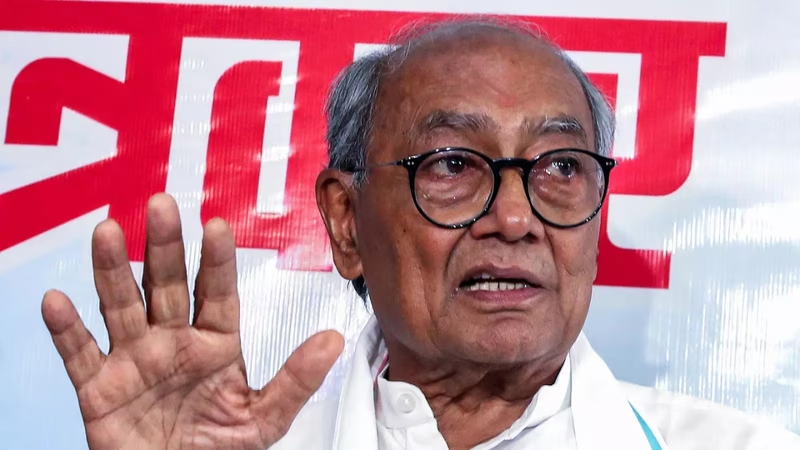
Digvijaya Singh Fires Back: ‘Congress All United’ Amid BJP-RSS Controversy
In a high-stakes political counteroffensive, senior Congress leader Digvijaya Singh has declared that the party stands firmly united—dismissing BJP attempts to paint internal fractures following his recent comments praising the RSS’s organizational structure. “Congress all united,” Singh asserted, directly challenging what he calls the BJP’s “deliberate campaign to sow discord” within the grand old party .
The controversy erupted after Singh acknowledged the RSS’s “strong organizational framework”—a remark swiftly weaponized by BJP leaders to suggest ideological confusion or softness within Congress ranks. But Singh, a veteran strategist and former Madhya Pradesh chief minister, was quick to clarify: admiring an opponent’s machinery doesn’t mean endorsing their ideology. “I oppose the RSS and PM Modi’s policies,” he stressed. “But as a political realist, I recognize effective organization when I see it.”
Table of Contents
- What Did Digvijaya Singh Actually Say?
- Congress Unity Under Fire
- BJP’s Strategy to Split the Grand Old Party
- RSS Organizational Strength vs. Ideological Opposition
- Nehru-Gandhi Family at the Center of the Storm
- Conclusion: A United Front or Political Theater?
- Sources
What Did Digvijaya Singh Actually Say?
Singh’s original comments—made during a regional political discussion—highlighted a key weakness he perceives in Congress: its lack of disciplined grassroots machinery compared to the RSS-backed BJP. “The RSS has built a robust, bottom-up organizational model over decades,” he noted. “We must learn from that structure—not their ideology—to rebuild Congress.”
However, the BJP selectively quoted him, framing the remark as praise for the RSS itself. Social media flooded with BJP-led hashtags accusing Congress of “RSS admiration,” prompting Singh to issue a pointed rebuttal: “I oppose everything the RSS stands for—from Hindutva majoritarianism to its anti-secular agenda. But organization is not ideology.”
Congress Unity Under Fire
Singh’s declaration of “Congress unity” comes at a critical juncture. With state elections looming and internal debates over leadership and strategy, the BJP has intensified efforts to amplify perceived divisions—especially around the Nehru-Gandhi family’s role.
Recent months have seen BJP leaders allege “family monopoly” and “generational entitlement” within Congress. Singh dismissed these as “desperate tactics.” He emphasized that the party’s Working Committee, state units, and grassroots workers remain aligned behind a common goal: countering BJP’s majoritarian politics.
“Unity doesn’t mean we don’t debate,” Singh clarified. “It means we debate openly and stand together publicly. That’s democracy—not what BJP does with its one-man rule.”
BJP’s Strategy to Split the Grand Old Party
Political analysts note that the BJP’s focus on Congress infighting is a well-worn playbook. By amplifying isolated remarks or internal disagreements, the ruling party aims to project Congress as chaotic and leaderless. Key tactics include:
- Manufacturing splits: Highlighting differences between regional satraps and central leadership.
- Targeting the Gandhi family: Painting them as out of touch or power-hungry to alienate younger voters.
- Exploiting ideological ambiguities: Framing any strategic acknowledgment of opponents as ideological betrayal.
Dr. Ayesha Khan, a political scientist at Jawaharlal Nehru University, observes: “The BJP knows a united opposition is its biggest threat. So it invests heavily in narrative warfare to fragment it” .
RSS Organizational Strength vs. Ideological Opposition
Singh’s nuanced position reflects a broader dilemma for Congress: how to rebuild institutional strength without compromising secular values. The RSS’s shakha (branch) network, youth mobilization, and community penetration are widely studied—even by its critics.
But as Singh insists, “Learning from your enemy’s logistics doesn’t mean adopting their worldview.” He pointed to Kerala and Punjab, where Congress-led coalitions have successfully built local machinery through alliances and cadre development—without echoing RSS methods.
[INTERNAL_LINK:congress-revival-strategy] efforts now focus on reviving district committees, empowering women and youth wings, and digitizing grassroots outreach—a quiet organizational revolution unfolding away from the headlines.
Nehru-Gandhi Family at the Center of the Storm
Singh specifically condemned BJP “attempts to sow discord” within the Nehru-Gandhi family—a clear reference to recent rumors and social media campaigns suggesting rifts between Rahul and Priyanka Gandhi. “They are united. The party is united. This is pure fiction by BJP IT cells,” he stated.
Historically, attacks on the Gandhi family have been met with strong internal solidarity. Singh’s defense reinforces that norm, signaling that any perceived vulnerability will be met with unified pushback.
Conclusion: A United Front or Political Theater?
Digvijaya Singh’s forceful affirmation of Congress unity is both a defensive shield and a strategic signal. While internal debates are inevitable in a diverse, century-old party, the public message is clear: Congress will not allow the BJP to define its narrative. As the 2029 general elections loom, organizational rebuilding—not just rhetoric—will determine whether this unity translates into electoral resilience.
Sources
- Times of India: ‘Cong all united’: Digvijaya after RSS remark; condemns BJP’s ‘attempts to sow discord’
- Election Commission of India – Political Party Reports: Official Website