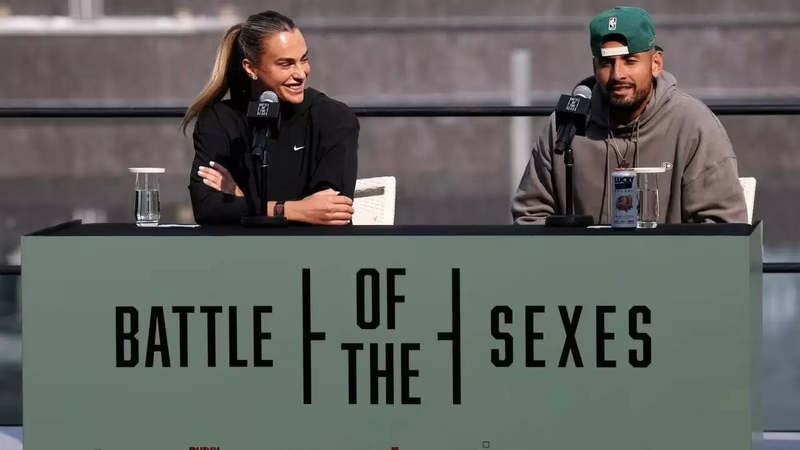
Battle of the Sexes Tennis Match: Entertainment or Exploitation? Billie Jean King Weighs In
When news broke of an upcoming Battle of the Sexes exhibition match between world No. 2 Aryna Sabalenka and maverick showman Nick Kyrgios, fans and media alike lit up with excitement. But one legendary voice—Billie Jean King—wasn’t celebrating. The tennis icon, whose own 1973 Battle of the Sexes match against Bobby Riggs became a landmark moment for gender equality, has publicly questioned the purpose and politics behind the modern reboot .
While the new match promises glitz, hype, and massive paychecks, King warns it lacks the social conscience that defined her historic victory. In her view, this isn’t progress—it’s pageantry with a profit motive and little regard for the legacy of women’s rights in sports.
Table of Contents
- What Is the New “Battle of the Sexes”?
- Billie Jean King’s 1973 Match: A Feminist Milestone
- Why the Sabalenka–Kyrgios Event Is Different
- Is Entertainment Enough for Women’s Tennis?
- Kyrgios and Sabalenka Weigh In
- Conclusion: Honoring the Past or Cashing In?
- Sources
What Is the New “Battle of the Sexes”?
Organized as a high-profile exhibition, the match between Aryna Sabalenka and Nick Kyrgios is set to take place outside the traditional Grand Slam calendar. Marketed as a spectacle, it’s expected to feature on-court banter, fan engagement, and possibly even mixed scoring formats—all designed to maximize entertainment value.
Unlike official WTA or ATP tournaments, this event is privately funded, with organizers promising “a celebration of tennis” rather than a competitive contest. Both players have signed on for undisclosed seven-figure sums, signaling its commercial—not competitive—nature .
Billie Jean King’s 1973 Match: A Feminist Milestone
To understand King’s critique, one must revisit history. In 1973, at the height of the women’s liberation movement, King faced self-proclaimed “male chauvinist” Bobby Riggs in a match that transcended sport. Riggs claimed women’s tennis was inferior; King saw it as a chance to prove equality on a global stage.
The match drew 90 million viewers worldwide and became a cultural touchstone. King’s victory wasn’t just athletic—it was political. It helped secure sponsorship for the fledgling WTA Tour and gave momentum to Title IX legislation in the U.S. “It was about human rights, not just tennis,” King later reflected .
This legacy is precisely what makes her uneasy about the modern iteration.
Why the Sabalenka–Kyrgios Event Is Different
King has been clear: the upcoming match is “apolitical” and “for entertainment and profit.” In her words, it carries none of the social stakes that defined her own Battle of the Sexes .
Several key differences stand out:
- Intent: 1973 was about proving women’s athletic legitimacy; 2025 is about ticket sales and social media buzz.
- Context: King’s match occurred amid a national debate on gender roles; today’s event drops into a post-feminist pop culture landscape.
- Impact: The 1973 match led to tangible gains for women in sports; it’s unclear what societal or structural benefit the new match provides.
Is Entertainment Enough for Women’s Tennis?
This raises a critical question: In an era where women’s tennis already commands global audiences and equal prize money at majors, does it need “gimmick” matches to stay relevant?
Some argue that exhibitions like this bring casual fans into the sport. But critics, including King, worry they reinforce outdated tropes—pitting men against women as a novelty rather than celebrating women’s tennis on its own terms.
The WTA has fought for decades to be seen as elite sport, not sideshow entertainment. As King told reporters, “We worked so hard to be taken seriously. Now, are we turning it into a circus?” .
Kyrgios and Sabalenka Weigh In
Both players have downplayed the political angle. Nick Kyrgios called it “just a fun match” and emphasized fan engagement. Sabalenka, while respectful of King’s legacy, stated she sees it as “a chance to showcase tennis differently” and support charitable causes tied to the event .
Still, their participation doesn’t erase the larger tension between legacy and commercialization. [INTERNAL_LINK:womens-sports-equality] initiatives have made huge strides—but visibility without purpose can be hollow.
Conclusion: Honoring the Past or Cashing In?
The Sabalenka–Kyrgios Battle of the Sexes may draw crowds and go viral—but without a commitment to advancing women’s sport or addressing inequality, it risks becoming a nostalgic echo rather than a meaningful evolution. Billie Jean King’s critique isn’t just about one match; it’s a call to remember why the original mattered—and to ensure today’s spectacles don’t lose sight of the movement that made them possible.
Sources
- Times of India: Battle of the Sexes: How Sabalenka–Kyrgios match strips politics from a historic feminist moment
- International Tennis Hall of Fame: Billie Jean King Profile