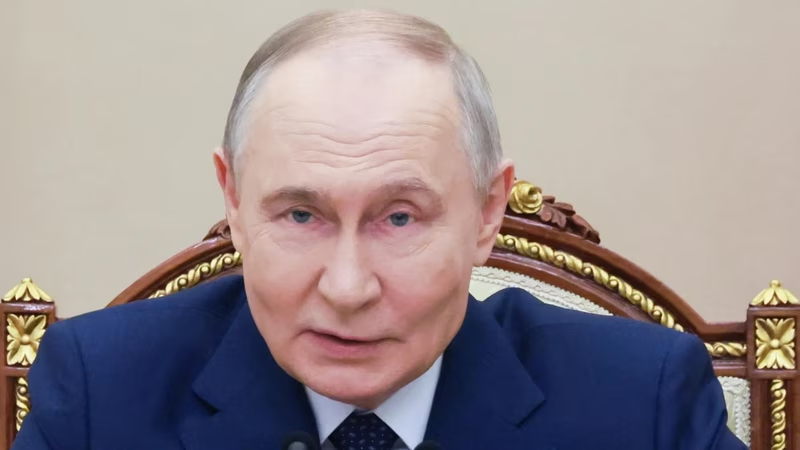
Tensions are boiling over in Eastern Europe. Just days before Ukrainian President Volodymyr Zelenskyy’s high-stakes meeting with former U.S. President Donald Trump, Russian leader Vladimir Putin has issued a stark and ominous warning: “If Kyiv doesn’t want peace, Russia will achieve its goals by military means.”
This isn’t just rhetoric. It’s a calculated escalation—one that signals Moscow’s growing impatience as winter sets in and Western support for Ukraine faces political headwinds in the U.S. and Europe. With claims of territorial gains and a declared “buffer zone” along the border, Putin’s message is clear: time is running out for diplomacy. And for Ukraine, the red lines are getting harder to defend.
Table of Contents
- Putin’s Latest Ultimatum: What He Said
- Putin Warning to Ukraine: Buffer Zones and Battlefield Gains
- Zelenskyy’s Response: Red Lines and the Trump Meeting
- Why the Timing Matters: U.S. Politics and Ukraine’s Future
- What Are Russia’s Real Goals?
- Global Reactions and Escalation Risks
- Conclusion
- Sources
Putin’s Latest Ultimatum: What He Said
In a televised address from the Kremlin, Putin framed the conflict as a defensive struggle against an “anti-Russia” West. “We have consistently proposed peaceful solutions,” he claimed. “But if the Kyiv regime, under Western direction, rejects any negotiation and insists on continuing the war, then Russia will be forced to complete its military objectives.”
He stopped short of declaring full mobilization but emphasized that Russia’s “special military operation” would not end until its security concerns were addressed—including what he described as “demilitarization” and “denazification” of Ukrainian territories.
Putin warning to Ukraine: Buffer Zones and Battlefield Gains
Putin backed his threats with specific battlefield assertions:
- Creation of a “buffer zone” along the Russia-Ukraine border, allegedly to prevent cross-border drone and artillery strikes.
- Advances in Donbass, claiming Russian forces now control “over 90%” of Donetsk and Luhansk regions.
- Progress near Zaporizhzhia, including strategic positioning around the Zaporizhzhia Nuclear Power Plant—the largest in Europe.
While independent verification is difficult due to information control in conflict zones, satellite imagery from sources like Institute for the Study of War suggests limited but real movement in southern Ukraine over the past month, though nowhere near the scale Putin described .
Zelenskyy’s Response: Red Lines and the Trump Meeting
Not to be outdone, President Zelenskyy fired back with his own set of non-negotiables ahead of his upcoming U.S. visit: “Occupied territories are not bargaining chips. The Zaporizhzhia plant is a red line. And long-term security guarantees are non-negotiable.”
Zelenskyy’s trip to the U.S.—where he is expected to meet with both President Biden and former President Trump—is widely seen as an effort to shore up bipartisan American support before the 2026 U.S. elections, which could reshape foreign policy dramatically.
Trump, who has repeatedly claimed he could “end the war in 24 hours,” remains a wildcard. His meeting with Zelenskyy will be closely watched for signals on whether his potential 2028 platform includes continued military aid—or a push for rapid concessions from Kyiv.
[INTERNAL_LINK:trump-ukraine-policy-2025] explores how a second Trump term could reshape transatlantic security.
Why the Timing Matters: U.S. Politics and Ukraine’s Future
Putin’s warning isn’t random. It’s perfectly timed to exploit fractures in Western unity:
- U.S. aid delays: Congress has stalled on $61 billion in military assistance, leaving Ukraine’s artillery and air defense stocks dangerously low.
- Election fatigue in Europe: Public support for Ukraine is softening in Germany, France, and the UK amid inflation and energy concerns.
- Ukraine’s manpower crisis: With conscription protests growing, Kyiv struggles to replenish frontline units.
Russia appears to believe that winter—and political distraction—could be its greatest allies.
What Are Russia’s Real Goals?
Despite the “peace” language, analysts agree Putin’s endgame remains territorial:
- Secure full control of Donbas (Donetsk + Luhansk)
- Create a land corridor to Transnistria (a Russian-backed breakaway in Moldova)
- Force NATO into a de facto ceasefire that legitimizes current occupation lines
As Dr. Fiona Hill, former U.S. National Security Council official, noted in a recent Brookings Institution analysis, “Putin does not want peace. He wants capitulation” .
Global Reactions and Escalation Risks
The international response has been swift:
- NATO reaffirmed “unwavering support” for Ukraine’s sovereignty.
- U.S. State Department called Putin’s remarks “a threat to global security.”
- E.U. leaders fast-tracked new sanctions on Russian drone and missile suppliers.
Yet the risk of escalation remains high—particularly around the Zaporizhzhia plant, where any military mishap could trigger a nuclear emergency.
Conclusion
The Putin warning to Ukraine is more than a bluff—it’s a strategic pressure tactic timed to coincide with a moment of Western vulnerability. As Zelenskyy heads to Washington, the world watches to see whether the U.S. will double down on support or drift toward a negotiated outcome that sacrifices Ukrainian sovereignty. One thing is certain: peace on Putin’s terms is not peace. It’s surrender. And Ukraine, so far, refuses to sign.