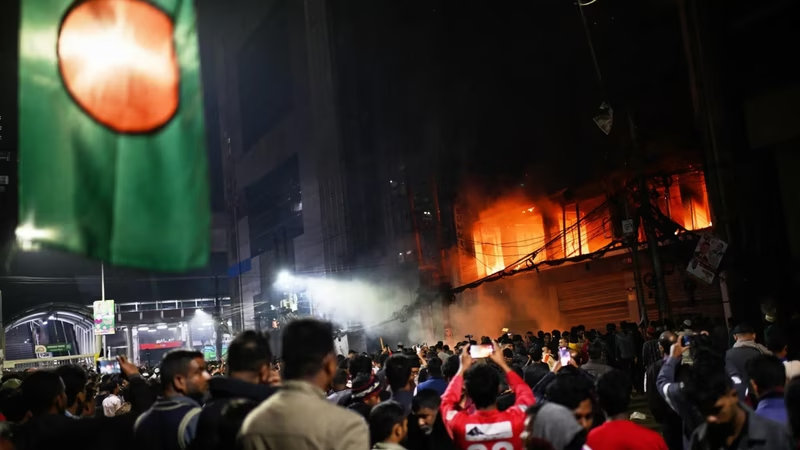
In a rare and forceful diplomatic rebuke, the United States has condemned the mob killing of Hindu worker in Bangladesh as “horrific” and “unacceptable.” The statement, issued by the US State Department, comes in the wake of the brutal lynching of 32-year-old garment worker Dipu Chandra Das—a crime that has sent shockwaves through Bangladesh’s already vulnerable minority communities and drawn urgent calls for justice from Washington and beyond.
Das, a Hindu man working in the Narayanganj district near Dhaka, was reportedly dragged from his home by a violent mob on accusations linked to blasphemy—a charge often weaponized against religious minorities in South Asia. Within hours, he was dead. His murder, captured on mobile phones and shared widely on social media, has become a grim symbol of the deteriorating security for non-Muslim citizens in a nation once hailed for its secular foundations.
Table of Contents
- The Incident: What Happened to Dipu Chandra Das?
- US State Department’s Unprecedented Condemnation
- Mob Killing of Hindu Worker in Bangladesh: A Wider Pattern?
- Bangladesh Government’s Reaction and Accountability
- Global and Domestic Outcry
- Implications for Religious Freedom in Bangladesh
- Conclusion
- Sources
The Incident: What Happened to Dipu Chandra Das?
On December 22, 2025, Dipu Chandra Das was accused—without evidence—of sharing an “offensive” social media post about Islam. Despite no formal complaint or police involvement, a crowd gathered outside his residence, incited by local rumors and online misinformation. Within minutes, the mob turned violent.
Eyewitnesses say Das pleaded for his life as he was beaten with rods and bricks before being set on fire. Local police arrived only after the attack was over. He died en route to the hospital. Authorities later arrested six suspects, but activists argue this is insufficient without prosecuting those who incited the violence online and in mosques.
Das leaves behind a wife and two young children. His family, now in hiding, fears for their lives—a stark reality for many minority families in post-coup Bangladesh.
US State Department’s Unprecedented Condemnation
In a statement that carries significant diplomatic weight, US State Department spokesperson Matthew Miller called the killing “horrific” and demanded that “Bangladeshi authorities take immediate, unequivocal action to protect religious minorities and hold perpetrators accountable.”
“The United States stands with all victims of religious hatred,” Miller added. “Silence in the face of such bigotry only emboldens extremists.”
Separately, US lawmakers—including Senator Chris Van Hollen and Representative Ilhan Omar—urged the Biden administration to review Bangladesh’s eligibility for trade benefits under the Generalized System of Preferences (GSP) if systemic persecution continues.
[INTERNAL_LINK:bangladesh-human-rights-crisis] explores how political instability has exacerbated minority vulnerability since the 2024 government transition.
Mob killing of Hindu worker in Bangladesh: A Wider Pattern?
This is not an isolated case. Reports from human rights organizations show a troubling uptick in violence against religious minorities since late 2024:
- In October 2025, a Hindu priest was attacked in Cumilla during Durga Puja preparations.
- In November, a Buddhist monastery in Cox’s Bazar was vandalized after false rumors spread online.
- Over 200 Hindu families have fled their villages in the past six months due to intimidation.
According to Human Rights Watch, blasphemy-related accusations are increasingly used as tools of land grabbing and social coercion against minority communities .
The erosion of secular safeguards, coupled with weak law enforcement and inflammatory rhetoric from fringe religious groups, has created a permissive environment for mob justice.
Bangladesh Government’s Reaction and Accountability
Prime Minister Sheikh Hasina’s office issued a brief statement “deploring the incident” and promising a “fast-track investigation.” However, critics point out that similar promises followed the 2016 murder of atheist blogger Avijit Roy and the 2021 lynching of a Buddhist monk—with little long-term reform.
Notably, no senior official has publicly visited Das’s family or attended his funeral—a stark contrast to how the state responds to attacks on majority communities. Civil society leaders argue that without political will, arrests are merely performative.
Global and Domestic Outcry
Beyond the US, the incident has drawn condemnation from:
- India: The Ministry of External Affairs expressed “deep concern” and urged Dhaka to ensure minority safety.
- UN Human Rights Office: Called for an independent probe and structural reforms to prevent recurrence.
- Amnesty International: Described the killing as “a failure of the state to uphold its most basic duty: protection of life.”
Within Bangladesh, student groups and interfaith coalitions have organized candlelight vigils in Dhaka and Chittagong, demanding justice and legal reforms to curb mob vigilantism.
Implications for Religious Freedom in Bangladesh
The Das case underscores a deeper crisis: Bangladesh’s gradual drift from its constitutional commitment to secularism. While the 1972 constitution enshrined equal rights for all religions, subsequent amendments and political compromises have weakened those protections.
For investors and trade partners, this instability is a red flag. Religious violence deters foreign direct investment, disrupts supply chains (especially in the garment sector where minorities are overrepresented), and damages Bangladesh’s global image as a moderate Muslim-majority democracy.
Conclusion
The mob killing of Hindu worker in Bangladesh is more than a tragic crime—it’s a test of the nation’s conscience and governance. The US’s sharp rebuke signals that the international community is watching closely. Without swift, transparent justice and systemic reforms to protect minorities, Bangladesh risks further isolation and internal fracture. For Dipu Chandra Das’s family—and millions like them—the world’s attention may be their only shield.