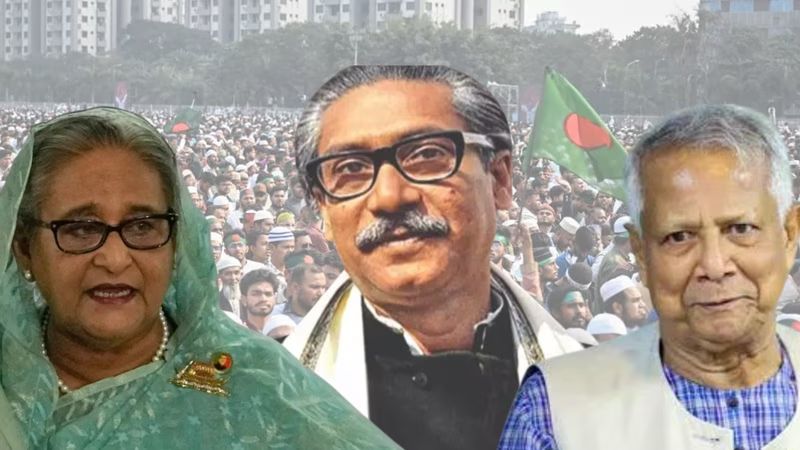
December in Bangladesh is supposed to be a season of celebration—the month of victory, commemorating the 1971 Liberation War. But in recent years, it’s become a month of reckoning. In December 2023, students took to the streets demanding justice, equity, and democratic reform. By December 2025, the streets are again filled with protesters—but this time, the demands feel eerily familiar, and the outcomes just as uncertain. This heartbreaking repetition isn’t coincidence. It’s a symptom of a deeper political malaise. Welcome to A Tale of Two Decembers—where history doesn’t just rhyme; it repeats in heartbreaking detail.
Table of Contents
- December 2023: The Spark That Ignited a Nation
- December 2025: The Cycle Returns with a Vengeance
- A Tale of Two Decembers: Key Similarities and Differences
- Why the Pattern Persists: Roots of Political Stagnation
- Regional and Global Implications
- What Comes Next for Bangladesh?
- Conclusion
- Sources
December 2023: The Spark That Ignited a Nation
The winter of 2023 saw Bangladesh rocked by a wave of student-led protests. Triggered by a controversial quota system in government jobs, the demonstrations quickly evolved into a broader movement against perceived nepotism, lack of transparency, and democratic erosion under Prime Minister Sheikh Hasina’s long-standing administration .
Young people—many of them university students—mobilized through social media, organizing peaceful rallies in Dhaka, Chittagong, and Rajshahi. Their core demand was simple: merit-based opportunity. Yet, the government responded with internet blackouts, mass arrests, and police force, casting a shadow over what should have been a festive season .
Though the protests eventually subsided, the underlying grievances were never addressed. Reforms were promised but never implemented. And so, the embers of dissent remained hot, waiting for the next gust of wind.
December 2025: The Cycle Returns with a Vengeance
Fast-forward to December 2025, and Bangladesh finds itself once again on the brink. Fresh protests have erupted—not just over quotas, but over the lack of any real political opposition, media censorship, and a deepening economic crisis marked by inflation and unemployment .
This time, the movement is even more disillusioned. Protesters aren’t just demanding policy changes; they’re questioning the very legitimacy of the political system. Slogans like “No more empty promises” and “Democracy or dictatorship?” are echoing through Shahbagh Square—the same ground that witnessed the 2013 Shahbag protests and now, a decade later, fresh outrage .
Despite the government’s attempts to frame the unrest as “foreign-inspired” or “politically motivated,” the grassroots nature of these demonstrations is undeniable. And just like in 2023, the state’s response has been heavy-handed—raising alarms among human rights groups like Human Rights Watch .
A Tale of Two Decembers: Key Similarities and Differences
At first glance, the two protest waves seem identical. But a closer look reveals both echoes and evolutions:
- Leadership: Both movements were youth-driven, but 2025’s protests are more decentralized, with no single figurehead—making them harder to co-opt or suppress.
- Demands: While 2023 focused on job quotas, 2025’s demands are systemic—calling for free elections, judicial independence, and press freedom.
- Government Response: In 2023, the crackdown was swift but short-lived. In 2025, surveillance and pre-emptive detentions have intensified, signaling a more entrenched authoritarian posture.
- Public Support: Polls suggest broader civilian backing in 2025, with even middle-class professionals joining students—reflecting wider economic distress .
Why the Pattern Persists: Roots of Political Stagnation
Bangladesh’s cyclical unrest isn’t accidental. It stems from structural issues that have festered for years:
- One-party dominance: The Awami League’s uninterrupted rule since 2009 has weakened institutional checks and balances.
- Electoral credibility crisis: Allegations of rigged elections in 2014, 2018, and 2024 have eroded public trust in the democratic process.
- Suppression of dissent: Laws like the Digital Security Act have been used to silence journalists, activists, and opposition voices.
- Economic strain: Post-pandemic recovery has been uneven, with youth unemployment soaring past 12%—a ticking time bomb.
Without meaningful political reform, protests will keep returning—each December, or sooner.
Regional and Global Implications
Bangladesh’s instability doesn’t exist in a vacuum. As a key player in South Asia—with strategic ports, a large garment industry, and growing geopolitical relevance—its internal chaos affects neighbors and global partners alike.
India watches closely, balancing diplomatic support for Hasina with concerns over refugee flows and radicalization. China, a major infrastructure investor through the Belt and Road Initiative, fears project delays. And Western nations, while publicly advocating for democracy, often prioritize economic and security ties over human rights—sending mixed signals .
[INTERNAL_LINK:bangladesh-geopolitics-south-asia] explores how Dhaka’s domestic crisis is reshaping regional alliances.
What Comes Next for Bangladesh?
There are three possible paths forward:
- Reform from within: The government initiates dialogue, releases political prisoners, and schedules truly free elections. Unlikely, but not impossible.
- Escalated repression: Crackdowns intensify, leading to international sanctions and further economic isolation.
- Grassroots transformation: The protest movement evolves into a sustained civil society coalition that pressures change from below—a slow but potentially durable solution.
For now, the streets remain tense. And December—once a month of hope—has become a season of sorrowful repetition.
Conclusion
A Tale of Two Decembers is more than a historical parallel; it’s a warning. Bangladesh stands at a crossroads: continue down the path of authoritarian consolidation and risk deeper chaos, or embrace inclusive democracy and break the cycle. The world may not be watching closely, but for 170 million Bangladeshis, the stakes couldn’t be higher. Without real change, there’s every reason to fear a third December—and a fourth.