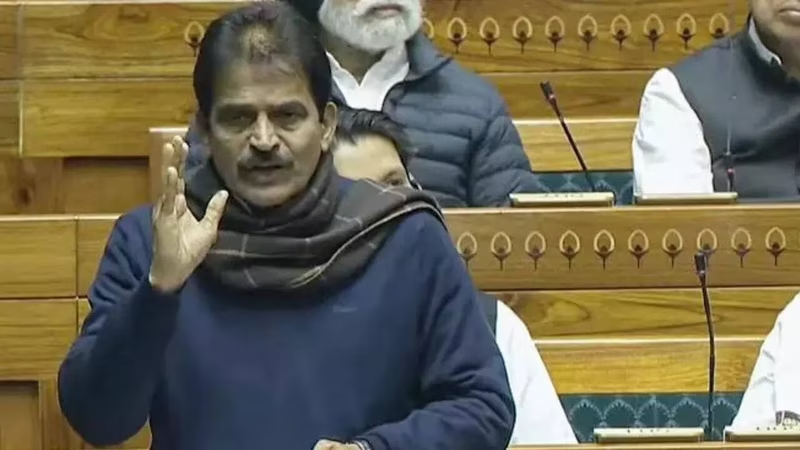
Political tensions have flared in Karnataka after Congress general secretary K C Venugopal made public remarks criticizing the state government’s recent demolition drive targeting illegal structures in Bengaluru. The backlash was swift and sharp: senior BJP leader and former Deputy CM R Ashoka fired back with a loaded retort—“Karnataka is not Rahul Gandhi’s colony”—igniting a fresh war of words between the ruling Congress and the opposition BJP .
The clash centers on the legitimacy of urban enforcement actions and, more broadly, who has the authority to speak on behalf of Karnataka’s governance. But beneath the rhetoric lies a deeper struggle over federalism, political overreach, and the optics of development versus displacement in India’s tech capital.
Table of Contents
- What Sparked the Karnataka Eviction Row?
- Congress Response: Venugopal’s Criticism
- BJP’s Rebuttal: ‘Karnataka Not Rahul Gandhi’s Colony’
- The Hypocrisy Charge: Kerala Waste Dumping Claims
- Legal and Administrative Questions: Who Runs Karnataka?
- Public Opinion: Bengaluru Residents Divided
- Conclusion: A Battle Over Federalism and Face
- Sources
What Sparked the Karnataka Eviction Row?
In late December 2025, the Bruhat Bengaluru Mahanagara Palike (BBMP), under the Congress-led state government, launched a high-profile demolition drive targeting unauthorized commercial and residential constructions across key zones like Rajarajeshwari Nagar and Yelahanka. Officials cited violations of zoning laws, fire safety norms, and encroachment on stormwater drains—critical in a city prone to flooding .
While framed as a civic cleanup, the evictions displaced dozens of small businesses and informal vendors, sparking protests. Critics argued the drive lacked rehabilitation plans and appeared selectively enforced—setting the stage for political intervention.
Congress Response: Venugopal’s Criticism
Enter K C Venugopal, the Congress general secretary and Rajya Sabha MP from Kerala. In a widely reported statement, he questioned the “harshness” and “timing” of the demolitions, suggesting they reflected poor planning by the state administration. Though he didn’t explicitly oppose the action, his remarks were interpreted as a rebuke of Karnataka CM Siddaramaiah’s government—a rare public critique from within the party’s national leadership .
Observers noted the irony: a senior Congress leader appearing to undermine his own party’s state government during a sensitive urban operation.
BJP’s Rebuttal: ‘Karnataka Not Rahul Gandhi’s Colony’
R Ashoka, Karnataka BJP’s veteran leader and Leader of the Opposition, seized the moment. At a press conference in Bengaluru, he launched a scathing counterattack:
“Who is Venugopal to comment on Karnataka’s administration? Is he the Super CM? Karnataka is not Rahul Gandhi’s colony or a fiefdom to be lectured by Delhi-based leaders” .
Ashoka accused the Congress of double standards—praising “strict governance” when it suits them nationally, yet condemning it when their own state government faces backlash. His “colony” remark quickly trended on social media, resonating with regional pride sentiments.
The Hypocrisy Charge: Kerala Waste Dumping Claims
Ashoka further escalated by invoking a separate environmental controversy. He reminded the public that Venugopal’s home state, Kerala, has long been accused of illegally dumping municipal waste into Karnataka’s Kodagu and Wayanad border regions—a recurring interstate dispute ignored by Congress leadership .
“While Venugopal lectures us on urban order, his state continues to treat Karnataka like a landfill,” Ashoka charged, framing the Congress critique as not just misplaced but hypocritical.
Legal and Administrative Questions: Who Runs Karnataka?
Beyond the political mudslinging, the episode raises valid constitutional questions. India’s federal structure grants states exclusive authority over law and order, public health, and urban development under the State List (Seventh Schedule). While national party leaders often comment on state issues, direct criticism of their own government’s executive actions can blur lines of accountability.
Legal experts note that while Venugopal has the right to express concern, doing so without coordination with the state CM risks public confusion and weakens governance optics—especially in a high-stakes metro like Bengaluru.
Public Opinion: Bengaluru Residents Divided
On the ground, reactions are split:
- Urban planners and environmentalists support the demolition drive as long overdue, citing unchecked construction as a flood risk.
- Small traders and labor unions decry the lack of notice and compensation, calling it “anti-poor.”
- Netizens are polarized—many applaud BJP’s defense of state autonomy, while others see Ashoka’s “colony” remark as divisive.
A recent Times of India poll showed 52% of Bengaluru respondents believe demolitions are necessary—but 68% want proper rehabilitation first .
Conclusion: A Battle Over Federalism and Face
The Karnataka eviction row is more than a political spat—it’s a microcosm of India’s evolving federal tensions. As cities like Bengaluru grow into global hubs, balancing development, legality, and equity becomes increasingly complex. The Congress’s internal dissonance and BJP’s aggressive federalism defense reveal how urban governance is now a high-stakes political battlefield. One thing is clear: in Karnataka, no one wants to be told how to run their house—especially not by someone 500 kilometers away in Delhi.
For more on urban policy conflicts, read our feature on [INTERNAL_LINK:indian-cities-illegal-encroachment-crisis].
Sources
- Times of India: “Karnataka not Rahul Gandhi’s colony: BJP slams Cong’s Venugopal”
- BBMP official statement on demolition drive, December 2025
- Karnataka State Pollution Control Board reports on interstate waste dumping
- TOI-CVoter Public Opinion Survey, Bengaluru, December 2025
- Constitution of India, Seventh Schedule – State List Subjects
- For authoritative insights on Indian federalism, visit the PRS Legislative Research website.