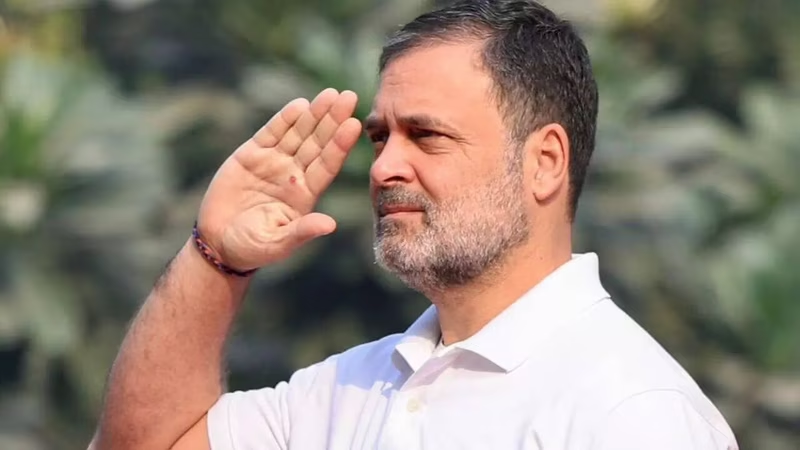
On December 28, 2025, as the Indian National Congress marked its 140th Foundation Day, senior leader Rahul Gandhi delivered a sweeping, emotionally charged message that went beyond mere celebration—it was a declaration of identity. In a widely shared post across social media and party channels, Gandhi proclaimed: “The Congress is not just a political party, but the voice of India’s soul.” The statement, steeped in historical resonance and contemporary urgency, sought to reposition the grand old party as the guardian of India’s pluralistic, democratic, and inclusive ethos at a time when its electoral fortunes remain under pressure .
More than nostalgia, Gandhi’s message was a strategic reaffirmation of ideology—tying the party’s past sacrifices to its present mission of defending the “weak, the deprived, and the hardworking people” against what he described as rising injustice and majoritarianism. As India navigates complex social and political currents, the Congress leadership is betting that its legacy can still speak to the nation’s conscience.
Table of Contents
- Congress Foundation Day: A Historical Milestone
- Rahul Gandhi’s Key Message: ‘Voice of India’s Soul’
- The Three Pillars of Congress Legacy Revisited
- Political Context: Why This Message Matters Now
- Public and Opposition Reactions to Gandhi’s Speech
- Can Congress Reclaim Its Moral Authority?
- Conclusion: Legacy as a Living Weapon
- Sources
Congress Foundation Day: A Historical Milestone
Founded on December 28, 1885, in Bombay (now Mumbai), the Indian National Congress began as a platform for educated Indians to voice grievances under British rule. What started as a 72-member gathering evolved into the principal force behind India’s independence movement—producing icons like Mahatma Gandhi, Jawaharlal Nehru, and Sardar Patel.
Over 140 years, the party has governed India for over five decades, shaped the Constitution, and championed land reforms, linguistic states, and scientific temper. Its Congress Foundation Day is not just a ceremonial date—it’s a reminder of a political tradition that helped define modern India .
Rahul Gandhi’s Key Message: ‘Voice of India’s Soul’
In his 2025 address, Gandhi avoided dry political rhetoric. Instead, he framed the Congress as a living embodiment of India’s civilizational values:
“For 140 years, the Congress has stood with farmers, workers, women, Dalits, Adivasis, and minorities. It has never bowed to fear. Today, as injustice spreads, we will rise again—not for power, but for justice” .
He paid tribute to freedom fighters and stressed the party’s role in strengthening democratic institutions—from the Election Commission to the judiciary. Notably, he linked historical struggle to current challenges: unemployment, inequality, and attacks on secularism.
The Three Pillars of Congress Legacy Revisited
Gandhi’s speech implicitly rested on three enduring themes of Congress identity:
- Freedom & Anti-Colonialism: From the Quit India Movement to the integration of princely states.
- Social Justice: Championing affirmative action, women’s rights, and welfare schemes like MNREGA.
- Democratic Pluralism: Defending secularism, federalism, and minority rights against homogenizing forces.
By invoking these pillars, Gandhi aimed to contrast Congress with what he called “centralized, top-down politics” of the current ruling establishment .
Political Context: Why This Message Matters Now
The timing is critical. With Lok Sabha elections approaching and state polls in key regions like Maharashtra and Haryana on the horizon, the Congress is fighting to rebuild relevance. Despite leading the INDIA alliance, the party struggles with leadership perception and grassroots mobilization.
Gandhi’s “soul of India” narrative is a deliberate attempt to shift the debate from electoral arithmetic to moral authority. As political analyst Dr. Zoya Hasan notes, “When institutions are under stress, parties often fall back on foundational values to re-energize their base” .
Public and Opposition Reactions to Gandhi’s Speech
Reactions were predictably polarized. Congress supporters praised the speech as “inspiring” and “necessary,” flooding social media with #VoiceOfIndiasSoul. Meanwhile, BJP leaders dismissed it as “empty rhetoric from a party that lost 23 states.”
Yet, independent observers noted the speech’s strategic depth. It wasn’t just about history—it was a call to frame the 2026 general election as a battle for India’s constitutional soul, not just policy differences .
Can Congress Reclaim Its Moral Authority?
Legacy alone won’t win votes. For Gandhi’s vision to resonate, the Congress must:
- Strengthen grassroots organization beyond elite leadership.
- Articulate a clear economic alternative to current policies.
- Ensure internal democracy and youth inclusion.
As the party’s 2024 internal survey revealed, many voters respect its history but doubt its readiness to govern. Bridging that gap is the real challenge.
Conclusion: Legacy as a Living Weapon
Rahul Gandhi’s Congress Foundation Day message is more than ceremonial—it’s a strategic rebranding of heritage as resistance. By calling the party the “voice of India’s soul,” he’s not just honoring the past; he’s weaponizing it for the future. Whether this narrative translates into political revival remains to be seen. But one thing is clear: in India’s ongoing democratic debate, the Congress intends to be not just a participant—but the conscience.
For deeper insights into India’s political evolution, explore our analysis on [INTERNAL_LINK:history-of-indian-national-congress].
Sources
- Times of India: “Congress not just a party, but voice of India’s soul”
- Indian National Congress official archives on foundation history
- Rahul Gandhi’s full Foundation Day statement, December 28, 2025
- Interview with Dr. Zoya Hasan, political scientist, Centre for Political Studies
- Media analysis from The Hindu and Indian Express, December 29, 2025
- For authoritative documentation on India’s political parties, refer to the Election Commission of India archives.