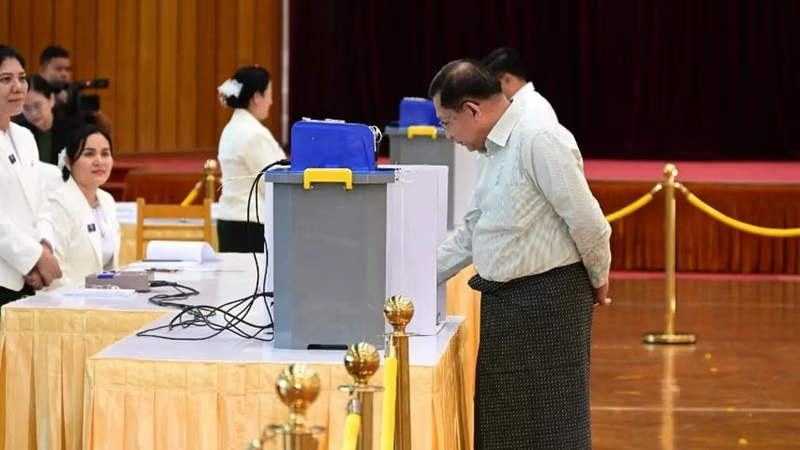
On a tense Sunday in late December 2025, polling stations opened across parts of Myanmar. But this wasn’t the hopeful return to democracy many had dreamed of. Instead, it was the opening act of what observers universally condemn as a Myanmar election 2025 orchestrated solely to give a veneer of legitimacy to a military regime drowning in its own illegitimacy and a brutal civil war.
Five years after the generals ripped power from a democratically elected government, they are attempting to use the very institution they destroyed—elections—to cement their rule. The stakes couldn’t be higher, not for democracy, which is absent from this process, but for the junta’s desperate bid for survival.
Table of Contents
- What’s Happening in the Myanmar Election 2025?
- Why This Is a Sham Election, Not a Democratic Exercise
- The Brutal Backdrop: Myanmar’s Civil War in 2025
- International Reaction: Rejecting the Junta’s Play
- The Silenced Opposition: Where is Aung San Suu Kyi?
- Conclusion: A Fraudulent Facade for a Failing Regime
- Sources
What’s Happening in the Myanmar Election 2025?
The military junta, officially known as the State Administration Council, announced a multi-stage general election to fill seats in the Union Parliament and regional assemblies . The first phase began on December 28, 2025, a date chosen by the regime itself. However, this process is fundamentally broken from the start.
Major opposition parties, including the National League for Democracy (NLD)—which won a landslide victory in the last free election in 2020—have been systematically dismantled and banned from participating . The regime amended political party laws in 2023 to impose impossible financial and membership hurdles, effectively outlawing any credible challenge .
Why This Is a Sham Election, Not a Democratic Exercise
Calling this a “democratic” process is a cruel joke. A genuine election requires free speech, a free press, and a level playing field for all candidates. None of these exist in Myanmar today.
- No Free Press: Reporters Without Borders has repeatedly warned that the junta is using state media and restrictive laws to control the narrative, silencing any critical reporting on the election .
- No Genuine Competition: With the NLD and other key democratic forces banned, the only parties allowed to run are pro-military or insignificant entities that pose no threat .
- Climate of Fear: The junta has intensified its campaign of terror in the lead-up to the vote, with unlawful attacks and arrests that may amount to war crimes, all to suppress dissent .
As the European Parliament starkly put it, this is a “sham” election designed to “undermine Myanmar’s legitimate interim government” and should be rejected outright .
The Brutal Backdrop: Myanmar’s Civil War in 2025
The Myanmar civil war 2025 is not just a backdrop to this election; it’s the central reality that makes the entire exercise absurd. The conflict, which erupted after the 2021 coup, has created one of the world’s worst humanitarian crises, with over 3.2 million people displaced .
Large swathes of the country are not under junta control. In Rakhine State, for example, the Arakan Army has seized 14 out of 17 townships, rendering any election there a logistical and security impossibility . Movement restrictions and aid blockades are rampant, trapping civilians in a nightmare of violence and deprivation .
How can a nation hold a credible national election when its government doesn’t even control its own territory? The answer is simple: it can’t. This vote is being held only in areas where the military feels secure enough to stage its political theater, ignoring the vast majority of the population living under the shadow of war .
International Reaction: Rejecting the Junta’s Play
The international community has been nearly unanimous in its condemnation. The UN has warned that these elections will only deepen the crisis . The European Union has passed a decisive resolution rejecting the vote’s legitimacy and demanding that no democratic credibility be granted to its outcome .
Regional and global human rights organizations like FORUM-ASIA and the International Trade Union Confederation (ITUC) have also denounced the process as a fraudulent attempt to cling to power [[16], [18]]. Even organizations focused on democracy, like International IDEA, have stated plainly that this is “not a genuine democratic exercise” .
The message from the world is clear: we see through your charade.
The Silenced Opposition: Where is Aung San Suu Kyi?
No discussion of Myanmar’s political crisis is complete without addressing the fate of its most famous political prisoner. Aung San Suu Kyi, the Nobel laureate and former State Counsellor, remains behind bars, a potent symbol of the junta’s fear of true democracy .
Her health has been a major concern throughout 2025, with her son publicly stating she suffers from serious heart problems and needs urgent medical attention [[25], [28]]. In a telling move, the junta has felt compelled to issue statements claiming she is in “good health,” a move widely seen as a desperate attempt to counter the narrative of her suffering and to silence her symbolic power .
Her continued imprisonment is the clearest possible evidence that this Myanmar election 2025 is not about democracy, but about eliminating it.
Conclusion: A Fraudulent Facade for a Failing Regime
The Myanmar election 2025 is a masterclass in political theater from a regime that has lost control of its country and its people. It is a fraudulent claim for credibility in the midst of a catastrophic civil war and a humanitarian disaster. With genuine opposition banned, its leader jailed, and its territory contested by powerful resistance forces, the junta’s vote is nothing more than a hollow ritual. The world has seen through the sham, and the people of Myanmar, who continue to fight for their freedom from the shadows and from the front lines, deserve far better than this cynical ploy.
Sources
- Myanmar’s military junta election plans: [[3], [5], [6]]
- Civil war and territorial control: [[9], [10], [12], [13]]
- International condemnation: [[15], [16], [17], [18], [20], [22]]
- Aung San Suu Kyi’s status: [[24], [25], [28], [30]]
- Election conditions and repression: [[21], [34], [36]]
- For more on the global implications of such political events, see our analysis on [INTERNAL_LINK:global-democracy-trends].
- For an in-depth look at the humanitarian crisis, refer to the UN Office for the Coordination of Humanitarian Affairs (OCHA) reports on Myanmar.