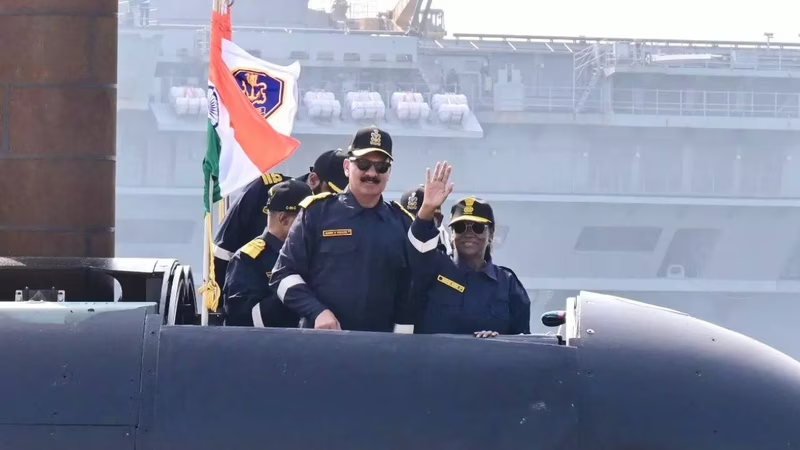
In a historic demonstration of India’s naval prowess and presidential engagement with defense forces, President Droupadi Murmu embarked on a submarine sortie aboard the **INS Vaghsheer** at the Karwar naval base on December 27, 2025. Accompanied by Chief of Naval Staff Admiral Dinesh K. Tripathi, this rare underwater journey makes her only the second President in India’s history to do so—following in the footsteps of the iconic Dr. APJ Abdul Kalam.
The sortie wasn’t just a ceremonial gesture. It was a strategic affirmation of India’s commitment to maritime security, indigenous defense manufacturing, and the modernization of its naval capabilities in the Indo-Pacific region. As China expands its submarine presence and global powers jostle for influence in the Indian Ocean, President Murmu’s presence beneath the waves sent a clear message: India is watching, ready, and capable.
Table of Contents
- What Happened During the President Murmu Submarine Sortie?
- About INS Vaghsheer: India’s Indigenous Submarine Power
- Karwar Naval Base: Project Seabird and Indo-Pacific Strategy
- Historical Context: From Kalam to Murmu
- Why Presidential Visits to Submarines Matter
- India’s Submarine Fleet: Challenges and Ambitions
- Conclusion: A Symbol of Strength and Self-Reliance
- Sources
What Happened During the President Murmu Submarine Sortie?
President Murmu arrived at the **Naval Base Karwar**—officially known as INS Kadamba—in the morning, where she was briefed on operational readiness and maritime security protocols. She then boarded the **INS Vaghsheer**, a Scorpène-class diesel-electric attack submarine, and undertook a short but symbolic submerged sortie in the Arabian Sea.
During the sortie, she observed the crew in action, interacted with officers, and was briefed on the submarine’s capabilities, including stealth operations, torpedo systems, and surveillance mechanisms. Photos released by the President’s office show her in a navy-blue flight suit, smiling confidently inside the vessel’s control room—a rare public glimpse into India’s underwater warfare domain.
About INS Vaghsheer: India’s Indigenous Submarine Power
Commissioned in January 2024, **INS Vaghsheer** is the sixth and final submarine in India’s **Kalvari-class** (Scorpène-class) series, built under Project 75 at Mazagon Dock Shipbuilders Limited (MDL) in Mumbai—with significant technology transfer from France’s Naval Group.
Key features of INS Vaghsheer:
- Displacement: 1,615 tons (surfaced), 1,775 tons (submerged)
- Length: 67.5 meters
- Speed: Over 20 knots (submerged)
- Armament: Six 533 mm torpedo tubes; can launch SM39 Exocet anti-ship missiles
- Stealth: Advanced acoustic silencing techniques for low detectability
Named after a sandfish (Vaghsheer), a deadly predator of the Indian Ocean, the submarine embodies India’s shift toward **Atmanirbhar Bharat** (self-reliance) in defense manufacturing.
Karwar Naval Base: Project Seabird and Indo-Pacific Strategy
The choice of **Karwar** for this historic sortie is deeply strategic. Located in Karnataka, INS Kadamba is India’s largest naval base on the west coast and the cornerstone of **Project Seabird**—one of Asia’s most ambitious naval infrastructure projects.
Why Karwar matters:
- Geographic Advantage: Closer to international shipping lanes than Goa or Mumbai.
- Security: Less congested than Mumbai, offering better operational secrecy.
- Expansion Capacity: Phase II will make it the Indian Navy’s premier submarine and fleet hub by 2030.
As India deepens its **Indo-Pacific partnerships** (with the US, Japan, Australia via QUAD), Karwar serves as a critical counterbalance to China’s growing presence in the Indian Ocean Region (IOR).
Historical Context: From Kalam to Murmu
President Murmu’s sortie revives a rare tradition. In 2005, **Dr. APJ Abdul Kalam**—India’s “Missile Man” and former scientist—became the first and only President to ride a submarine, boarding the **INS Sindhurakshak**.
That journey was deeply personal for Kalam, reflecting his passion for defense technology. Murmu’s sortie, two decades later, carries broader symbolism: it signals presidential endorsement of India’s naval modernization and signals unity between the highest office and the armed forces during a time of regional uncertainty.
Why Presidential Visits to Submarines Matter
Such visits are more than photo ops—they serve critical strategic purposes:
- Morale Boost: Recognizes the extreme risks submariners face (months underwater, zero margin for error).
- Policy Signaling: Highlights national priority on maritime security and blue-water navy ambitions.
- Public Awareness: Brings attention to indigenous defense projects often hidden from public view.
- Deterrence Messaging: Subtly communicates naval readiness to adversaries.
In an era where undersea warfare is gaining prominence—from Ukraine’s sea drones to China’s nuclear sub patrols—India’s leadership is wisely spotlighting this silent service.
India’s Submarine Fleet: Challenges and Ambitions
Despite milestones like INS Vaghsheer, India faces urgent challenges:
- Ageing Fleet: Over half of India’s 15 submarines are over 25 years old.
- Delays in Project 75I: Next-gen subs with air-independent propulsion (AIP) are years behind schedule.
- Strategic Gap: China operates over 60 submarines, including nuclear-powered vessels.
Yet, the government is accelerating plans: six new P-75I submarines, potential collaborations with Germany or Spain, and development of India’s own nuclear SSN program are all underway. President Murmu’s sortie underscores political will to close this gap.
Conclusion: A Symbol of Strength and Self-Reliance
The President Murmu submarine sortie is far more than a ceremonial ride—it’s a strategic statement. By choosing to sail on an indigenously built Kalvari-class submarine at India’s most advanced naval base, she has spotlighted the nation’s maritime resolve, technological progress, and unwavering commitment to defending its oceanic frontiers. As India charts its course as a leading Indo-Pacific power, moments like these remind us that true security lies not just on land or in the skies—but deep beneath the waves. For more on India’s naval modernization, explore [INTERNAL_LINK:india-naval-expansion-indo-pacific].