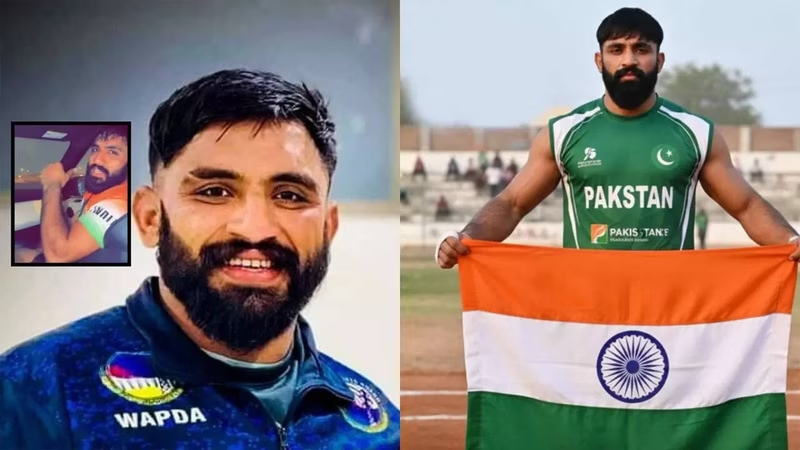
In a move that has reignited debates about sports, patriotism, and bureaucratic overreach, the Pakistan Kabaddi Federation (PKF) has handed an indefinite ban to national player Ubaidullah Rajput. The reason? He wore an Indian team jersey and waved the Indian tricolour while playing for a private Indian franchise in a tournament in Bahrain.
Rajput, a former Pakistan international, claims it was a case of miscommunication—but the PKF called it a “grave violation” of national sporting ethics and federation protocols. The incident has not only ended his career—at least temporarily—but also exposed the fragile line between professional opportunity and national loyalty in South Asian sports. This Pakistan kabaddi ban raises urgent questions: Where should sports end and politics begin?
Table of Contents
- What Happened in Bahrain?
- The Pakistan Kabaddi Ban: Official Reasons
- Ubaidullah Rajput’s Defense
- Broader Context: India-Pakistan Sports Tensions
- No-Objection Certificate: Why It Matters
- Public and Player Reactions
- Conclusion: A Cautionary Tale for Athletes
- Sources
What Happened in Bahrain?
In December 2025, a private kabaddi exhibition tournament was held in Manama, Bahrain, featuring club-style teams from India, Pakistan, and the diaspora. Ubaidullah Rajput, a well-known name in Pakistan’s kabaddi circuit, was signed by an Indian-based franchise, reportedly due to his past performance and international experience.
During one of the matches, Rajput appeared on the court wearing the team’s official jersey—blue with the Indian flag emblem—and later celebrated a win by waving India’s tricolour alongside teammates. Photos and videos of the moment went viral on social media, drawing sharp criticism in Pakistan.
The Pakistan Kabaddi Ban: Official Reasons
On December 27, 2025, the Pakistan Kabaddi Federation issued a formal statement announcing Rajput’s indefinite suspension. The ban was justified on two grounds:
- Participation without a No-Objection Certificate (NOC): The PKF requires all national-level players to obtain prior written permission before representing any foreign or private entity.
- Representing a team associated with India: The federation deemed the act of wearing an Indian jersey and waving the tricolour as “damaging to national integrity and sporting dignity.”
“No Pakistani athlete is allowed to promote or represent any symbol of a rival nation without explicit approval,” the PKF stated, adding that Rajput’s actions “undermined the ethos of national representation.”
Ubaidullah Rajput’s Defense
In a video statement posted on social media, Rajput expressed deep regret and called the incident a “misunderstanding.” He claimed the jersey was provided by the tournament organizers and that he assumed it was a generic team uniform, not an official Indian national emblem.
“I never intended to disrespect Pakistan,” Rajput said. “I was told it was a private league, and all players wore similar kits. I didn’t realize the flag was part of the design until after the match.”
He also insisted he had verbally informed local sports officials about the invitation but admitted he never filed a formal NOC request—a procedural lapse that may have sealed his fate.
Broader Context: India-Pakistan Sports Tensions
This isn’t the first time sports have become a battleground for national identity between the two nuclear neighbors. Cricket has long been the primary flashpoint, with bilateral series often canceled due to diplomatic tensions.
But kabaddi—historically a shared cultural heritage sport across Punjab—has remained one of the few arenas where cross-border interaction persisted. However, even here, nationalism is creeping in. According to a 2024 report by the South Asia Sports Council, political sensitivities are increasingly influencing athlete mobility and team affiliations in regional tournaments .
The Rajput case may set a dangerous precedent, discouraging athletes from seeking global opportunities for fear of backlash at home.
No-Objection Certificate: Why It Matters
In Pakistan’s sporting ecosystem, the NOC isn’t just paperwork—it’s a gatekeeping tool. Federations use it to control athlete movement, protect national team eligibility, and assert authority.
Key facts about the NOC system:
- Required for any participation in foreign leagues, exhibitions, or even training camps.
- Process can take weeks, often involving security clearance in “sensitive” sports like kabaddi or cricket.
- Many athletes bypass it due to lack of awareness or urgency—putting their careers at risk.
Experts argue the system needs reform. “Athletes aren’t diplomats,” says Dr. Ayesha Malik, a sports policy researcher. “They’re professionals seeking livelihoods. Over-policing their choices harms their growth.”
Public and Player Reactions
Reactions in Pakistan have been polarized. Nationalist voices on social media hailed the ban as “necessary to protect our flag,” while sports enthusiasts called it “career-ending overkill.”
Several former kabaddi players, including 2018 Asian Games medalist Nasir Ali, defended Rajput. “He made a mistake, but an indefinite ban? That kills talent and pushes players underground,” Ali said in an interview.
Meanwhile, Indian kabaddi fans expressed disappointment, noting that such incidents hinder the sport’s global unification efforts.
Conclusion: A Cautionary Tale for Athletes
The Pakistan kabaddi ban on Ubaidullah Rajput is more than a disciplinary action—it’s a stark reminder of how deeply nationalism is woven into South Asian sports. While federations have a duty to uphold protocols, blanket bans risk alienating the very talent they claim to protect. For future athletes, the lesson is clear: always secure that NOC, and never assume a jersey is just a jersey. For a deeper look at sports diplomacy in South Asia, explore our feature on [INTERNAL_LINK:india-pakistan-cricket-diplomacy-history].