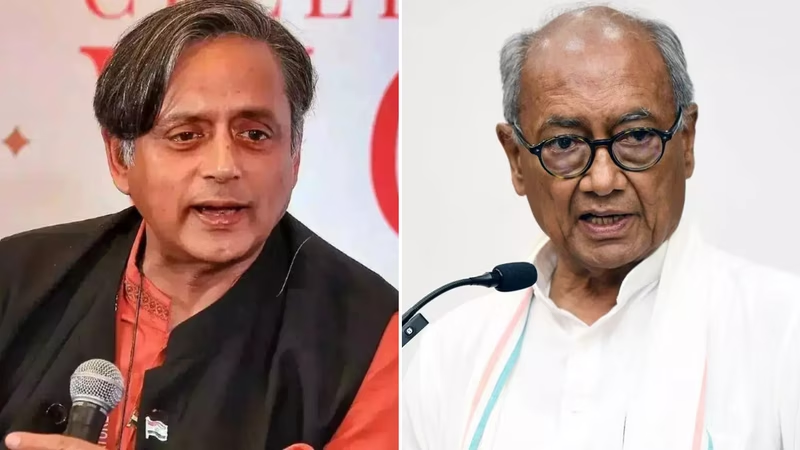
When veteran Congress leader Digvijaya Singh recently made headlines by publicly commending the Rashtriya Swayamsevak Sangh (RSS) for its “discipline,” the political world braced for backlash. But it was his own party colleague, Shashi Tharoor, who delivered the most incisive response—not with outrage, but with a single, layered sentence: “We can learn.”
Tharoor’s remark, made during a live television interview, quickly went viral, not just for its brevity but for what it represented: a textbook example of political discipline in action. In an era where impulsive tweets and heated rhetoric dominate Indian politics, Tharoor’s measured, strategic comment stood out as a masterstroke of nuance and tactical communication.
Table of Contents
- The Context Behind Tharoor’s Famous Retort
- What Is Political Discipline—and Why It Matters
- Tharoor vs. Singh: A Clash of Political Philosophies
- Why the RSS Comment Sparked Controversy
- How Tharoor’s Response Redefined Party Messaging
- Conclusion: The Enduring Power of Strategic Silence
- Sources
The Context Behind Tharoor’s Famous Retort
On December 27, 2025, senior Congress leader Digvijaya Singh appeared on a news channel and made a statement that sent shockwaves through his own party. While discussing organizational strength in Indian politics, he said the RSS “has a lot of discipline” and implied that political outfits could learn from its structure. Coming from a top Congress figure—especially one known for his sharp anti-BJP stance—the comment was seen by many as ideologically jarring.
Within hours, Shashi Tharoor was asked to respond. Instead of condemning Singh outright or defending the indefensible, Tharoor offered a calm, diplomatic reply: “If Digvijaya Singh says the RSS has discipline, well, we can learn.” The brilliance? He didn’t endorse the RSS. He didn’t attack his colleague. He simply reframed the narrative to emphasize a core value—political discipline—without compromising ideological boundaries.
What Is Political Discipline—and Why It Matters
At its core, political discipline refers to a leader’s ability to maintain strategic consistency, control messaging, and avoid impulsive actions that could damage their party’s credibility or long-term goals. It’s not about silence—it’s about choosing the right words, at the right time, for the right effect.
In India’s hyper-polarized media environment, lapses in political discipline can have outsized consequences. A single off-the-cuff remark can dominate news cycles for days, distract from policy agendas, and alienate voter bases. Tharoor’s response exemplifies how seasoned politicians can navigate landmines with grace.
Key traits of strong political discipline include:
- Message Control: Staying on-script without appearing robotic.
- Emotional Regulation: Avoiding reactive language, even under provocation.
- Strategic Ambiguity: Using language that allows for multiple interpretations while advancing a core principle.
- Loyalty Without Blindness: Defending party unity while gently correcting missteps.
Tharoor’s “we can learn” remark ticks every box—turning a potential crisis into a moment of leadership.
Tharoor vs. Singh: A Clash of Political Philosophies
While both are stalwarts of the Indian National Congress, Tharoor and Singh represent different wings of the party’s ideological spectrum. Singh, a former Madhya Pradesh Chief Minister, is known for his grassroots organizational acumen and blunt speaking style. Tharoor, a former UN diplomat and author, is celebrated for his intellectual approach and rhetorical finesse.
This incident highlights a growing tension within the Congress: between those who believe in ideological clarity and those who advocate for pragmatic borrowing from rival models. Singh’s praise of RSS discipline—however well-intentioned—risked blurring the Congress’s historical stance against the Sangh Parivar’s ideology. Tharoor’s response, by contrast, preserved ideological distance while appearing open-minded.
Why the RSS Comment Sparked Controversy
The RSS is not merely a social organization in the Indian political imagination—it’s a deeply polarizing entity. For the Congress, which has historically positioned itself as a secular bulwark against majoritarian nationalism, any positive remark about the RSS is viewed with suspicion by its core supporters.
According to a 2023 report by the Carnegie India think tank, the Congress’s identity crisis is partly rooted in its struggle to define its relationship with Hindutva-adjacent institutions . Singh’s comment, therefore, wasn’t just about “discipline”—it touched a raw nerve about the party’s foundational values.
Moreover, the timing was sensitive. With state elections looming in key regions, internal contradictions could be exploited by opposition parties to portray the Congress as ideologically confused or opportunistic.
How Tharoor’s Response Redefined Party Messaging
Rather than let Singh’s comment go unchallenged or escalate into a public feud, Tharoor used the moment to reinforce a unifying principle: that all political organizations—regardless of ideology—can benefit from operational excellence, without endorsing each other’s worldviews.
This approach aligns with what political scientists call “principled pragmatism”—maintaining core values while being open to tactical adaptation. It’s a delicate balance, but one that Tharoor has mastered over years of navigating international diplomacy and domestic politics.
Importantly, his comment also served as an implicit course-correction for his party: Yes, we value discipline—but we don’t need to admire our opponents to cultivate it.
Conclusion: The Enduring Power of Strategic Silence
Shashi Tharoor’s “we can learn” retort is more than a witty comeback—it’s a case study in political discipline. In a single sentence, he defused tension, upheld party values, and demonstrated why emotional intelligence matters as much as ideology in modern politics. As the Congress seeks to rebuild its national presence, moments like these offer a blueprint for how to engage in public discourse with both integrity and impact. For more on India’s evolving political narratives, explore our deep dive on [INTERNAL_LINK:congress-party-revival-strategy].