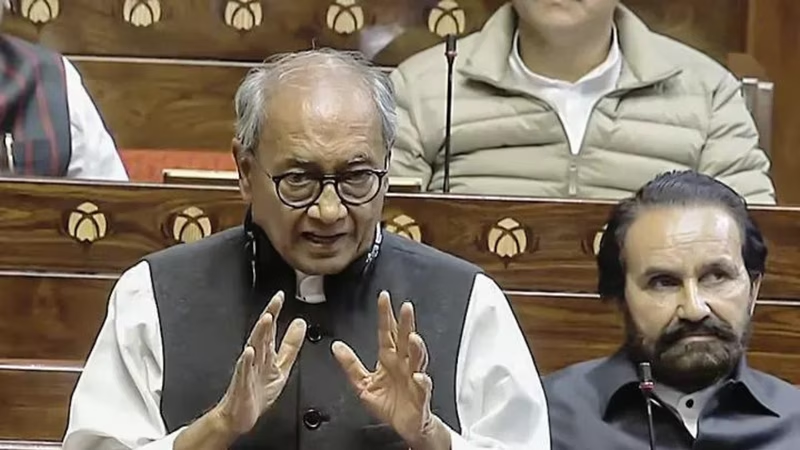
In a move that has sent shockwaves through the Grand Old Party, senior Congress leader Digvijaya Singh recently heaped praise on the Rashtriya Swayamsevak Sangh (RSS), lauding its unmatched organizational strength. This unexpected endorsement from a veteran Congress stalwart has triggered a fierce internal debate, forcing the party leadership into immediate damage control. What did Singh actually say, and how has the Congress officially responded to this Digvijaya Singh RSS praise controversy?
Table of Contents
- The Controversial Post That Started It All
- Congress’s Official Reaction: Damage Control Mode
- Digvijaya Singh’s Damage Control: “I’m a Bitter Critic”
- The Bigger Picture: What This Means for Congress
- Sources
The Controversial Post That Started It All
The political tempest began when Digvijaya Singh, a senior Rajya Sabha MP and a permanent invitee to the Congress Working Committee (CWC), shared a black-and-white photograph on social media . The image, reportedly from the 1990s, depicted a massive RSS gathering, which Singh used as a visual aid to underscore his point .
Accompanying the photo, Singh wrote a pointed message about the “power of organisation,” explicitly holding up the RSS-BJP’s structural might as a model of political discipline and reach. In a clear, though indirect, jab at his own party’s leadership, he tagged top Congress figures including President Mallikarjun Kharge, Rahul Gandhi, Jairam Ramesh, and Priyanka Gandhi . His core argument was stark: the Congress must introspect its own organizational weaknesses in the face of its rival’s formidable machinery .
Congress’s Official Reaction: Damage Control Mode
The party’s response to this public airing of its internal grievances was swift and carefully calibrated. The Congress stopped short of endorsing Singh’s views, issuing a clear statement that there was “nothing to learn” from the RSS, directly countering his central thesis .
This official stance was a clear attempt to draw a line in the sand and prevent the narrative from spiraling out of control. Other leaders rushed to present a united front. Sachin Pilot, another prominent Congress figure, publicly reiterated that while “everyone has the right to their own opinion,” the party itself remains united . This dual message—respecting internal debate while firmly rejecting the substance of the praise—was the party’s delicate balancing act.
Digvijaya Singh’s Damage Control: “I’m a Bitter Critic”
Facing intense backlash both from within his party and from the BJP, which seized on his comments as a validation of its own strength, Digvijaya Singh was forced to clarify his position. In a subsequent statement, he backtracked significantly, declaring, “I am one of the bitterest critics of RSS, Modi” .
He insisted that his original post was not a directive to the Congress leadership but merely a personal observation. He added a crucial caveat: “My post was not telling the Congress leadership anything,” attempting to frame his comments as a general commentary rather than a formal critique . This clarification, coming just before a scheduled CWC meeting on December 27, 2025, was a clear effort to defuse the situation and avoid a formal internal confrontation .
The Bigger Picture: What This Means for Congress
Beyond the immediate controversy, the Digvijaya Singh RSS praise episode exposes deep, festering wounds within the Indian National Congress. The fact that a senior leader of his stature felt compelled to publicly highlight the party’s organizational decay speaks volumes about the internal frustrations.
Here’s why this incident is significant:
- Organizational Crisis: Singh’s core point, however clumsily delivered, touches on a widely acknowledged truth: the Congress’s local and state-level organizational structure has atrophied significantly over the past decade, while the BJP-RSS network has expanded its grassroots reach .
- Leadership Disconnect: The public nature of his critique suggests a potential disconnect between the party’s old guard and its current leadership, raising questions about internal communication and strategic direction.
- Opposition’s Dilemma: The Congress is now caught between its ideological opposition to the RSS and the pragmatic reality of its rival’s operational efficiency. Ignoring the organizational gap is not a viable long-term strategy, yet openly admiring the enemy is political suicide.
For a party striving to rebuild its identity as the primary opposition force, this incident is a stark reminder of the long road ahead. The internal debate sparked by Singh is unlikely to be resolved with a single clarification; it points to a fundamental strategic question the Congress must answer: how to modernize its own “power of organisation” without compromising its core values .
In conclusion, while Digvijaya Singh may have walked back his comments, the genie is out of the bottle. The controversy has laid bare the Congress’s most critical internal challenge for all to see. The party’s response in the coming months will be a true test of its ability to reform and adapt in a rapidly changing political landscape.
Sources
- Times of India: ‘Nothing to learn’: How Cong reacted to Digvijaya Singh’s RSS praise
- Web Search Results: [[1], [2], [12], [13], [16], [17], [6], [10]]
- PRS India (for Congress party structure): https://prsindia.org/