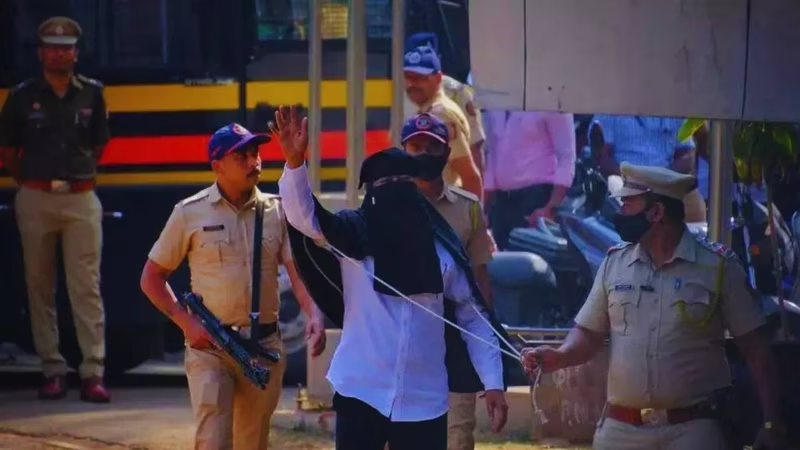
Handcuffed, faces partially covered, and flanked by armed police—this was the surreal scene outside the Pune Municipal Corporation (PMC) nomination center on December 27, 2025. Bandu Andekar, a convicted gangster currently behind bars, arrived with two relatives to file nominations for the upcoming civic elections.
But despite a special court order allowing them to leave jail for the purpose, their bid collapsed within minutes. Why? They didn’t have the required documents.
The failed attempt—widely seen as a brazen attempt to leverage political power from behind bars—ended not with paperwork, but with confusion, delays, and frustration for dozens of other candidates. It also reignited a national debate: should individuals with serious criminal charges even be allowed to contest local elections?
Table of Contents
- Who Is Bandu Andekar?
- The Dramatic PMC Nomination Attempt
- PMC Polls Nomination Rejected: Key Reasons
- Legal Loopholes and Election Rules
- Public and Political Reactions
- Broader Issue: Criminals in Indian Politics
- Conclusion: A System Under Scrutiny
- Sources
Who Is Bandu Andekar?
Bandu Andekar isn’t just any name in Pune’s underworld. He’s a convicted criminal with multiple cases—including murder, extortion, and land grabbing—to his name. He’s currently incarcerated in Yerawada Central Jail and faces trial in at least four more serious cases .
Yet, Andekar has long held sway in parts of Pune, especially in the Hadapsar and Kharadi areas, where his network allegedly controls real estate, illegal liquor trade, and local muscle politics. His family’s attempt to enter PMC polls is widely viewed as an effort to legitimize and institutionalize that influence.
The Dramatic PMC Nomination Attempt
Acting on a Pune court’s permission, Andekar and his relatives—Rajendra Andekar and Suresh Andekar—were escorted by a 10-officer police team to the PMC office. Their hands were cuffed, and they wore mufflers covering their lower faces, a common practice for high-profile undertrials to avoid media exposure.
But when they reached the nomination counter, they couldn’t produce essential documents: voter ID cards, affidavits, and proof of residence. Without these, the returning officer had no choice but to reject their filings—legally and procedurally correct, but politically explosive.
Their presence caused a 45-minute delay for other candidates, many of whom complained about the “circus-like atmosphere” and lack of dignity in the electoral process .
PMC Polls Nomination Rejected: Key Reasons
The rejection wasn’t arbitrary. According to the Election Commission of India’s guidelines for urban local body polls, every candidate must submit:
- A completed nomination form (Form 2A for PMC).
- Valid voter ID from the ward they’re contesting.
- Affidavit disclosing criminal cases, assets, and education.
- Security deposit (₹10,000 for general category).
- Photograph and signature verified in person.
While the Andekars had court orders, they reportedly lacked the basic paperwork—especially voter registration in the contested wards. As one election official noted, “Court orders don’t replace electoral law” .
Thus, the PMC polls nomination rejected not due to bias, but due to non-compliance—a technical failure with major symbolic consequences.
Legal Loopholes and Election Rules
Here’s the grim reality: Indian law does **not** bar undertrials or even convicts (unless sentenced to 2+ years) from contesting local elections. Section 8 of the Representation of the People Act (RPA) only disqualifies those **convicted and sentenced**—not those merely accused.
This loophole has allowed thousands of candidates with pending criminal cases to run for office. According to ADR (Association for Democratic Reforms), over 40% of candidates in Maharashtra’s 2022 civic polls had criminal cases .
Andekar’s case exploits this gap perfectly: run while in jail, retain influence, and—if elected—potentially use political immunity to stall trials.
Public and Political Reactions
The incident sparked swift condemnation:
- Bharatiya Janata Party (BJP): Called it a “mockery of democracy” and blamed the ruling Maha Vikas Aghadi (MVA) alliance for weak enforcement.
- Shiv Sena (UBT): Demanded immediate electoral reforms to bar undertrials from contesting.
- Civil Society Groups: Staged protests outside PMC, holding placards reading “Criminals Out, Clean Politics In.”
Ironically, none of the major parties have clean slates—many of their own candidates face serious allegations. This has led to accusations of hypocrisy across the board.
Broader Issue: Criminals in Indian Politics
Pune’s episode isn’t isolated. From Bihar to Tamil Nadu, jailed dons and accused kingpins routinely file nominations—sometimes winning seats from prison cells.
Why do parties support them? Three reasons:
- Money: They fund campaigns through illicit networks.
- Muscle: They control vote banks through fear or patronage.
- Winability: In fractured urban wards, even 5,000 votes can decide a seat.
Until India reforms its electoral laws—possibly by amending the RPA to include undertrials in disqualification clauses—cases like Andekar’s will keep repeating [INTERNAL_LINK:criminals-in-indian-elections-reform].
Conclusion: A System Under Scrutiny
The rejection of Bandu Andekar’s PMC polls nomination may seem like a small bureaucratic win—but it’s a symptom of a much larger disease. A democracy that allows accused murderers to stand for office isn’t just flawed; it’s failing its most vulnerable citizens.
The solution isn’t just better paperwork—it’s stronger laws, courageous political will, and a citizenry that refuses to normalize criminality in public life. Until then, expect more handcuffed candidates, more courtroom permissions, and more elections held in the shadow of violence.
Sources
- Times of India. (2025). “Hands tied, face covered: Why did a gangster’s Pune civic polls nomination bid fail?” https://timesofindia.indiatimes.com/…
- Indian Express. (2025). “Pune civic polls: Andekar family’s nomination drama causes chaos at PMC office.”
- Association for Democratic Reforms (ADR). (2022). “Criminal Background of Candidates in Maharashtra Civic Polls.” https://www.adrindia.org
- Election Commission of India. (2024). “Guidelines for Municipal Corporation Elections in Maharashtra.”
- Representation of the People Act, 1951 – Section 8 (Disqualifications).