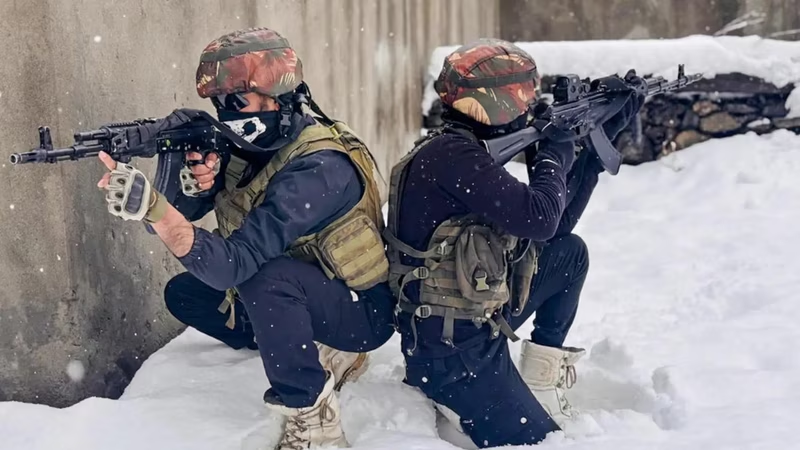
It’s -10°C. Snow blankets the rugged peaks of the Chenab Valley. Visibility is near zero. And in the silent, frozen forests of Kishtwar and Doda, an invisible war is heating up.
The Indian Army has confirmed that 30–35 Pakistan-backed terrorists are currently active in the region—many attempting to use the brutal Chillai Kalan winter as cover to regroup, resupply, or vanish into remote hideouts. But this year, security forces aren’t giving them that chance. In a bold and unprecedented move, the Army has escalated its counterterror ops in J&K—even as blizzards rage and mountain passes close.
This isn’t just routine patrolling. It’s a meticulously coordinated, all-weather campaign involving special forces, drone surveillance, intelligence fusion, and local policing—all designed to deny militants any sanctuary, even in the most inhospitable terrain.
Table of Contents
- Chillai Kalan: The Deadliest Season for Security Ops
- Why Kishtwar and Doda Are New Terror Hotspots
- Counterterror Ops in J&K: The Strategy Behind the Offensive
- How Terrorists Use Winter to Their Advantage
- Technology and Tactics in Extreme Conditions
- Civilian Impact and Local Cooperation
- Conclusion: No Season for Terror
- Sources
Chillai Kalan: The Deadliest Season for Security Ops
Chillai Kalan—the 40-day harshest winter period in Kashmir that begins around December 21—brings heavy snowfall, avalanches, and near-total isolation to high-altitude villages. Historically, militant activity dips during this time… but not because the threat disappears.
Instead, terrorists often use the cover of snow and reduced foot patrols to move undetected, establish hideouts, or receive infiltration support from across the Line of Control (LoC). For years, remote valleys like Marwah, Warwan, and parts of Doda have served as winter sanctuaries for groups like Lashkar-e-Taiba (LeT) and Jaish-e-Mohammed (JeM) .
But 2025 is different. With improved intelligence and better cold-weather gear, the Army is refusing to let winter become a tactical advantage for the enemy.
Why Kishtwar and Doda Are New Terror Hotspots
Traditionally, militancy was concentrated in the Kashmir Valley. But over the past decade, security successes there have pushed terror networks south—into the Chenab region, which includes Kishtwar, Doda, and Ramban.
This area is ideal for insurgents because:
- It borders the LoC in some sectors, enabling infiltration.
- Dense forests and glacial terrain make surveillance difficult.
- Sparsely populated villages offer anonymity.
- Historically, fewer Army posts compared to Srinagar or Baramulla .
Recent intelligence suggests that several “foreign terrorists”—a euphemism for Pakistani or Afghan nationals—have entered the region via forest routes, aiming to launch fidayeen (suicide) attacks or recruit locals.
Counterterror Ops in J&K: The Strategy Behind the Offensive
The current counterterror ops in J&K are not reactive—they’re proactive and integrated. According to Army sources, the operation involves:
- Multi-Agency Fusion: Real-time coordination between the Army, J&K Police, Intelligence Bureau (IB), and Sashastra Seema Bal (SSB).
- Dominance Patrols: Small, mobile units operating 24/7, even in snowstorms, to deny safe movement.
- Drone Surveillance: Night-vision and thermal drones track heat signatures in zero-visibility conditions.
- Community Intelligence: Local informants and village defense committees provide ground truth .
“We’re not waiting for them to strike. We’re hunting them in their caves, their bunkers, their supply trails,” said a senior officer speaking on condition of anonymity .
How Terrorists Use Winter to Their Advantage
Winter isn’t just cover—it’s a strategic tool for militants:
- Reduced Mobility of Security Forces: Heavy snow slows down convoys and foot patrols.
- Broken Communication Lines: Landslides and snow often knock out mobile towers.
- Psychological Edge: They assume soldiers won’t operate in extreme cold.
But with modern cold-weather combat gear, satellite communication, and high-altitude training, Indian forces are turning the tables. The Army’s High Altitude Warfare School (HAWS) in Gulmarg has trained thousands of troops specifically for these conditions [INTERNAL_LINK:indian-army-high-altitude-warfare].
Technology and Tactics in Extreme Conditions
Gone are the days of blind searches. Today’s operations rely on cutting-edge tools:
- AI-Powered Drone Swarms: Scan 50 sq km in under an hour, flagging anomalies.
- Ground Penetrating Radar: Detects underground bunkers beneath snow.
- Biometric Databases: Instant ID verification at checkpoints using facial recognition .
These technologies, combined with human intelligence, have led to a sharp rise in pre-emptive neutralizations—well before attacks can be planned.
Civilian Impact and Local Cooperation
While security is paramount, the Army is also mindful of civilian hardship. Winter operations include:
- Medical camps in cut-off villages.
- Food and fuel drops via helicopters.
- Strict protocols to avoid civilian casualties during raids.
Local support is crucial. In Doda, for instance, youth have formed volunteer groups to report suspicious movements—a sign that trust in security forces is growing .
Conclusion: No Season for Terror
The message from the Indian Army is clear: there is no off-season for terrorism—and no sanctuary, not even in the frozen heart of Chillai Kalan. By intensifying its counterterror ops in J&K during the harshest weather, the military is sending a powerful signal to both terrorists and citizens: security is non-negotiable, regardless of the thermometer.
As one soldier put it, “If they can hide in the snow, we can hunt in it.” And in the mountains of Kishtwar and Doda, that hunt is on—with zero tolerance for pause.
Sources
- Times of India. (2025). “30–35 terrorists on radar: Army steps up counterterror ops in J&K amid Chillai Kalan.” https://timesofindia.indiatimes.com/…
- The Hindu. (2025). “Chenab Valley emerges as new frontier in J&K militancy.”
- South Asia Terrorism Portal (SATP). “Terrorist Movement Patterns in Jammu Division, 2024–2025.” https://www.satp.org/
- Ministry of Defence, India. (2024). “Indigenisation of Surveillance Tech in Counter-Insurgency Ops.”