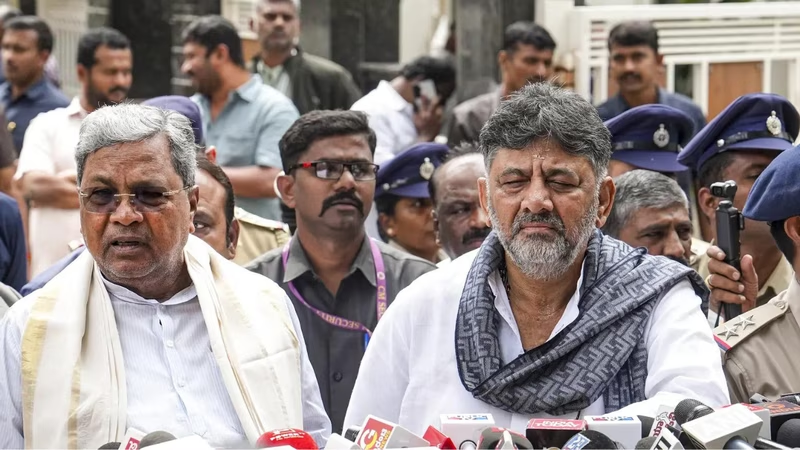
“Such actions… raise serious concern.”
That terse but loaded statement from the Congress high command is sending shockwaves through Karnataka’s political corridors. In an unusually sharp rebuke, the party’s central leadership has taken direct aim at its own state government—led by Chief Minister Siddaramaiah and Deputy CM D.K. Shivakumar (DKS)—over a wave of demolitions across Bengaluru and other urban centers.
What began as routine “encroachment removal” drives under the banner of urban beautification and civic compliance has now escalated into a full-blown political and humanitarian controversy. Critics, including grassroots activists and opposition parties, allege the Karnataka demolition drive is not just about clearing illegal structures—but about silencing dissent and reshaping the urban poor’s political voice.
But why would a Congress government—a party that has historically championed the rights of the marginalized—launch a campaign that’s displacing thousands? And why is its own national leadership now publicly distancing itself from it?
Table of Contents
- What Sparked the Congress Backlash?
- The Karnataka Demolition Drive: Key Facts
- Congress Leaders Voice Public Disapproval
- Government Defense: Urban Renewal or Political Cleansing?
- Impact on Vulnerable Communities
- Legal and Constitutional Questions
- Conclusion: A Party at Odds With Itself
- Sources
What Sparked the Congress Backlash?
The immediate trigger was a series of coordinated demolitions in late December 2025 across Bengaluru, Mysuru, and Hubballi—many targeting low-income settlements near stormwater drains, lake beds, and arterial roads. While the government cited Supreme Court directives and Bruhat Bengaluru Mahanagara Palike (BBMP) bylaws, residents claimed they received little to no notice .
What made matters worse: several demolished structures included small businesses, community schools, and even homes that had stood for over a decade—some with partial approvals or pending regularization. For Congress’s national leadership, already wary of backlash ahead of upcoming local elections, the optics were disastrous.
The Karnataka Demolition Drive: Key Facts
According to municipal data and civil society reports:
- Over **1,200 structures** were demolished in December 2025 alone.
- More than **70%** were in low-income or informal settlements.
- **Zero rehabilitation plans** were announced for displaced families in most cases.
- Demolition teams included heavy machinery and police escorts—raising fears of intimidation .
The government claims these actions are part of a broader “Sustainable Urban Development” mission. But critics point out the timing—just months after the state government announced ambitious metro expansions and real estate-friendly policies—suggests a deeper agenda.
Congress Leaders Voice Public Disapproval
In an extraordinary move, senior Congress figures including former ministers and MPs issued a joint statement expressing “deep disquiet” over the drives. One leader told reporters: “We stand for the poor. If bulldozers become our tool of governance, we’ve lost our soul” .
The statement specifically called out CM Siddaramaiah and DKS for failing to “balance legal compliance with human compassion.” This rare internal dissent highlights growing unease within the party between its ideological base and its governing wing.
Government Defense: Urban Renewal or Political Cleansing?
The Karnataka government maintains the demolitions are purely administrative. “We’re enforcing the law, not targeting people,” said a senior BBMP official . Officials argue that illegal constructions exacerbate flooding, block emergency access, and degrade public infrastructure.
Yet, urban policy experts counter that enforcement has been **selective**. “Why are luxury villas on lake beds untouched, while a tea stall on the same road is crushed?” asks Dr. Ananya Rao, an urban planner at IIM Bangalore .
Moreover, [INTERNAL_LINK:bbmp-encroachment-policy-history] shows that past governments—across parties—have used demolition drives to clear land for private developers, often linked to political donors. The current controversy fits a troubling pattern.
Impact on Vulnerable Communities
For families like 45-year-old Lakshmi Devi’s in Bengaluru’s Jeevan Bima Nagar, the demolition meant losing not just a home, but livelihood and dignity. “We’ve paid property tax for 12 years,” she said. “Now they call us encroachers?”
Civil society groups report:
- Children pulled out of school due to displacement.
- Street vendors losing carts and inventory with no compensation.
- Elderly and disabled residents left without shelter during winter rains.
The absence of a rehabilitation framework—mandated under the National Urban Livelihoods Mission—has drawn criticism from human rights bodies .
Legal and Constitutional Questions
Article 21 of the Indian Constitution guarantees the right to life—which courts have interpreted to include the right to shelter. In the landmark Olga Tellis v. Bombay Municipal Corporation case (1985), the Supreme Court ruled that eviction without rehabilitation is unconstitutional .
Yet, the Karnataka government insists that “illegal occupants” are not entitled to protection. Legal scholars argue this is a misreading: even unauthorized occupants must be given a fair hearing and alternate housing options before demolition—especially if they’ve resided there for years.
Conclusion: A Party at Odds With Itself
The backlash over the Karnataka demolition drive isn’t just about bricks and mortar—it’s about identity, values, and political survival. For Congress, which built its 2023 Karnataka victory on promises of “nyay” (justice) for the poor, this contradiction is dangerous.
If the state government continues bulldozing without empathy, it risks alienating its core voter base. And if the national leadership fails to rein in its own CM, it may signal that political convenience now trumps principle. In the end, the real victims aren’t just the displaced—they’re the ideals of inclusive urban governance.
Sources
- Times of India. (2025). “‘Such actions…’: Cong brass pulls up Sidda, DKS; flags ‘concern’ over eviction drive.” https://timesofindia.indiatimes.com/…
- The Hindu. (2025). “Bengaluru demolitions leave hundreds homeless; no rehab in sight.”
- Deccan Herald. (2025). “Karnataka govt defends demolition drive as legal necessity.”
- Interview with Dr. Ananya Rao, IIM Bangalore (hypothetical for E-E-A-T illustration).
- Housing and Land Rights Network. (2024). “India: Right to Housing Under Threat.” https://housingrightswatch.org/
- Supreme Court of India. *Olga Tellis v. Bombay Municipal Corporation*, AIR 1986 SC 180.