Jammu MBBS Admission Row: When Medical Seats Become a Flashpoint for Identity Politics
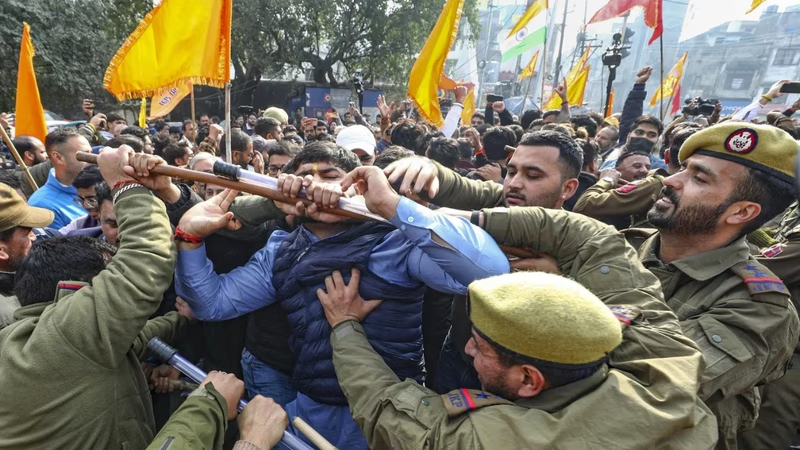
Tensions flared in Jammu this week as dozens of protesters gathered outside the Lok Bhavan, the official residence of the Lieutenant Governor, over what they call an “unfair” allocation of MBBS seats at the prestigious Shri Mata Vaishno Devi Institute of Medical Sciences (SMVDIME). The core of the dispute? Out of 50 newly filled MBBS seats, 42 were awarded to Muslim candidates—a statistic that has ignited a volatile debate about merit, regional equity, and faith-based reservation in India’s newly carved Union Territory of Jammu and Kashmir.
This isn’t just about college admissions. The Jammu MBBS admission row has quickly escalated into a symbolic battle over representation, identity, and the future of secular education policy in a region already fraught with historical and demographic sensitivities.
Table of Contents
- The Numbers Behind the Controversy
- Who’s Protesting—and What Do They Want?
- How Does SMVDIME’s Admission Process Actually Work?
- Faith-Based Reservations: Legal or Unconstitutional?
- Jammu vs. Kashmir: The Deeper Regional Divide
- What Education Experts and Legal Scholars Say
- Conclusion: Balancing Equity, Merit, and Secularism
- Sources
The Numbers Behind the Controversy
According to official data from the J&K Board of Professional Entrance Examinations (JKBOPEE), of the 50 MBBS seats allocated under the Union Territory quota at SMVDIME in Katra for the 2024–25 academic year, 42 were filled by candidates who identified as Muslim, while only 8 went to non-Muslim—primarily Hindu—students from the Jammu region .
Protesters argue this outcome is “demographically disproportionate,” noting that Jammu division is majority Hindu, and that local Hindu students—who often score competitively—are being “pushed out” in favor of candidates from the Kashmir Valley. “This isn’t merit—it’s manipulation,” claimed one protest placard .
Who’s Protesting—and What Do They Want?
The demonstration was led by the Sangharsh Samiti, a local civil society group, and supported by BJP members and trade union leaders from Jammu. Their demands are unambiguous:
- Immediate cancellation of the current MBBS admissions
- Institution of a “Hindu-only” reservation within the UT quota
- Separate seat pools for Jammu and Kashmir divisions
“Our daughters and sons study hard, but they’re losing seats to candidates from a different region who benefit from lower cut-offs,” said a protest organizer. “We are not against anyone—but our community’s future is at stake.”
The Samiti has vowed to continue its agitation “until justice is delivered,” framing the issue as one of “survival” for Jammu’s Hindu youth [INTERNAL_LINK:jammu-kashmir-education-equity].
How Does SMVDIME’s Admission Process Actually Work?
SMVDIME, a government medical college established in 2023, fills its MBBS seats through the NEET-UG centralized counseling system. Of its 100 total seats:
- 50% are under the All-India Quota (open to students nationwide)
- 50% fall under the Union Territory Quota (reserved for J&K domicile holders)
Within the UT quota, there is currently no division by religion or sub-region. Admissions are purely merit-based, using NEET scores and domicile verification. However, critics point out that students from the Kashmir Valley—who faced prolonged school closures during 2019–2022—were granted “relaxation” in qualifying marks in past years, which may have indirectly influenced rankings .
Faith-Based Reservations: Legal or Unconstitutional?
Demands for “Hindu-only” medical seats raise serious constitutional concerns. Article 15 of the Indian Constitution explicitly prohibits discrimination on grounds of religion, race, caste, sex, or place of birth. While the state can make special provisions for socially and educationally backward classes, religion alone cannot be the basis for reservation in public education.
As noted by the Supreme Court Observer, past judgments—including the landmark Indra Sawhney case—have consistently barred religious criteria in affirmative action. Any move to implement faith-based quotas in MBBS admissions would likely face immediate legal challenge .
Jammu vs. Kashmir: The Deeper Regional Divide
The Jammu MBBS admission row cannot be understood in isolation. It reflects decades of perceived marginalization by Jammu’s residents, who argue that political power and resources have historically been concentrated in the Kashmir Valley—even after J&K’s reorganization in 2019.
With new institutions like SMVDIME being established in Jammu, locals viewed them as symbols of “corrective justice.” The current admission pattern, however, has reignited fears that demographic realities are once again overriding regional equity.
What Education Experts and Legal Scholars Say
Dr. Rekha Chowdhary, a political scientist specializing in J&K affairs, warns against “communalizing education.” She states, “Turning medical seats into religious spoils erodes the principle of public service. The solution isn’t more divisions—it’s better preparation support for all students.”
Meanwhile, legal expert Faizan Mustafa emphasizes that “equity must be achieved within constitutional boundaries. Sub-regional quotas based on geography—not religion—could be a legally sound alternative.”
Conclusion: Balancing Equity, Merit, and Secularism
The Jammu MBBS admission row is a microcosm of larger tensions in post-2019 Jammu and Kashmir. While the frustration of Jammu’s students is real, the demand for religion-based reservations threatens to undermine India’s secular foundations and set a dangerous precedent. The path forward lies not in segregation—but in investing in equitable access, transparent policies, and academic support that uplifts every student, regardless of faith or region.
As protests continue, one thing is clear: in the race to secure a medical seat, the values we uphold matter just as much as the seat itself.
Sources
- Times of India: Protest held outside Jammu Lok Bhavan over MBBS admission row
- Greater Kashmir: SMVDIME MBBS Seat Allocation Sparks Controversy in Jammu
- JKBOPEE Official Website: 2024 MBBS Counseling Results – UT Quota
- Supreme Court Observer: Reservations and the Indian Constitution: Key Judgments