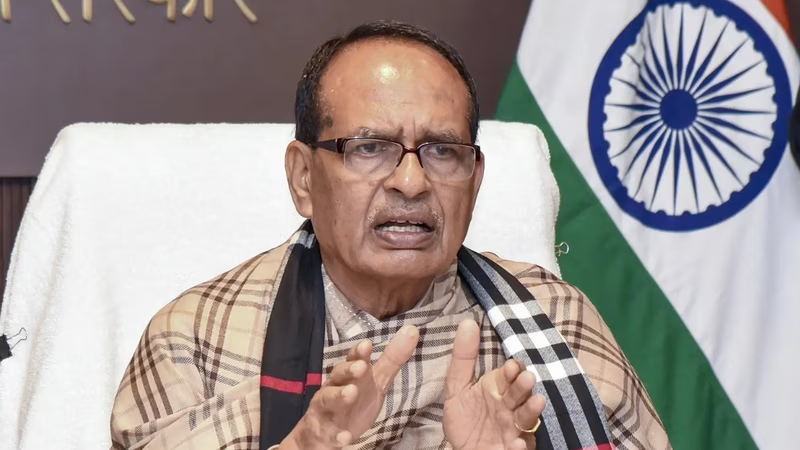
In a sharp rebuttal to opposition claims that the government’s new rural employment initiative betrays Mahatma Gandhi’s legacy, Union Rural Development Minister Shivraj Singh Chauhan has declared that the VB-G RAM G Act is, in fact, its purest modern expression.
Speaking amid growing political controversy, Chauhan accused the Congress of “spreading misinformation” about the scheme while conveniently ignoring its own record—citing how the party, during its tenure, not only slashed MGNREGA allocations but also froze wage rates for years, leaving millions of rural workers in limbo .
“They talk about Bapu’s ideals, but when they were in power, they neglected the very workers Gandhi ji fought for,” Chauhan stated. “Our VB-G RAM G Act ensures actual, visible outcomes—clean water, durable roads, functional drains—not just attendance sheets and delayed payments.”
This defense isn’t just political posturing—it’s a direct challenge to the narrative that the Modi government is dismantling Gandhian welfare. Instead, Chauhan frames the new law as an evolution: one that marries Gandhi’s vision of self-reliant villages with 21st-century governance tools like digital monitoring, real-time audits, and outcome-based funding.
Table of Contents
- What Is the VB-G RAM G Act?
- Shivraj Chauhan’s Defense: Gandhian Spirit Redefined
- Congress Criticism and the MGNREGA Record
- Key Features: Transparency and Tangible Assets
- Bapu’s Ideals: What Did Gandhi Really Say About Rural India?
- Political Battle Over Gandhi’s Legacy
- Conclusion: Is VB-G RAM G a New Chapter in Rural Welfare?
- Sources
What Is the VB-G RAM G Act?
The VB-G RAM G Act—officially the “Viksit Bharat – Gramin Aajeevika Mission G” (G for Gandhi)—is the Modi government’s revamped framework for rural employment and infrastructure development. While it builds on the foundation of MGNREGA, it introduces critical upgrades:
- Asset-Centric Focus: Prioritizes creation of durable community assets (e.g., rainwater harvesting, rural roads, sanitation units) over mere wage employment.
- Digital Monitoring: Uses geo-tagged photos, satellite verification, and a centralized dashboard to track progress and prevent fund leakage.
- Timely Wage Disbursement: Links payments directly to verified work completion via DBT (Direct Benefit Transfer), reducing delays .
Importantly, the “G” in the title is a deliberate homage to Mahatma Gandhi—signaling continuity, not rupture, with his vision.
Shivraj Chauhan’s Defense: Gandhian Spirit Redefined
Chauhan’s core argument hinges on a reinterpretation of Gandhian philosophy. “Bapu didn’t just want people to dig ditches,” he emphasized. “He wanted villages to be self-sustaining, clean, and empowered.”
He pointed to Gandhi’s concept of “Gram Swaraj” (village self-rule), which envisioned rural communities managing their own resources, education, and economy. The VB-G RAM G Act, according to Chauhan, operationalizes this by ensuring that every rupee spent creates a visible, long-term asset that benefits the entire village—not just the worker who built it.
“MGNREGA became a dole,” Chauhan alleged. “VB-G RAM G is a development mission.”
Congress Criticism and the MGNREGA Record
The Congress has accused the government of “erasing Gandhi’s name” from rural schemes and undermining the right-to-work guarantee. But Chauhan fired back with data:
- During UPA-II (2009–2014), MGNREGA wage rates were frozen despite inflation, effectively cutting real wages by over 18% .
- The scheme’s budget was slashed from ₹40,100 crore in 2010–11 to ₹33,000 crore by 2013–14 .
- Payment delays averaged 45–60 days, with nearly 30% of workers receiving wages beyond the statutory 15-day limit .
“Now they pose as defenders of the poor,” Chauhan remarked, “but when they had the power, they abandoned them.”
Key Features: Transparency and Tangible Assets
Beyond rhetoric, the VB-G RAM G Act introduces structural reforms aimed at fixing systemic flaws:
- Outcome-Based Funding: 70% of funds released only after asset verification.
- Community Ownership: Gram Sabhas must approve all works and monitor quality.
- Integration with Other Schemes: Links with Swachh Bharat, Jal Jeevan Mission, and PM Awas Yojana to avoid duplication .
This integrated approach reflects a shift from “employment as relief” to “employment as investment”—a distinction Chauhan says is deeply Gandhian.
Bapu’s Ideals: What Did Gandhi Really Say About Rural India?
Gandhi’s writings consistently emphasized rural reconstruction as the key to India’s freedom and prosperity. In Hind Swaraj, he wrote: “The future depends on what you do today in your village.” He championed local production, sanitation, education, and self-governance—not dependency on state handouts.
As noted by the Gandhi Ashram Sevagram, Gandhi’s model was about dignity through productive labor, not passive welfare . This philosophical alignment is what Chauhan insists the VB-G RAM G Act embodies.
Political Battle Over Gandhi’s Legacy
This debate is part of a larger tug-of-war over who “owns” Gandhi’s legacy. The Congress, as the party Gandhi was associated with, has long claimed moral authority over his ideals. But the BJP has increasingly positioned itself as the true executor of Gandhian economics—through schemes like Swachh Bharat and now VB-G RAM G.
Chauhan’s remarks are a direct challenge to that historical claim. By accusing the Congress of hypocrisy and presenting VB-G RAM G as the authentic Gandhian path, the BJP is attempting to flip the script ahead of crucial state elections in rural heartlands.
Conclusion: Is VB-G RAM G a New Chapter in Rural Welfare?
Whether the VB-G RAM G Act truly honors Bapu’s vision will ultimately be judged not by speeches, but by results on the ground. If it delivers timely wages, durable assets, and empowered villages, it could redefine rural development in India. If it becomes another bureaucratic exercise, it will fuel further criticism.
But one thing is clear: Shivraj Chauhan has drawn a line in the sand. He’s not just defending a policy—he’s reclaiming Gandhi for a new era of accountable, outcome-driven governance. And in doing so, he’s turned a technical rural scheme into a high-stakes ideological battle.
Sources
- Times of India. “G RAM G’s core spirit rooted in Bapu’s ideals, says Shivraj.” https://timesofindia.indiatimes.com/…
- Ministry of Rural Development, Government of India. “VB-G RAM G Mission Guidelines.”
- PRS Legislative Research. “MGNREGA Budget and Wage Trends (2006–2014).” [[3], [4]]
- World Bank Report on MGNREGA Implementation (2015).
- Gandhi Ashram Sevagram. “Gandhi’s Vision of Gram Swaraj.” https://www.gandhiashramsevagram.org/