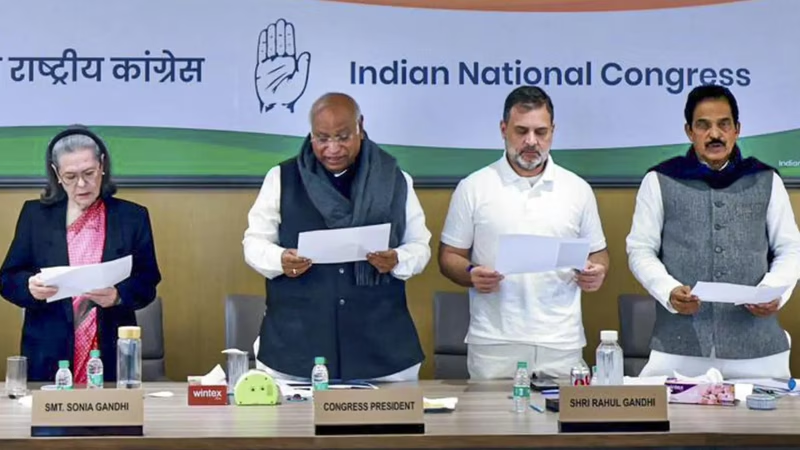
In a quiet but significant moment during a recent Congress Working Committee (CWC) meeting, the party almost crossed a diplomatic red line—only to pull back just in time, thanks to a timely intervention by Shashi Tharoor.
The flashpoint? A proposed resolution on the ongoing political unrest in Bangladesh. An initial draft placed direct blame on the Indian government for the deteriorating situation across the border—a move that risked both factual inaccuracy and international embarrassment. But Tharoor, the party’s most prominent voice on foreign affairs and a former UN diplomat, pushed back hard, arguing that such language was not only misleading but strategically unwise .
The result? The controversial line was dropped. The final resolution instead shifted focus to a critique of India’s perceived diplomatic passivity—accusing the government of a “failure to engage” rather than causing the crisis itself. This seemingly small edit speaks volumes about the tensions within the Congress on how to handle sensitive geopolitical issues and the delicate balance between domestic criticism and international responsibility.
Table of Contents
- Congress Bangladesh Resolution: Initial Draft Causes Furor
- Shashi Tharoor’s Objection: A Call for Diplomatic Precision
- Why Blaming India for Bangladesh Unrest Is Problematic
- The Revised Resolution: What It Actually Says
- Internal Dynamics: Who Wanted to Blame Delhi?
- Broader Implications for Indian Foreign Policy Discourse
- Conclusion: A Fine Line Between Critique and Responsibility
- Sources
Congress Bangladesh Resolution: Initial Draft Causes Furor
The original draft resolution, circulated among CWC members ahead of the meeting, contained a direct accusation: that the Indian government bore responsibility for the political instability unfolding in Bangladesh. The language was blunt and unambiguous, suggesting New Delhi’s actions—or inactions—had directly fueled unrest in its eastern neighbor .
Given Bangladesh’s complex internal dynamics—including student protests, opposition crackdowns, and economic distress—such a claim was not only factually tenuous but also diplomatically reckless. It risked undermining India’s long-standing position of non-interference in the internal affairs of sovereign states, a cornerstone of its foreign policy since Nehru.
Shashi Tharoor’s Objection: A Call for Diplomatic Precision
Enter Shashi Tharoor. Drawing on decades of experience in international diplomacy—including as Under-Secretary-General at the United Nations—Tharoor reportedly raised strong objections during the CWC discussion. His argument was clear: while the Modi government could be criticized for a lack of proactive diplomacy or strategic engagement, it could not—and should not—be accused of causing civil unrest in another country.
“We can say the government failed to anticipate or respond effectively,” Tharoor is said to have argued, “but we cannot say it created the crisis. That crosses a line of credibility and responsibility.”
His intervention wasn’t just about semantics—it was about maintaining the Congress’s credibility on foreign policy. In an era where every statement is amplified globally, careless language can have real-world consequences.
Why Blaming India for Bangladesh Unrest Is Problematic
Attributing domestic turmoil in Bangladesh to Indian policy is not only inaccurate but also plays into dangerous geopolitical narratives. Consider these facts:
- Bangladesh’s current unrest stems primarily from internal political rivalries between the ruling Awami League and the opposition BNP, not external interference .
- India has consistently supported Bangladesh’s democratic institutions and economic development—evidenced by over $10 billion in credit lines and infrastructure partnerships .
- Accusing India of fomenting unrest mirrors propaganda used by hostile actors like China and Pakistan to drive a wedge between the two nations .
As noted by the Council on Foreign Relations, India-Bangladesh relations are among the most stable and productive in South Asia—precisely because both sides avoid blaming each other for internal challenges .
The Revised Resolution: What It Actually Says
After Tharoor’s pushback, the CWC adopted a more nuanced and responsible version. The final resolution removed any suggestion of India causing the unrest. Instead, it stated:
“The Government of India has failed in its diplomatic duty to proactively engage with all stakeholders in Bangladesh during this period of political uncertainty, thereby missing an opportunity to uphold regional stability.”
This reframing shifts the critique from causation to omission—a far more defensible and diplomatically sound position. It aligns with how opposition parties in mature democracies typically hold governments accountable on foreign policy: not by inventing conspiracies, but by demanding strategic foresight and engagement.
Internal Dynamics: Who Wanted to Blame Delhi?
The initial draft likely came from factions within the Congress eager to score quick political points against the Modi government. In today’s hyper-polarized climate, some believe that any criticism—however exaggerated—is justified if it damages the ruling party.
But Tharoor’s stance reflects a more institutionalist wing of the party—one that values long-term credibility over short-term headlines. This tension between populist messaging and principled diplomacy is a recurring theme in modern Indian politics, and the Bangladesh resolution episode is a textbook case.
Broader Implications for Indian Foreign Policy Discourse
This incident highlights a critical gap in India’s political discourse: the lack of foreign policy literacy among many lawmakers. As India’s global footprint expands, parties must move beyond knee-jerk reactions and develop coherent, fact-based positions on international issues.
The Congress, as the principal opposition, has a special responsibility here. Its statements are scrutinized not just domestically but by foreign governments, investors, and international media. [INTERNAL_LINK:indian-opposition-foreign-policy-challenges] must evolve to meet the demands of a multipolar world.
Conclusion: A Fine Line Between Critique and Responsibility
The Congress’s decision to drop the inflammatory line from its Congress Bangladesh resolution was a small victory for diplomatic sense over political opportunism. Thanks to Shashi Tharoor’s intervention, the party avoided a self-inflicted wound that could have damaged its reputation both at home and abroad.
Going forward, this episode should serve as a template: opposition parties can—and should—hold the government accountable on foreign policy. But they must do so with precision, evidence, and respect for the complex realities of international relations. In geopolitics, words carry weight. And sometimes, the most powerful thing a party can do is choose them wisely.
Sources
- Times of India. “CWC retracts Bangladesh unrest blame on government.” https://timesofindia.indiatimes.com/…
- Al Jazeera. “Bangladesh protests: What’s behind the student-led unrest?”
- Ministry of External Affairs, Government of India. “India-Bangladesh Development Partnership.”
- Strategic Studies Institute. “Geopolitical Rivalries in the Bay of Bengal.”
- Council on Foreign Relations (CFR). “India-Bangladesh Relations: A Model for South Asia?” https://www.cfr.org/