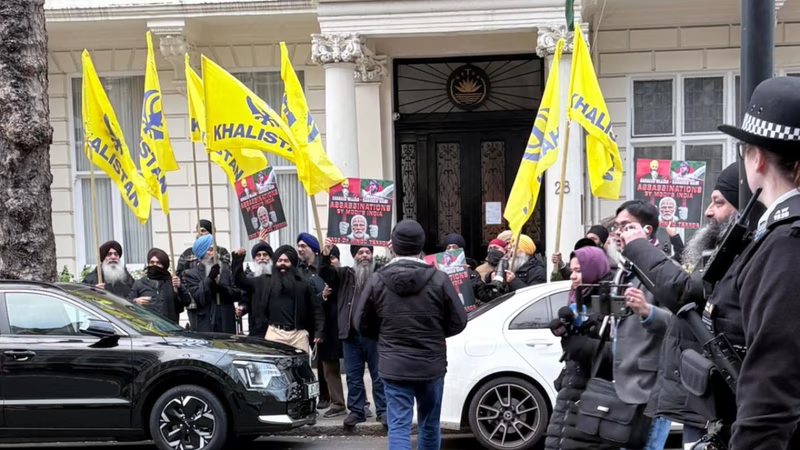
Tensions spilled onto the streets of London this week as a solemn Hindu demonstration over rising religious persecution in Bangladesh was abruptly disrupted by a group of Khalistanis. The incident, which unfolded outside the Bangladesh High Commission, has reignited debates about diaspora activism, freedom of expression, and the growing politicization of human rights protests in Western capitals.
Organized by members of the UK Hindu community, the peaceful rally drew more than 500 participants demanding justice for Dipu Das—a Hindu man recently lynched in Bangladesh amid escalating violence against religious minorities. But what began as a dignified call for international attention quickly turned confrontational when Khalistani demonstrators arrived, waving separatist flags and chanting anti-India and anti-Hindu slogans.
Table of Contents
- The Hindu Protest for Justice
- Khalistani Counter-Protest Escalates Tensions
- Who Was Dipu Das—and Why It Matters
- Police Intervention and Public Reaction
- Broader Implications for Diaspora Politics
- Conclusion
- Sources
The Hindu Protest for Justice
The Hindu community in the UK has long been vocal about the deteriorating situation for religious minorities in Bangladesh. The protest on December 22, 2025, was organized in direct response to the brutal lynching of Dipu Das in Cumilla, where he was attacked by a mob over allegations of blasphemy—a recurring and often deadly accusation used against Hindus and other non-Muslims.
Protesters held placards reading “Justice for Dipu Das,” “Protect Hindus in Bangladesh,” and “Stop Religious Persecution.” Many wore white in mourning and chanted prayers for peace and safety for their co-religionists back home.
Organizers emphasized the historical context: Hindus once constituted nearly 22% of Bangladesh’s population at independence in 1971. Today, that figure has dwindled to under 8%, with reports from human rights groups like Human Rights Watch documenting decades of land grabbing, forced conversions, and targeted violence.
Khalistani Counter-Protest Escalates Tensions
Just as the Hindu gathering reached its peak, a group of approximately 50–75 individuals—identified by witnesses and media as Khalistanis—arrived on the scene. They carried Khalistani flags, shouted slogans like “Khalistan Zindabad” and “Down with India,” and directed verbal abuse toward the Hindu demonstrators.
According to现场 (on-site) reports, some counter-protesters accused the Hindu group of being “agents of the Indian state” and attempted to link their cause to broader anti-Sikh narratives—a claim widely seen as a non sequitur given the protest’s exclusive focus on Bangladesh.
This tactic of hijacking minority rights protests to advance separatist agendas has raised alarms among UK-based civil society groups. “It’s deeply troubling when a legitimate human rights plea is weaponized for unrelated political propaganda,” said a spokesperson for the British Hindu Forum. “Dipu Das had nothing to do with Punjab or Indian domestic politics. This was about saving lives in Bangladesh.”
Who Was Dipu Das—and Why It Matters
Dipu Das, a 32-year-old Hindu shopkeeper from Cumilla, was accused of sharing a “blasphemous” image on social media—an allegation he denied. Before police could verify the claim, a mob stormed his home, dragged him into the street, and beat him to death. His body was later found with severe injuries, sparking nationwide outrage.
His case is not isolated. In 2024 and 2025 alone, at least 12 similar lynchings have been reported across Bangladesh, according to the Bangladesh Hindu Buddhist Christian Unity Council (BHBCUC). Temples have been vandalized, homes torched, and families forced to flee during festivals like Durga Puja.
The London protest sought to pressure the UK government to raise these issues diplomatically and to urge the Bangladesh High Commission to ensure protection for all citizens, regardless of faith.
Police Intervention and Public Reaction
Metropolitan Police were called to the scene after tensions flared between the two groups. Officers formed a human barrier to separate the demonstrators and monitored the situation closely to prevent physical altercations. No arrests were reported, but police confirmed they were reviewing video footage for potential hate speech violations.
Reactions on social media were swift. Many condemned the Khalistani group for derailing a humanitarian cause. “Why are Khalistani extremists inserting themselves into a Bangladesh issue?” tweeted a UK-based journalist. “This isn’t solidarity—it’s opportunism.”
Others expressed concern over the normalization of anti-Hindu rhetoric under the guise of “anti-India” sentiment. [INTERNAL_LINK:rise-of-anti-hindu-rhetoric-in-western-diaspora] highlights a growing trend where Hindu identity is conflated with the Indian state, making legitimate concerns about persecution easy to dismiss.
Broader Implications for Diaspora Politics
This incident underscores a critical challenge in diaspora activism: the fragmentation of minority voices. While both groups—Hindus and Sikhs—have faced historical trauma, their current geopolitical concerns are distinct.
Hindus in Bangladesh are fighting for basic survival and legal protection in a Muslim-majority nation. Khalistani activists, meanwhile, focus on historical grievances related to 1984 and seek symbolic recognition for a separatist cause that has little traction in India today.
Conflating these issues not only dilutes the urgency of each cause but also risks alienating potential allies. As one interfaith leader noted, “Solidarity must be based on mutual respect, not opportunistic co-optation.”
Conclusion
The disruption of the Hindu protest in London by Khalistanis is more than just a local clash—it’s a symptom of deeper fractures in how diaspora communities engage with global human rights issues. While freedom of protest is sacred, its power is diminished when unrelated agendas overshadow the original cause. The lynching of Dipu Das and the ongoing persecution of minorities in Bangladesh demand focused, compassionate attention—not political theater. As the UK Hindu community continues to advocate for justice, their message must not be drowned out by those whose grievances, however valid in their own context, belong to a different chapter of history.