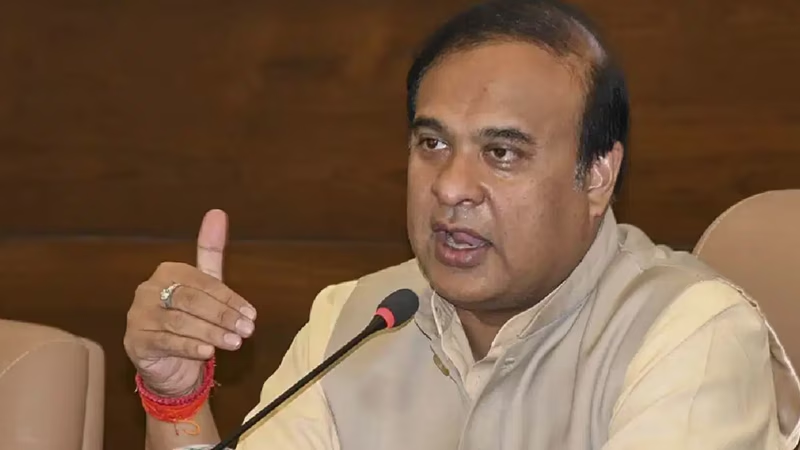
In a dramatic and polarizing speech that has reignited one of India’s most sensitive political debates, Assam Chief Minister Himanta Biswa Sarma has claimed that the state faces an existential risk if the population of people of Bangladeshi descent exceeds 50%. Calling it a potential “annexation attempt,” Sarma framed the issue not just as a matter of law and order, but as a “civilizational battle” to preserve Assamese language, culture, and identity.
Speaking at a public rally in Guwahati, Sarma warned: “If the demographic balance shifts beyond the point of return, Assam may cease to be Assam. This is not fear-mongering—it’s a warning backed by history.” His comments come amid renewed political focus on the National Register of Citizens (NRC), border security, and alleged “appeasement politics” by previous governments.
While critics have slammed his remarks as inflammatory and divisive, supporters argue that Sarma is confronting a long-ignored reality. As India’s northeastern gateway, Assam has borne the brunt of cross-border migration for decades—a complex issue entangled with colonial history, porous borders, and electoral politics.
Table of Contents
- What Did Himanta Biswa Sarma Say Exactly?
- Understanding the Assam Demographic Threat Claim
- Historical Context of Migration in Assam
- Political Reactions and Controversy
- What the Data Says on Population Trends
- Why This Matters for India’s Border States
- Conclusion: Beyond Rhetoric Toward Solutions
- Sources
What Did Himanta Biswa Sarma Say Exactly?
In his January 2025 address, CM Sarma stated: “If the population of Bangladesh-origin people crosses the 50% mark in Assam, we are not talking about integration—we are talking about annexation. This is not about religion. This is about the survival of the Assamese people, their language, and their way of life.”
He accused past administrations of enabling “uncontrolled infiltration” through lax border management and welfare schemes that allegedly encouraged settlement. Sarma called for a “civilizational awakening” to protect what he described as the “indigenous soul of Assam.”
Understanding the Assam Demographic Threat Claim
The phrase “Assam demographic threat” has been used for decades by regional parties like the All Assam Students’ Union (AASU) and Asom Gana Parishad (AGP). It refers to the fear that large-scale migration from Bangladesh—both during Partition and post-1971—has altered Assam’s ethnic and linguistic fabric.
Key concerns include:
- Erosion of the Assamese language in public life and education.
- Loss of land rights due to encroachment and illegal settlement.
- Electoral manipulation through alleged inclusion of ineligible voters.
Sarma’s language is among the most explicit yet from a sitting chief minister, framing demographic change as a national security issue rather than just a social one.
Historical Context of Migration in Assam
Migration into Assam isn’t new:
- British Era (1826–1947): Colonial rulers encouraged Bengali Muslim peasants to settle in Assam’s riverine tracts for agriculture.
- Partition (1947): Millions crossed borders; Assam absorbed Hindu refugees from East Pakistan.
- 1971 Bangladesh Liberation War: Another wave of refugees, both Hindu and Muslim, entered Assam.
- Post-1971: Alleged continuous illegal migration became a flashpoint, leading to the six-year-long Assam Agitation (1979–1985).
The resulting Assam Accord (1985) promised detection and deportation of “foreigners” who entered after March 24, 1971. Yet, implementation has been sporadic and legally contested.
Political Reactions and Controversy
Sarma’s remarks drew immediate backlash. The Congress called them “xenophobic” and accused the BJP of “manufacturing fear to polarize voters.” Opposition leaders pointed out that census data doesn’t support a 50% figure for any single migrant-origin group.
However, BJP leaders defended Sarma, citing Supreme Court observations from the NRC process, which noted that “millions of illegal migrants have diluted the demographic character of Assam.” Human rights groups, meanwhile, warned that such rhetoric could fuel xenophobia and violence against minorities. For deeper insights into identity politics in the Northeast, see [INTERNAL_LINK:northeast-india-identity-and-citizenship].
What the Data Says on Population Trends
Official statistics remain contentious:
- The 2011 Census doesn’t categorize people by “Bangladeshi origin,” making direct estimates difficult.
- Based on language and religion, analysts estimate 30–35% of Assam’s population may have roots in East Bengal/Bangladesh—but this includes both legal and illegal migrants, as well as pre-1971 settlers who are Indian citizens.
- The final NRC list (2019) excluded 1.9 million people—many of whom claim they are genuine Indians but lack legacy documents.
According to the World Bank, accurate migration data is “critical for policy but politically weaponized in border states” .
Why This Matters for India’s Border States
Assam isn’t alone. Similar concerns exist in West Bengal, Tripura, and Meghalaya. In Tripura, the indigenous tribal population dropped from 59% in 1951 to 31% in 2011 due to migration—a shift that fueled decades of insurgency.
The core question is this: How does a democracy balance humanitarian obligations, national security, and the cultural rights of indigenous communities? Sarma’s warning, whether alarmist or prophetic, forces this question into the open.
Conclusion: Beyond Rhetoric Toward Solutions
While the phrase “Assam demographic threat” may sound incendiary, it reflects deep-seated anxieties rooted in real historical grievances. Himanta Biswa Sarma’s annexation warning is less a prediction and more a political mobilization tactic—one that demands concrete action on border fencing, citizenship verification, and cultural preservation. Yet, solutions must avoid scapegoating minorities and uphold constitutional values. The civilizational battle Sarma speaks of shouldn’t be about exclusion—it should be about inclusive nation-building that honors both identity and justice.
Sources
Times of India: Sarma’s Annexation Warning in Assam
World Bank: Migration and Identity in India’s Northeast
The Assam Accord (1985) – Official Text
Census of India 2011 – Assam Data