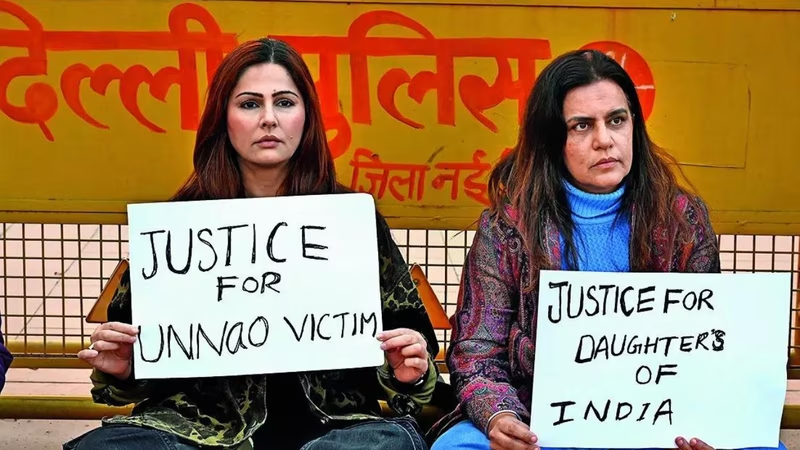
In a pivotal legal showdown that underscores the gravity of crimes against minors by those in power, the Central Bureau of Investigation (CBI) has urged the Supreme Court to reject bail for former BJP MLA Kuldeep Singh Sengar in the infamous Unnao rape case. The agency’s argument hinges on a powerful precedent: the Supreme Court’s own 2008 judgment in the L K Advani case, which established that public servants must be held to a higher standard of accountability—especially when children are involved.
The case, which has shocked the nation since it first came to light in 2017, involves the brutal sexual assault of a minor girl in Unnao, Uttar Pradesh, by Sengar, who at the time was a sitting MLA. Despite being convicted in 2019 and sentenced to life imprisonment, legal technicalities around the application of the POCSO Act have kept the case alive in higher courts. Now, with the Delhi High Court recently ruling that Sengar cannot be prosecuted under POCSO—a decision that could significantly weaken his punishment—the CBI is fighting back hard.
Table of Contents
- Why the Unnao Rape Case Still Matters
- The L K Advani Judgment: A Legal Linchpin
- CBI’s Core Argument: Public Trust and Strict Liability
- What Is POCSO and Why Its Application Is Critical?
- Broader Implications for Indian Democracy
- Conclusion: Justice Must Not Bend for the Powerful
- Sources
Why the Unnao Rape Case Still Matters
The Unnao rape case is more than just a criminal trial—it’s a litmus test for India’s justice system. It exposed how political clout can be weaponized to silence victims, intimidate witnesses, and delay justice. The survivor’s family faced relentless threats; her father died in police custody under suspicious circumstances; and her car was allegedly rammed in a deadly “accident” that many believe was orchestrated to kill her.
Sengar was finally convicted under Section 376 of the IPC (rape) and sentenced to life. But the CBI insists he must also face charges under the Protection of Children from Sexual Offences (POCSO) Act, which carries harsher minimum sentences and no provision for early release. The Delhi High Court’s exclusion of POCSO from his prosecution, the CBI argues, sets a dangerous precedent.
The L K Advani Judgment: A Legal Linchpin
In 2008, the Supreme Court ruled in L K Advani vs CBI that public servants—defined broadly to include elected representatives—owe a “special duty of care” to the public. The bench stated that “when a person holds public office, his conduct must be above reproach, and any offence committed in abuse of that position warrants enhanced scrutiny and stricter punishment.”
The CBI is now invoking this exact principle. Since Sengar was an MLA at the time of the crime, he wasn’t just a private citizen—he was a figure of authority who allegedly exploited his position to target a vulnerable minor. This, the CBI contends, makes the case not just about rape, but about an abuse of public trust.
CBI’s Core Argument: Public Trust and Strict Liability
The agency’s legal strategy is both morally compelling and legally sound:
- Public Office = Greater Responsibility: Lawmakers are custodians of public welfare. Crimes committed by them, especially against children, violate the very foundation of representative democracy.
- POCSO’s Non-Negotiable Scope: The Act was designed to be “child-centric and gender-neutral,” with mandatory minimum sentences. Exempting lawmakers undermines its deterrent effect.
- Preventing a Slippery Slope: If Sengar escapes POCSO, what’s to stop other powerful figures from claiming similar exemptions?
As one CBI official anonymously noted, “This isn’t about one man. It’s about sending a message: no one is above the law—especially when a child’s life is shattered.”
What Is POCSO and Why Its Application Is Critical?
The Protection of Children from Sexual Offences Act, 2012, was enacted to provide a robust legal framework for crimes against minors. Key features include:
- Stringent Punishments: Aggravated penetrative sexual assault carries a minimum sentence of 20 years, extendable to life or death.
- No Bail for Repeat Offenders: The law makes bail extremely difficult to obtain for those accused under its provisions.
- Child-Friendly Procedures: Special courts, in-camera trials, and victim support mechanisms are mandated.
Denying its application in the Unnao rape case—where the victim was just 16—would not only dilute justice but signal that political power can shield perpetrators from the law’s full force.
Broader Implications for Indian Democracy
This legal battle transcends Sengar’s fate. It touches on fundamental questions: Can elected officials be held accountable for heinous crimes? Does public office confer immunity or greater liability? The Supreme Court’s decision will set a binding precedent for thousands of pending cases involving politicians accused of sexual offences.
Experts warn that failing to uphold the CBI’s stance could embolden corrupt actors and erode public faith in institutions. As the National Commission for Protection of Child Rights (NCPCR) has emphasized, “The integrity of POCSO depends on its universal application—without exception.” For more on legal protections for minors, see our guide on [INTERNAL_LINK:child-rights-laws-in-india].
Conclusion: Justice Must Not Bend for the Powerful
The CBI’s strategic citation of the L K Advani judgment in the Unnao rape case is a masterstroke of legal reasoning. It reframes the issue not as a technical dispute over statutes, but as a moral imperative: those entrusted with public power must face the harshest consequences when they betray it—especially when a child is the victim. As the Supreme Court prepares to hear the matter, the nation watches, hoping that justice for the Unnao survivor becomes a landmark victory for accountability in Indian democracy.
Sources
Times of India: CBI Cites Advani Judgment in Unnao Case
Supreme Court Judgment: L K Advani vs CBI (2008)
National Commission for Protection of Child Rights (NCPCR) – Official Portal
The POCSO Act, 2012 – India Code