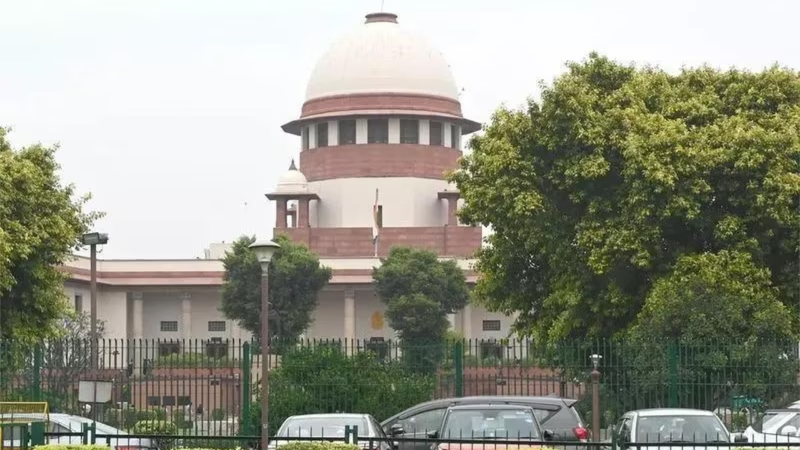
In a move that has sent shockwaves through India’s environmental and legal communities, the Supreme Court has taken the rare step of initiating its own review—known as suo motu cognisance—of a recent, highly contentious judgment concerning the Aravali Hills.
The case, to be heard by a bench led by the Chief Justice of India on Monday, centers on a November 20, 2025 ruling that redefined these ancient hills in a way critics argue is a death warrant for one of the country’s most vital ecological barriers. The core of the controversy? A seemingly simple number: 100 meters.
Table of Contents
- The 100m Rule: A Simplistic Definition with Catastrophic Consequences
- Why the Aravali Hills Matter (More Than You Think)
- Supreme Court Steps Back in a Rare Move
- What Happens Next: The Road Ahead
- Conclusion: A Defining Moment for India’s Ecological Future
- Sources
The 100m Rule: A Simplistic Definition with Catastrophic Consequences
The November ruling established a uniform, elevation-based definition for the Aravali Hills, stating that only landforms rising 100 meters or more above the local relief would qualify for legal protection against mining . On the surface, this sounds like a clear, scientific criterion. But in reality, it’s an ecological time bomb.
Experts and environmentalists have been quick to point out the fatal flaw in this logic. The Aravali Range, being one of the world’s oldest fold mountains, has been eroded over millions of years. Its current form is not one of towering, dramatic peaks, but a complex, interconnected network of low hills, rocky outcrops, and dense forests. By applying a rigid 100-meter threshold, an estimated 90% of the entire range could be effectively de-classified and stripped of its protected status [[14], [23]].
This isn’t just about losing pretty landscapes. The practical implications are severe:
- Green Light for Mining: Vast swathes of land, previously understood to be part of the ecologically sensitive Aravali ecosystem, could now be open to fresh mining leases .
- Accelerated Desertification: The Aravali acts as a crucial barrier against the eastward march of the Thar Desert. Destroying its vegetative cover through mining will accelerate soil erosion and desertification in Haryana and Delhi-NCR [[22], [18]].
- Water Crisis: The range is a critical zone for groundwater recharge. Mining activity contaminates and depletes these aquifers, threatening the water security of millions [[17], [22]].
Why the Aravali Hills Matter (More Than You Think)
To understand the magnitude of this potential disaster, we must appreciate the multifaceted importance of the Aravali Range. It’s far more than just a scenic backdrop.
An Ancient Shield Against the Desert
Dubbed India’s “Great Green Wall,” the Aravali Hills are our primary defense against the Thar Desert. They block dust-laden, hot winds from the west, protecting the fertile plains of northern India from becoming arid wastelands . Without this natural shield, the desertification of Haryana and the water-stressed Delhi-NCR region would dramatically worsen.
A Lifeline for Water and Biodiversity
The hills are a complex hydrological system. Their forests and rocky soil act like a giant sponge, absorbing monsoon rains and slowly releasing them to recharge groundwater tables—a lifeline for countless villages and cities. Furthermore, the range is a biodiversity hotspot, home to a rich array of flora and fauna, many of which are endemic and endangered [[19], [25]].
Supreme Court Steps Back in a Rare Move
Faced with an unprecedented wave of criticism from ecologists, hydrologists, and civil society, the Supreme Court has taken the extraordinary step of initiating its own review . This suo motu action—where the court acts on its own motion without a formal petition—is a testament to the gravity of the situation and the potential for irreversible environmental damage.
This move signals that the court may be acknowledging a critical oversight in its original judgment: the conflation of a geographical definition with an ecological one. As experts have argued, the ecological integrity of the Aravali is not defined by its height in meters, but by its interconnected geological structure, its role in the regional climate, and its function as a single, vital ecosystem .
Environmental groups, who have long been fighting to protect this fragile range from illegal mining and construction, see this as a critical, last-minute opportunity to correct a dangerous precedent .
What Happens Next: The Road Ahead
The upcoming hearing before the CJI-led bench is not just a legal formality; it’s a pivotal moment for India’s environmental jurisprudence. The court has several paths it can take:
- Strike Down the 100m Rule: The court could completely abandon the elevation-based definition in favor of a more holistic, ecology-centric approach.
- Modify the Definition: It could refine the rule, perhaps by lowering the threshold or adding critical ecological criteria that must be met alongside elevation.
- Uphold the Original Ruling: While unlikely given the suo motu action, this would be a devastating blow to conservation efforts.
Whatever the outcome, this case has already sparked a crucial national conversation about how we define and protect our natural heritage in the face of growing development pressures. For more on India’s conservation challenges, see our guide on [INTERNAL_LINK:national-parks-conservation-laws].
Conclusion: A Defining Moment for India’s Ecological Future
The Supreme Court’s decision to revisit its own Aravali Hills judgment is a beacon of hope for environmentalists. The controversial 100m elevation rule, while appearing neat on paper, threatened to sacrifice the ecological soul of India’s oldest mountain range for the sake of administrative simplicity. The court now has a chance to reaffirm that our environmental laws must be guided by science and ecological reality, not arbitrary metrics. The future of the Aravali Hills, and the millions who depend on them, hangs in the balance.
Sources
Live Law: Supreme Court Clarifies Aravalli Boundaries, Regulates Mining
The Hindu: Supreme Court accepts Centre’s definition of Aravali Hills
Civil Society: Protection of the Aravalli Range: Importance, Threats and the Way Forward
Mongabay India: How the Supreme Court’s New Definition Threatens India’s Oldest Mountains
Supreme Court of India: Judgment dated 20 November 2025 on the Aravali Hills