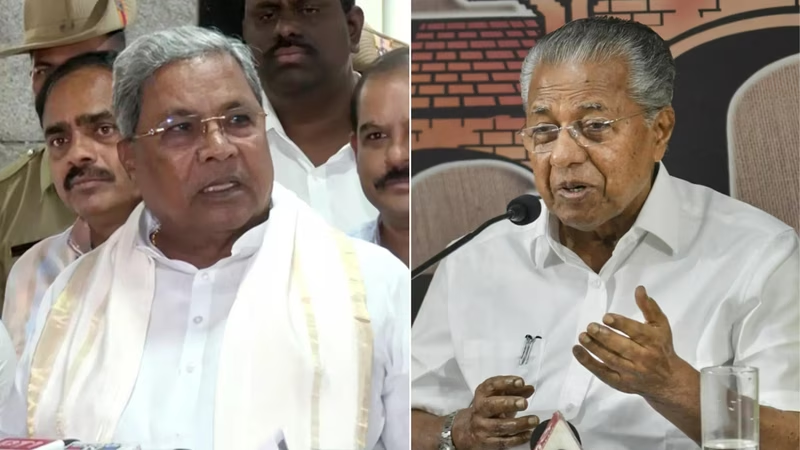
Political tempers flared this weekend as Karnataka Chief Minister Siddaramaiah launched a blistering counterattack against Kerala CM Pinarayi Vijayan over the latter’s controversial “North Indian bulldozer justice” comment targeting Bengaluru’s recent anti-encroachment actions. What began as a critique from across state lines has now escalated into a high-stakes inter-state political showdown—with the Bengaluru eviction drive at its explosive center.
Siddaramaiah didn’t hold back. In a strongly worded statement, he accused Vijayan of making “politically motivated” remarks without understanding ground realities. “This is not about bulldozers—it’s about the rule of law,” Siddaramaiah asserted, framing the evictions as a necessary, court-backed effort to reclaim public land from powerful encroachers and land mafia syndicates.
Table of Contents
- What Did Pinarayi Vijayan Say?
- Siddaramaiah’s Defense of the Bengaluru Eviction Drive
- The Legal Backbone of the Eviction Campaign
- The Land Mafia and Bengaluru’s Vanishing Public Spaces
- Political Undertones: Why This Clash Matters
- Public Reaction and Urban Policy Experts Weigh In
- Conclusion: Rule of Law vs Political Rhetoric
- Sources
What Did Pinarayi Vijayan Say?
During a public address in Thiruvananthapuram, Kerala CM Pinarayi Vijayan referred to recent demolitions in Bengaluru as an example of “North Indian bulldozer justice”—a loaded phrase that has gained notoriety in Indian political discourse for implying summary, extra-legal punishment often targeting specific communities.
While Vijayan didn’t explicitly accuse Karnataka of communal targeting, the phrase’s historical baggage—linked to actions in states like Uttar Pradesh—sparked immediate backlash. Critics argue the term is misleading when applied to Bengaluru, where evictions primarily target commercial and residential structures built illegally on government-owned land, including stormwater drains, lake beds, and road corridors.
Siddaramaiah’s Defense of the Bengaluru Eviction Drive
Karnataka’s CM fired back with sharp clarity. “I request Mr. Pinarayi Vijayan not to make statements without knowing the facts,” Siddaramaiah said. “Our actions are based on court orders, land records, and citizen complaints—not political agendas.”
He emphasized that the Bengaluru eviction drive is part of a systematic effort under the Karnataka Land Revenue Act and directives from the Karnataka High Court to clear encroachments that have choked the city’s infrastructure for decades. “We are not targeting any religion, language, or community,” Siddaramaiah stressed. “We are targeting illegal occupation of public land—period.”
The Legal Backbone of the Eviction Campaign
Contrary to the “bulldozer justice” narrative, the Bengaluru evictions follow a defined legal process:
- Survey & Identification: BBMP and Revenue Department officials use GIS mapping and land records to identify encroachments.
- Notice Period: Affected parties receive 15–30 days’ notice to vacate or present ownership claims.
- Court Oversight: Many eviction orders stem from public interest litigations (PILs) filed by environmental and civic groups.
- Transparency Portal: All affected properties are listed on the Karnataka Land Records Portal for public verification .
According to the Revenue Department, over 4,200 illegal structures were removed in Bengaluru between October and December 2025 alone—most located on lake buffers, primary roads, and parklands .
The Land Mafia and Bengaluru’s Vanishing Public Spaces
Siddaramaiah’s government argues that unchecked encroachment has turned Bengaluru into a city where public assets are treated as private real estate. A 2024 Comptroller and Auditor General (CAG) report revealed that nearly 30% of designated public land in Bengaluru’s core zones had been illegally occupied—robbing citizens of parks, footpaths, and drainage corridors .
These encroachments, officials allege, are often orchestrated by land mafia networks that collude with corrupt local officials to grab, build, and sell land at premium rates. The current eviction drive aims to dismantle this ecosystem and restore civic balance.
Political Undertones: Why This Clash Matters
While framed as a policy dispute, the Siddaramaiah-Vijayan clash reflects deeper political currents. Both leaders head Left-leaning governments—Karnataka under Congress, Kerala under CPI(M)—yet their approaches to governance differ sharply.
Vijayan’s comment may be seen as part of a broader national narrative where southern states position themselves as defenders of “constitutional morality” against perceived authoritarian trends. Siddaramaiah, however, insists his actions are rooted in local necessity, not national political theater.
For more on urban governance in India’s megacities, explore our analysis on [INTERNAL_LINK:urban-land-reforms-india].
Public Reaction and Urban Policy Experts Weigh In
Public opinion in Bengaluru is largely supportive of the evictions, especially among residents affected by flooding due to blocked drains or traffic chaos from narrowed roads.
“Encroachers have turned Bengaluru into a concrete jungle with no breathing space,” said Meera Rajan, a civic activist. “This isn’t about bulldozers—it’s about survival.”
Urban planning experts from the Indian Institute for Human Settlements (IIHS) note that while eviction is necessary, rehabilitation for genuinely vulnerable occupants remains a gap. “The state must distinguish between land mafia profiteers and low-income settlers with no alternatives,” said Dr. Anjali Rao, a housing policy researcher .
Conclusion: Rule of Law vs Political Rhetoric
At its core, the controversy over the Bengaluru eviction drive is a test of how India balances urban justice with political narrative. Siddaramaiah’s stance—backed by legal process and civic necessity—stands in stark contrast to Vijayan’s emotionally charged rhetoric. As Bengaluru fights to reclaim its lungs and arteries from illegal occupation, the real question isn’t about bulldozers; it’s about who gets to define public space in India’s fastest-growing cities.
Sources
- The Times of India. “CM vs CM: Sidda takes on Pinarayi over ‘bulldozer’ remark; defends eviction drive.” December 28, 2025.
- Karnataka Revenue Department. “Encroachment Removal Statistics – Q4 2025.”
- Karnataka Land Records Portal. https://landrecords.karnataka.gov.in
- Comptroller and Auditor General of India (CAG). “Performance Audit of Urban Land Management in Bengaluru.” Report No. 7 of 2024.
- Indian Institute for Human Settlements (IIHS). “Housing and Land Rights in Indian Cities: Policy Brief 2025.” https://www.iihs.co.in
- [INTERNAL_LINK:urban-land-reforms-india]