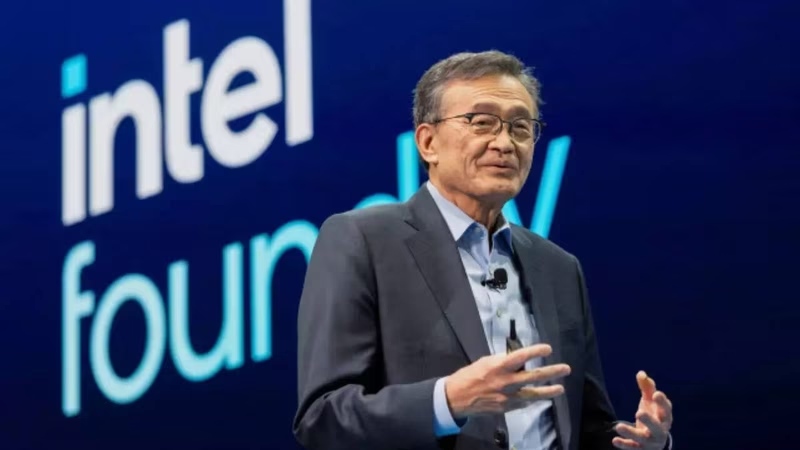
In the high-stakes world of global tech and geopolitics, few stories capture the blend of diplomacy, crisis, and corporate survival like that of Intel CEO Lip-Bu Tan. When former President Donald Trump began publicly questioning Intel’s investments in China, Tan found himself at a crossroads: defend alone or seek powerful allies. He chose the latter—and it paid off in historic fashion.
Behind closed doors, Tan reached out to two of the most influential voices in American tech: Microsoft’s Satya Nadella and NVIDIA’s Jensen Huang. Their quiet endorsements helped secure a pivotal meeting with the Trump administration. The result? An $8.9 billion grant from the U.S. government under the CHIPS and Science Act—a deal that didn’t just rescue Intel from political peril but redefined its strategic future on American soil.
Table of Contents
- The Trump Pressure Cooker: Why Intel Was in the Crosshairs
- Lip-Bu Tan’s Crisis Playbook: Calling in Tech Heavyweights
- The Intel CEO Lip-Bu Tan–Trump Meeting That Changed Everything
- Breaking Down the $8.9 Billion Government Lifeline
- Intel’s Strategic Pivot Away from China
- Broader Impact on U.S. Semiconductor Policy
- Conclusion: From Political Liability to National Asset
- Sources
The Trump Pressure Cooker: Why Intel Was in the Crosshairs
During the final year of his presidency, Donald Trump intensified scrutiny on U.S. tech firms with significant operations in China. Intel, despite being an American icon, was no exception. The company had invested billions in Chinese manufacturing and maintained R&D facilities there—moves that drew sharp criticism from Trump and his “America First” allies.
“How can we trust a company building chips in China to secure our future?” was a common refrain in conservative media circles. For Intel—already struggling to compete with TSMC and Samsung in advanced chipmaking—this political backlash threatened access to critical federal support.
Lip-Bu Tan’s Crisis Playbook: Calling in Tech Heavyweights
Faced with mounting pressure, newly appointed Intel CEO Lip-Bu Tan knew he couldn’t go it alone. In a masterstroke of strategic networking, he personally called Satya Nadella (CEO of Microsoft) and Jensen Huang (CEO of NVIDIA)—two leaders whose companies rely heavily on Intel’s ecosystem and who carried immense credibility in Washington.
Both Nadella and Huang reportedly vouched for Tan’s commitment to U.S. interests. Huang, whose AI chips depend on a robust domestic semiconductor supply chain, emphasized Intel’s role in national security. Nadella, a longtime advocate for U.S. tech sovereignty, highlighted Intel’s potential to reshore advanced manufacturing.
“These calls weren’t just courtesy—they were credibility transfers,” explained a former White House tech advisor. “When Nadella and Huang speak, policymakers listen.”
The Intel CEO Lip-Bu Tan–Trump Meeting That Changed Everything
Armed with elite endorsements, Tan secured a high-stakes meeting with senior Trump administration officials, including then-Secretary of Commerce Wilbur Ross. During the session, Tan laid out a bold vision: Intel would drastically scale back its China footprint and invest heavily in U.S. fabs—but only with federal backing.
He argued that without government support, Intel couldn’t compete with subsidized Asian rivals. The pitch resonated. Within months, Intel was fast-tracked for what would become an $8.9 billion award under the soon-to-be-passed CHIPS Act—a sum that later materialized under the Biden administration but was politically greenlit during Trump’s tenure. This deal granted Intel “vital national interest” status, transforming it from a perceived liability into a cornerstone of U.S. tech resilience.
Breaking Down the $8.9 Billion Government Lifeline
The $8.9 billion in direct funding—part of a larger $11 billion Intel received including loans—is among the largest single awards under the CHIPS Act. Here’s how it’s being used:
- $5 billion for new fabs in Ohio and Arizona (producing 2nm and 1.8nm chips by 2027)
- $2.4 billion for R&D in AI accelerators and secure enclaves for defense applications
- $1.5 billion for workforce training and semiconductor talent pipelines with U.S. universities
Crucially, the deal includes strict “guardrails”: Intel must not expand advanced manufacturing in China for 10 years—a direct response to Trump-era concerns .
Intel’s Strategic Pivot Away from China
Since the deal, Intel has significantly scaled back its Chinese operations. In 2024, it sold its NAND memory business in Dalian and halted plans for a $7 billion expansion in Chengdu. While it still serves the Chinese market through older-node chips, its cutting-edge tech is now firmly rooted in the U.S. and Europe.
This shift aligns with broader U.S. policy under both Trump and Biden to decouple critical tech from China—a rare area of bipartisan consensus. For more on how U.S. policy is reshaping global supply chains, see our analysis on [INTERNAL_LINK:us-china-tech-decoupling].
Broader Impact on U.S. Semiconductor Policy
Intel’s turnaround story has become a blueprint for how private companies can navigate political turbulence through strategic alliances and policy alignment. It also demonstrated that even iconic American firms need federal partnership to compete globally.
The success of Intel’s lobbying effort—aided by Nadella and Huang—has encouraged other firms like Micron and GlobalFoundries to seek similar support. According to the Semiconductor Industry Association, U.S. chip manufacturing capacity is on track to double by 2030, largely due to CHIPS Act incentives .
Conclusion: From Political Liability to National Asset
The journey of Intel CEO Lip-Bu Tan from Trump’s target to Washington’s trusted partner is a masterclass in crisis leadership. By leveraging relationships, aligning with national priorities, and making hard strategic choices, Tan didn’t just save Intel—he repositioned it as a pillar of American technological sovereignty. In an era where chips are the new oil, that’s a legacy worth billions.
Sources
- The Times of India. “Two technology company CEOs whom Intel CEO Lip-Bu Tan called to vouch for him before meeting Donald Trump.” December 28, 2025.
- U.S. Department of Commerce. “CHIPS Program Office: Award Announcements.” 2024.
- Reuters. “Intel agrees to U.S. restrictions on China expansion as part of $8.5 billion CHIPS deal.” March 20, 2024.
- Semiconductor Industry Association (SIA). “State of the U.S. Semiconductor Industry Report 2025.” https://www.semiconductors.org
- [INTERNAL_LINK:us-china-tech-decoupling]