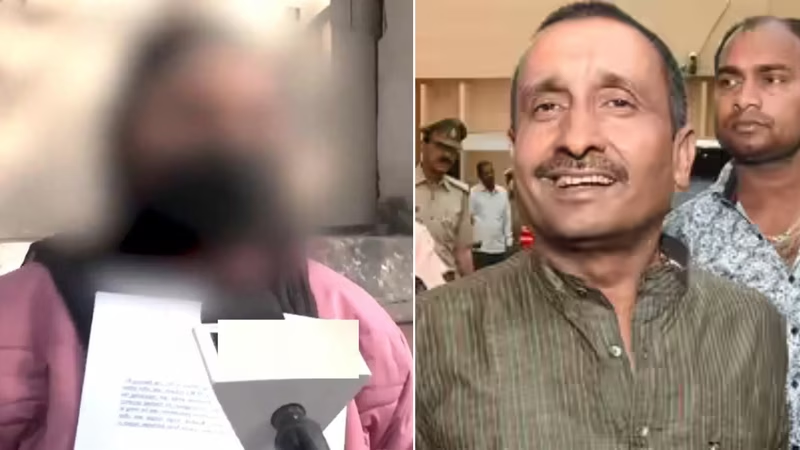
For a survivor who has spent years fighting an uphill battle for justice, a new, potentially devastating blow has landed. The young woman at the heart of the infamous Unnao rape case has lodged a formal and explosive complaint with the Central Bureau of Investigation (CBI). Her allegation? That the CBI’s own Investigating Officer (IO) colluded with a judge in a deliberate attempt to break her spirit and derail the legal proceedings against her powerful tormentor, former BJP MLA Kuldeep Singh Sengar .
This shocking accusation comes on the heels of the Delhi High Court’s controversial December 23, 2025, decision to suspend Sengar’s life sentence and grant him bail pending his appeal . For the survivor, this was a moment of deep personal pain. She has publicly stated she is “hurt by the judgment” and fears a system that seems to be closing ranks against her .
Table of Contents
- The Latest Allegations of Collusion
- A Brief History of the Unnao Rape Case
- The Delhi High Court Bail Decision and its Impact
- Scrutinizing the CBI Investigative Process
- The Long Road Ahead for Justice
The Latest Allegations of Collusion
The survivor’s new complaint is a direct assault on the integrity of the very agency tasked with prosecuting her case. She claims the CBI’s Investigating Officer worked in tandem with a judge, creating a hostile environment designed to intimidate her into silence . According to her, the IO’s actions were not just negligent but intentionally malicious, aimed at favouring the accused and protecting his interests .
Her legal team has echoed these sentiments, alleging a broader “collusion” between the CBI and Sengar’s camp to facilitate the suspension of his sentence . These are grave accusations that, if proven, would represent a catastrophic failure of India’s justice system. The CBI, a premier investigative body, is now placed in the unusual and uncomfortable position of investigating its own officer for potential misconduct in one of its most high-profile cases.
A Brief History of the Unnao Rape Case
To understand the weight of these new allegations, one must look back at the case’s harrowing timeline. In June 2017, a 17-year-old girl in Unnao, Uttar Pradesh, was allegedly raped by Kuldeep Singh Sengar, a sitting BJP MLA at the time, and his associates . Her fight for justice began almost immediately, with complaints sent to the Chief Minister’s office and local police, who initially refused to act .
The case took a terrifying turn when her father was brutally assaulted in custody, leading to his death. In a horrific act of intimidation, a truck later rammed into her car, leaving her and her lawyer in critical condition and two of her aunts dead. The brazenness of these attacks, widely believed to be orchestrated by Sengar’s men, forced the Supreme Court to intervene in August 2019. The apex court transferred the case to Delhi and ordered a CBI probe, a move that was seen as a critical step towards ensuring a fair trial .
Sengar was eventually convicted in December 2019 and sentenced to life imprisonment. For the survivor and her family, it was a hard-won, albeit partial, victory.
The Delhi High Court Bail Decision and its Impact
The recent decision by the Delhi High Court has undone much of that hard-earned sense of security. On December 23, 2025, the court granted Sengar bail and suspended his life sentence while his appeal is pending . While courts can grant such relief on technical or medical grounds, the timing and context have fueled public outrage and the survivor’s deep sense of betrayal.
For a survivor who has faced death threats, a near-fatal car crash, and the loss of her father and aunts, seeing her convicted rapist walk free is more than a legal setback—it’s a profound personal trauma. Her reaction—expressing that she is “hurt by the judgment” —is a stark reminder that legal proceedings have real, human consequences.
Scrutinizing the CBI Investigative Process
The CBI is often hailed as a professional and impartial agency, but this case has thrown its processes under intense scrutiny. The survivor’s accusation that an IO, a key figure in building the prosecution’s case, was actively working against her, raises serious questions about oversight and internal accountability.
How could such a fundamental conflict of interest—or outright corruption—go unnoticed for so long? This situation highlights a critical vulnerability within even our most trusted institutions. It underscores the importance of robust whistleblower protections and independent review mechanisms to ensure that a single officer’s alleged misconduct cannot compromise an entire investigation.
For its part, the CBI will now have to conduct a thorough and transparent inquiry into these fresh allegations. The outcome of this internal probe will be watched not just by the survivor, but by a nation deeply concerned about the integrity of its justice system. To understand more about the CBI’s role and challenges, see [INTERNAL_LINK:crown-jewel-cbi-challenges-in-india].
The Long Road Ahead for Justice
The Unnao rape case has long been a litmus test for India’s commitment to justice for its most vulnerable citizens. From the initial police inaction to the Supreme Court’s intervention, and now to these latest allegations of collusion, the journey has been fraught with obstacles that seem to extend far beyond the courtroom.
The survivor’s courage in coming forward with these new, explosive claims is a testament to her unwavering resolve. However, it also paints a bleak picture of a system that appears to be stacked against her at every turn. The onus is now on the CBI and the judiciary to act swiftly, fairly, and transparently to address her complaints and restore public faith in the rule of law.
For now, the nation watches and waits, hoping that this chapter in the Unnao rape case will not be another example of institutional failure, but a catalyst for a much-needed course correction.
Summary
The Unnao rape case has entered a new and disturbing phase, with the survivor alleging that a CBI Investigating Officer colluded with a judge to undermine her pursuit of justice. This comes as a direct response to the Delhi High Court’s December 2025 decision to grant bail to her convicted rapist, Kuldeep Singh Sengar, and suspend his life sentence. These serious allegations, if substantiated, would reveal a deep rot within the investigative process and pose a significant test for India’s criminal justice system. The survivor, who has already endured unimaginable trauma, now faces yet another fight to ensure her voice is heard and justice is truly served.
Sources
- Times of India: ‘IO colluded with …’: Unnao rape survivor’s explosive charge; meets CBI officials
- The Print: Unnao rape case survivor’s lawyer claims CBI was in ‘collusion’ with Sengar…
- Supreme Court of India Transfer Order (2019): https://main.sci.gov.in/
- Delhi High Court Order Crl. A. 53/2020 (December 23, 2025)
- National Crime Records Bureau (NCRB): https://ncrb.gov.in/