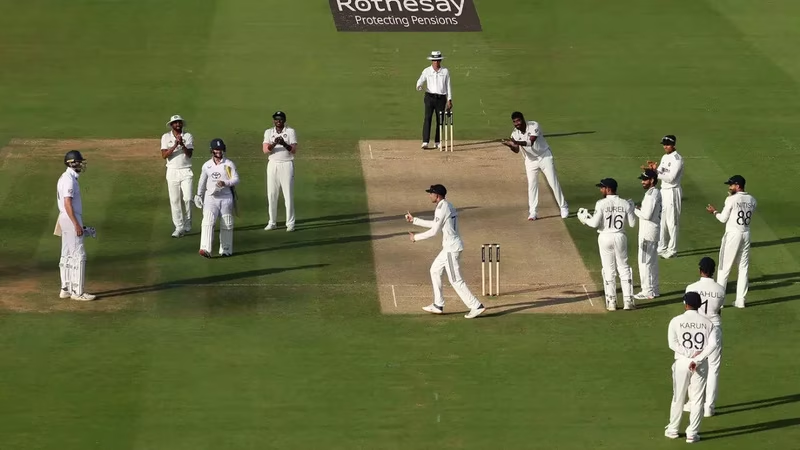
England fans might be celebrating a hard-fought 2-2 draw against India—but not Alastair Cook. In a brutally honest assessment that’s sent shockwaves through the cricketing world, the legendary opener has declared that the series result is little more than “false comfort.” Why? Because, in Cook’s view, the Indian side England battled wasn’t even “great.” With England already 0-3 down in the Ashes against a dominant Australia, Cook warns that misreading this India series as a success could have dire consequences for the team’s future. Let’s unpack why one of England’s most respected voices believes the England’s 2-2 series draw is a dangerous mirage.
Table of Contents
- What Did Alastair Cook Actually Say?
- England’s 2-2 Series Draw: The Context
- Was India Really a Weakened Side?
- The Ashes Reality Check: England in Crisis
- Why Cook’s Critique Matters for England’s Future
- Expert Opinions: Does the Cricket World Agree?
- Conclusion: A Wake-Up Call, Not a Celebration
- Sources
What Did Alastair Cook Actually Say?
In a candid interview following the conclusion of the five-Test series—cut short to four due to scheduling—Cook didn’t mince words. “Don’t get me wrong, it’s nice to avoid a loss,” he said, “but let’s be honest: that Indian side wasn’t great.”
He elaborated that while Shubman Gill’s captaincy showed promise and India had moments of brilliance, the team was missing key players like Jasprit Bumrah (rested), R Ashwin (injured), and Virat Kohli (on paternity leave). “You can’t claim parity when you’re not playing the full-strength XI,” Cook argued .
More alarmingly, Cook expressed concern that this draw might lull England into a false sense of security. “Right now, Australia are dismantling us in the Ashes. We’re 0-3 down. And instead of fixing our technical and mental flaws overseas, we’re patting ourselves on the back for drawing with a second-string India. That’s not progress—that’s delusion.”
England’s 2-2 Series Draw: The Context
The series, played in December 2025 across four venues in India, saw England fight back valiantly after losing the first Test in Chennai. Wins in Kolkata and Dharamsala—led by standout performances from Joe Root and debutant spinner Rehan Ahmed—suggested a renaissance in England’s red-ball resilience.
However, critics like Cook point out that India’s squad featured a mix of rookies and fringe players. With Rahul Dravid as head coach and Gill as captain (in place of the rested Rohit Sharma), the team was clearly in transition—using the series as a trial ground for the 2027 World Test Championship cycle .
Was India Really a Weakened Side?
Let’s break down India’s missing stars:
- Jasprit Bumrah: World’s No. 1 Test bowler, rested for workload management.
- Ravichandran Ashwin: 500+ wicket legend, sidelined with a minor calf strain.
- Virat Kohli: On parental leave following the birth of his second child.
- Rohit Sharma: Officially “rested” as captain, with Gill handed the reins.
While young talents like Yashasvi Jaiswal and Dhruv Jurel impressed, the absence of India’s core veterans meant England faced a side still finding its identity—hardly the “complete” Indian unit that has dominated home conditions for over a decade .
The Ashes Reality Check: England in Crisis
While the India series wrapped up, England’s main Test team was getting steamrolled in Australia. Trailing 0-3 after losses in Brisbane, Adelaide, and Melbourne, the side—led by Ben Stokes—has looked technically inept against the moving ball and mentally fragile under pressure .
Cook’s core argument is this: **The India result is masking a far deeper problem**. “Beating or drawing with a developing India side doesn’t prepare you for the pace, bounce, and hostility of Australian conditions,” he stressed. “We’re confusing quantity of runs in flat Indian pitches with quality of technique against elite fast bowling.”
This disconnect could prove fatal if England don’t recalibrate before the final two Ashes Tests.
Why Cook’s Critique Matters for England’s Future
Cook isn’t just any pundit—he’s England’s all-time leading Test run-scorer and a master of overseas batting. His concerns carry weight because they’re rooted in experience:
- He knows how easy it is to overrate home or friendly-conditions success.
- He understands that true Test greatness is forged in adversity—like Australia’s seaming pitches.
- He fears England’s new “dual captaincy” and experimental selection are creating inconsistency.
As noted by the England and Wales Cricket Board (ECB), the team’s long-term strategy relies on building resilience in all conditions—not just celebrating moral victories .
Expert Opinions: Does the Cricket World Agree?
Cook’s take has divided opinion. Former Australian captain Ricky Ponting agreed: “India were missing their spine. England should take confidence but not overrate it.” However, Indian coach Rahul Dravid countered: “Every cap matters. Our young players earned that draw.”
Meanwhile, BBC Sport’s Jonathan Agnew called Cook’s comments “harsh but necessary,” adding that “England’s real test isn’t India—it’s surviving the short ball Down Under.”
Conclusion: A Wake-Up Call, Not a Celebration
Alastair Cook’s brutal take on England’s 2-2 series draw isn’t meant to diminish the team’s effort—it’s a wake-up call. In the high-stakes world of international cricket, moral victories don’t win Ashes urns or World Test Championships. If England mistakes this transitional Indian side for the real deal, they risk entering future battles with confidence built on sand. As Cook implied: real champions aren’t defined by who they beat—but by how they respond when they’re being beaten.