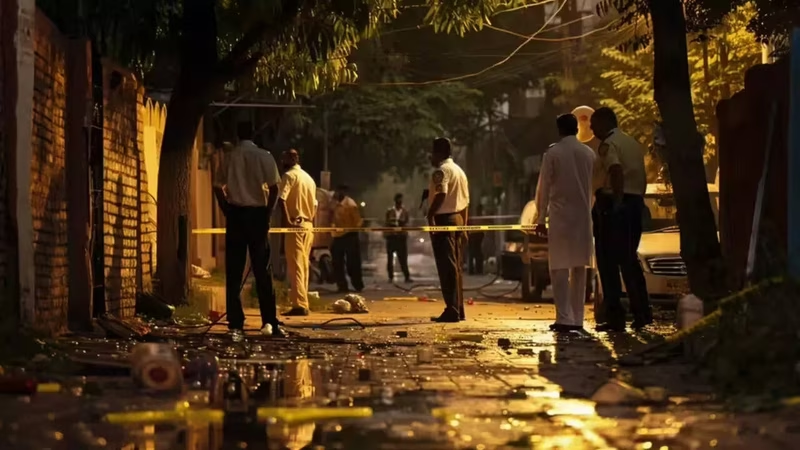
A sum so small it barely buys a cup of tea. Yet in a cramped Delhi neighborhood, ₹20 became the flashpoint for a double tragedy that has left a family shattered and a city stunned. According to police reports from December 26, 2025, a 38-year-old man allegedly strangled his wife to death after she refused to hand over just twenty rupees. Minutes later, consumed by guilt or despair—or both—he walked to a nearby railway track and jumped in front of an oncoming train. This chilling incident, now confirmed as a homicide followed by suicide, has ignited a national conversation about mental health, domestic abuse, and the hidden pressures tearing at India’s urban households. At the heart of it all lies a question that won’t go away: how could something so trivial unleash such irreversible violence?
Table of Contents
- The Delhi Homicide Over ₹20: What Happened?
- Police Investigation: Autopsy and Initial Confusion
- Delhi Homicide Over ₹20: The Human Story
- Was Addiction or Mental Illness a Factor?
- Broader Patterns: Domestic Violence in Urban India
- What Can Be Done? Prevention and Support Systems
- Conclusion: A Tragedy That Couldn’t Be Ignored
- Sources
The Delhi Homicide Over ₹20: What Happened?
The incident unfolded in the early hours of December 26, 2025, in the Mustafabad area of North East Delhi. Neighbors reported hearing a brief but intense argument from the couple’s one-room apartment around 4:30 AM. According to preliminary statements from family members, the husband—a daily wage laborer—asked his wife for ₹20, reportedly to buy cigarettes or tea. When she refused, citing household expenses, the argument escalated violently .
Minutes later, the man was seen running from the house toward the nearby railway tracks. Witnesses say he stood calmly on the tracks until the 5:15 AM local train struck him. Meanwhile, the wife was found unresponsive in their home. She had been manually strangled.
Police Investigation: Autopsy and Initial Confusion
Initially, the case was shrouded in ambiguity. Family members gave conflicting accounts—some suggesting a mutual suicide pact, others hinting at an accident. However, a post-mortem examination conducted at GTB Hospital left no room for doubt: the wife’s death was ruled a **homicide by manual strangulation**, with clear ligature marks and internal trauma consistent with assault .
The man’s death was confirmed as suicide by the railway police. Crucially, investigators recovered a mobile phone and a diary from the couple’s home, which are now being analyzed for clues about their relationship, financial stress, and the husband’s mental state in the days leading up to the tragedy .
Delhi Homicide Over ₹20: The Human Story
Behind the headlines is a family in ruins. The couple, married for 12 years, had two children—a 10-year-old boy and a 7-year-old girl—who are now orphans. Relatives describe the husband as “increasingly irritable” over the past year, often unemployed, and prone to mood swings. The wife, by contrast, was seen as the family’s backbone, working part-time as a tailor to make ends meet .
Friends say the couple had frequent arguments over money, but nothing that suggested lethal violence. “He wasn’t a bad man,” said a neighbor. “But lately, he seemed lost—like he couldn’t handle the pressure anymore.”
Was Addiction or Mental Illness a Factor?
Delhi Police have launched a parallel inquiry into whether substance abuse or untreated mental health conditions played a role. Preliminary toxicology reports are pending, but sources within the investigation suggest the husband may have been struggling with alcohol dependence—a detail echoed by family members who asked not to be named .
This aligns with a disturbing trend. According to the World Health Organization (WHO), nearly 7.5% of India’s population suffers from some form of mental disorder, yet fewer than 1 in 10 receive adequate care . When combined with financial stress, job insecurity, and social stigma, the results can be catastrophic.
Broader Patterns: Domestic Violence in Urban India
While the ₹20 detail is jarring, experts warn against dismissing this as an isolated incident. Data from the National Crime Records Bureau (NCRB) shows that **domestic violence accounts for nearly 30% of all crimes against women in India**—and urban centers like Delhi are not immune .
What makes this case emblematic is how trivial financial disputes can become flashpoints in households under chronic stress. Rising inflation, stagnant wages, and lack of social safety nets are creating a pressure cooker environment in many low-income homes.
What Can Be Done? Prevention and Support Systems
Preventing future tragedies like this **Delhi homicide over ₹20** requires a multi-pronged approach:
- Community mental health outreach: Integrating counselors into urban local bodies and primary health centers.
- Domestic violence hotlines with male support programs: Most services focus on victims; perpetrators in crisis also need intervention pathways.
- Financial literacy and stress management workshops in vulnerable neighborhoods, potentially run by NGOs or municipal corporations.
- Early warning systems: Training teachers, ASHA workers, and local police to recognize signs of escalating household conflict.
[INTERNAL_LINK:domestic-violence-resources-india] could be a vital step for cities like Delhi to build resilience from the ground up.
Conclusion: A Tragedy That Couldn’t Be Ignored
The **Delhi homicide over ₹20** is not just a crime story—it’s a mirror held up to the silent crises festering in millions of homes. It reminds us that violence often stems not from grand malice, but from accumulated despair, untreated illness, and the crushing weight of everyday survival. While justice may be served in the legal sense, true healing will require society to look beyond the headlines and start supporting its most vulnerable before it’s too late.
Sources
- Times of India: Delhi homicide: Man kills wife for refusing to give Rs 20; later dies by suicide
- World Health Organization: Mental Health in India
- National Crime Records Bureau (NCRB): Crime in India 2023
- The Hindu: Delhi police probe husband-wife death case
- NDTV: Man kills wife over Rs 20, jumps before train in Delhi