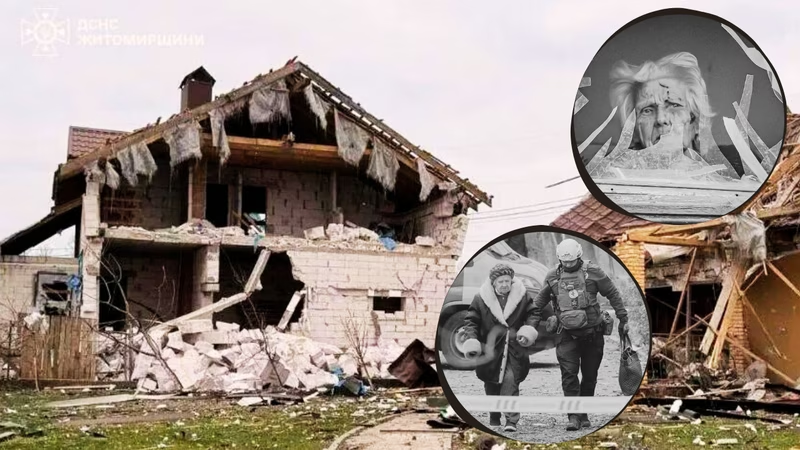
A bitter December wind howls across Kyiv—but for thousands of Ukrainians, the real danger isn’t just the cold. It’s the silence of a furnace that won’t turn on. In the early hours of December 27, 2025, Russia launched one of its most intense barrages of the winter, striking critical energy infrastructure across multiple regions. The result? Widespread blackouts and a chilling humanitarian emergency: **over 2,600 homes left without heating** as temperatures plummet to -12°C (10°F) . This latest **Russia barrage Ukraine power loss** event marks a grim escalation in Moscow’s apparent strategy to weaponize winter itself.
Table of Contents
- What Happened: The Overnight Russia Barrage
- Russia Barrage Ukraine Power Loss: The Human Toll
- Which Regions Were Hit Hardest?
- Ukraine’s Response: Repair and Resilience
- Why Russia Is Targeting Energy in Winter
- How Civilians Are Coping With Blackouts
- Conclusion: A War Fought With Winter as a Weapon
- Sources
What Happened: The Overnight Russia Barrage
According to Ukraine’s Air Force, Russia launched a coordinated assault in the early hours of December 27 involving more than **70 Shahed drones and 15 cruise missiles**, targeting energy facilities in central and western Ukraine . The attack wave began around 2:00 AM local time, overwhelming air defenses in several oblasts.
Ukraine’s Energy Minister, Herman Halushchenko, confirmed that the strikes caused “significant damage” to high-voltage substations and thermal generation units. Emergency crews were dispatched immediately, but full restoration could take days—time civilians don’t have in sub-zero conditions .
Russia Barrage Ukraine Power Loss: The Human Toll
The most alarming consequence is the direct impact on civilians. As of Saturday morning, the State Emergency Service of Ukraine reported that **2,614 residential buildings**—primarily apartment complexes and rural homes—have been disconnected from central heating systems due to the power outages .
In cities like Khmelnytskyi and Rivne, local authorities have opened **emergency warming centers** in schools and municipal buildings. These centers provide hot meals, blankets, and medical aid to vulnerable populations, including the elderly and families with young children .
“We’re not just fighting missiles—we’re fighting frostbite,” said Olena, a resident of Zhytomyr, in a social media post. “My grandmother hasn’t had heat in 18 hours. We’re burning furniture just to stay above freezing.”
Which Regions Were Hit Hardest?
Initial damage assessments point to four oblasts bearing the bruck of the attack:
- Kyiv Oblast: Partial blackout in western districts; 800+ homes affected.
- Rivne Oblast: Critical damage to a 330kV substation; 900 homes without heat.
- Khmelnytskyi Oblast: Thermal power plant offline; rolling blackouts across the region.
- Zhytomyr Oblast: Multiple drone impacts on energy infrastructure; rural villages completely cut off.
While Kyiv city itself avoided a total blackout thanks to layered air defenses, the surrounding regions—less protected—suffered severe infrastructure damage .
Ukraine’s Response: Repair and Resilience
Ukraine’s state energy company, Ukrenergo, has activated its “Blackout Protocol Alpha,” prioritizing hospitals, water pumps, and emergency shelters for power restoration. Repair teams are working in 12-hour shifts under armed escort due to the risk of follow-up strikes .
President Volodymyr Zelenskyy addressed the nation on Saturday, condemning the attack as “a deliberate war crime against civilians” and urging Western allies to accelerate deliveries of air defense systems like NASAMS and IRIS-T . [INTERNAL_LINK:ukraine-air-defense-requests]
Why Russia Is Targeting Energy in Winter
This is not a new tactic—but it’s becoming more systematic. Since October 2022, Russia has repeatedly targeted Ukraine’s energy grid, but the timing and scale of winter strikes suggest a clear strategic goal: to break civilian morale by making daily survival unbearable .
Experts from the Institute for the Study of War note that these attacks are designed to “maximize suffering during the coldest months,” forcing displacement and straining Ukraine’s already overstretched humanitarian resources .
How Civilians Are Coping With Blackouts
Across affected areas, communities are showing remarkable resilience:
- Neighborhood watch networks are sharing generators and checking on elderly neighbors.
- Local businesses** are offering free charging stations and hot drinks.
- Digital blackout maps** on Telegram help residents locate warming centers in real time.
Still, the psychological toll is mounting. “You can’t sleep when you’re worried your pipes will freeze—or your child will get sick,” said a schoolteacher from Rivne. “This is terror by thermostat.”
Conclusion: A War Fought With Winter as a Weapon
The **Russia barrage Ukraine power loss** on December 27 is more than an infrastructure failure—it’s a calculated assault on civilian endurance. With over 2,600 homes in the dark and temperatures dangerously low, Ukraine’s fight is now as much about keeping its people warm as it is about defending its borders. As the world watches, the question remains: will international support arrive fast enough to outpace the frost?
Sources
- Times of India: Russia barrage: Ukraine faces massive power loss
- Ukraine Air Force Official Telegram Channel
- Institute for the Study of War: Russian Offensive Campaign Assessment
- Reuters: Ukraine struggles to restore power after Russian strikes
- BBC: Ukraine winter crisis deepens amid Russian energy attacks