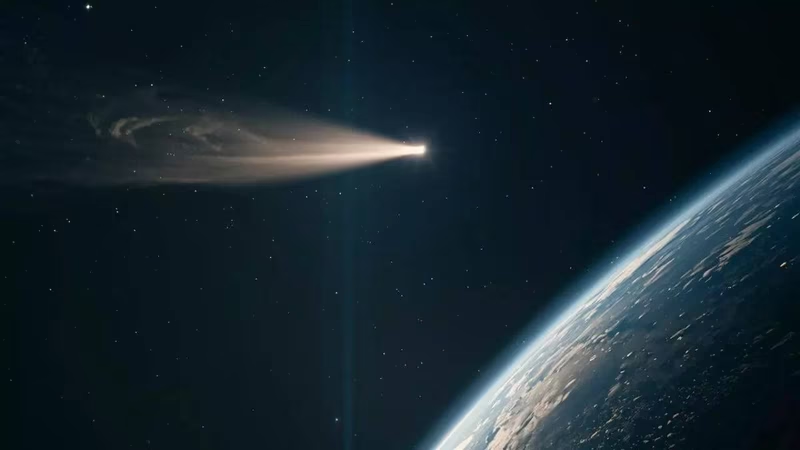
Imagine a visitor from another galaxy, tumbling through our solar system for the first and only time in its existence. This isn’t science fiction—it’s the reality of interstellar comet 3I/ATLAS, a cosmic wanderer that’s giving astronomers an unprecedented front-row seat to alien geology. And now, it’s showing off a bizarre dance of wobbling jets that’s rewriting the textbooks. Let’s dive into what this truly means for our understanding of the universe.
Table of Contents
- What is Interstellar Comet 3I/ATLAS?
- The Shocking Discovery of Wobbling Jets
- Decoding the Anti-Tail: A Cosmic Illusion
- Why Wobbling Jets on 3I/ATLAS Matter
- 3I/ATLAS vs. ‘Oumuamua and Borisov: A Cosmic Lineup
- Conclusion: What 3I/ATLAS Teaches Us About Our Place in the Galaxy
- Sources
What is Interstellar Comet 3I/ATLAS?
Discovered on July 1, 2025, by the ATLAS survey telescope in Chile, 3I/ATLAS is only the third confirmed interstellar object to grace our solar system, following the enigmatic 1I/‘Oumuamua and the comet-like 2I/Borisov . The ‘3I’ in its name officially designates it as the third interstellar object ever found. With a hyperbolic excess velocity of a staggering 57 km/s, its trajectory confirms it’s not bound to our Sun and is merely a traveler passing through .
Unlike its predecessors, 3I/ATLAS was spotted early in its journey, while it was still far beyond Jupiter’s orbit. This gave scientists a rare, extended window to study a pristine chunk of another star system as it’s gradually “awakened” by our Sun’s heat—a process we’ve never been able to observe in real-time until now .
The Shocking Discovery of Wobbling Jets
Over a dedicated 37-night observation campaign from July to September 2025, an international team of astronomers witnessed something extraordinary: massive, jet-like structures in the comet’s coma that were wobbling in a regular, predictable pattern . These weren’t just faint wisps; some of these jets stretched for nearly one million kilometers into space .
This rhythmic wobble is a direct clue to the comet’s hidden core. Just like a spinning garden sprinkler, the jets are being flung out from specific points on the comet’s icy nucleus as it rotates. By analyzing the wobble, scientists have calculated that interstellar comet 3I/ATLAS completes one full rotation approximately every 15 hours and 30 minutes . This is a monumental discovery, as it’s the first time we’ve been able to measure the rotation period of an object from outside our solar system.
Decoding the Anti-Tail: A Cosmic Illusion
Adding to the mystery, these wobbling jets were found within a feature that appears to defy logic: an “anti-tail.” While a comet’s primary tail is famously blown away from the Sun by the solar wind, an anti-tail is a rare optical illusion. It’s actually a thin, sunward-pointing sheet of dust that lies in the comet’s orbital plane. From our viewpoint on Earth, this dust trail appears to extend straight towards the Sun, creating the illusion of a tail pointing the wrong way .
To see such complex, dynamic jet activity within this already rare feature makes 3I/ATLAS a truly exceptional subject for study .
Why Wobbling Jets on 3I/ATLAS Matter
These wobbling jets are far more than just a cosmic light show. They are a direct probe into the comet’s composition and internal structure.
In comets, jets form when solar heat penetrates the surface, causing subsurface ices (mostly water) to sublimate into gas. This gas builds up pressure and eventually bursts through weaker spots on the nucleus, dragging dust along with it . The specific pattern, strength, and location of these jets can reveal:
- The internal composition: What ices are present and how they are distributed.
- The surface geology: Where the weak spots and cliffs are that allow for jet formation .
- The thermal properties: How efficiently the comet’s surface absorbs and conducts heat.
Since 3I/ATLAS is a pristine object, untouched by our Sun for billions of years, the data from its jets provides a direct, uncontaminated sample of the building blocks of its home planetary system. It’s like having a time capsule from another star delivered right to our doorstep.
3I/ATLAS vs. ‘Oumuamua and Borisov: A Cosmic Lineup
To fully appreciate 3I/ATLAS, it’s crucial to compare it with its famous interstellar siblings.
| Feature | 1I/‘Oumuamua | 2I/Borisov | 3I/ATLAS |
|---|---|---|---|
| Type | Asteroid-like (inactive) | Active Comet | Active Comet |
| Discovery Timing | After perihelion (too late) | Before perihelion | Very early, far from Sun |
| Rotation Period | Complex tumble (unknown) | Unknown | 15.5 hours (measured) |
| Key Feature | Unusual shape, non-gravitational acceleration | Classic cometary activity | Wobbling jets in an anti-tail |
As the table shows, while Borisov was our first look at a “normal” interstellar comet, 3I/ATLAS is offering a far richer, more dynamic dataset due to its early discovery and the unique clarity of its jet activity . [INTERNAL_LINK:interstellar-objects-explained] This trio of visitors is painting a complex picture of the diversity of planetary systems throughout our galaxy.
Conclusion: What 3I/ATLAS Teaches Us About Our Place in the Galaxy
The discovery of wobbling jets on interstellar comet 3I/ATLAS is a landmark achievement in astronomy. It transforms an abstract visitor from another star into a tangible, rotating, geologically active world that we can study in detail. The 15.5-hour rotation period is just the beginning; the composition of the gases in those jets will tell us what its home system was made of. In essence, every puff of gas from this alien iceball is a message from a distant star, helping us understand not just where it came from, but also how common—or rare—our own solar system’s formation story might be.
Sources
- Times of India: Astronomers spot wobbling jets on rare interstellar comet 3I/ATLAS
- ESA: Comet 3I/ATLAS – frequently asked questions
- EarthSky: Interstellar comet 3I/ATLAS reveals weird wobbling jets
- NASA JPL: NASA Discovers Interstellar Comet Moving Through Solar System
- Bolin, B. T., et al. (2025). Interstellar comet 3I/ATLAS: discovery and physical description. Astronomy & Astrophysics.