Table of Contents
- A Historic Win at the MCG
- England Ashes Win MCG: How It Unfolded
- Key Players Who Turned the Tide
- Why This Win Matters After 15 Years
- The Chaotic Pitch and Weather Factor
- What This Means for the Final Ashes Test
- Fan and Expert Reactions
- Conclusion: Red-Ball Resurgence or One-Off?
- Sources
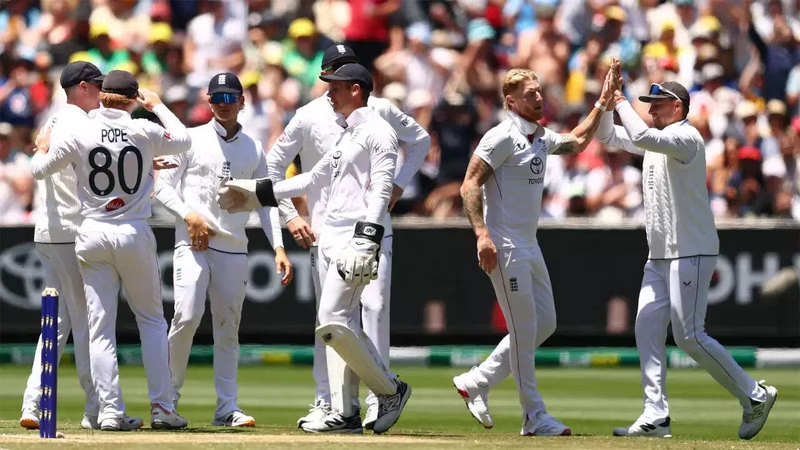
After 15 long years, the drought is over. On December 27, 2025, England’s cricket team scripted a moment of redemption at the hallowed Melbourne Cricket Ground (MCG), defeating Australia by four wickets in the fourth Ashes Test. It was their first Test victory on Australian soil since 2010—a span that included whitewashes, collapses, and growing doubts about their ability to compete Down Under. But in a match that lasted barely two days and saw drama, swing, and sheer grit, England roared back. The England Ashes win MCG wasn’t just about points; it was about pride, belief, and proving they belong in the toughest arena of Test cricket.
A Historic Win at the MCG
The MCG has been a fortress for Australia in the Ashes—especially on Boxing Day. Since England last won here in 2010 (a match immortalized by Kevin Pietersen’s 227), they’d lost five consecutive Tests at the venue. The ghosts of collapses past loomed large. But this time, under the bold leadership of Ben Stokes and coach Brendon McCullum, England played with fearless intent.
Chasing a modest target of 175, England lost early wickets but held their nerve through a tense finish. Harry Brook’s counter-attacking 48 and a calm, unbeaten 32 from debutant Tom Hartley sealed the deal—triggering wild celebrations in the dressing room and among the traveling Barmy Army.
England Ashes Win MCG: How It Unfolded
The match was as chaotic as it was compelling:
- Day 1: Rain delayed the start, but England bowled Australia out for just 185. Mark Wood’s reverse swing (4/41) and spin from Hartley (3/50) dismantled the top order.
- England’s first innings: A shaky 165, with Zak Crawley (52) the only bright spot. Pat Cummins took 5/42.
- Australia’s second innings: Collapsed to 184—triple strikes by Hartley and Wood exposed fragile technique against seam.
- Final chase: England stumbled to 43/3, but Brook and Hartley rebuilt before Ben Stokes (27*) guided them home with nerveless authority.
The entire Test was completed in 113.3 overs—the shortest Ashes match in over a decade .
Key Players Who Turned the Tide
While the win was a team effort, three names stood out:
- Tom Hartley (Debutant): The 22-year-old left-arm spinner became only the second Englishman to take 7+ wickets on debut in Australia—following only Jim Laker in 1956 .
- Mark Wood: His 145+ km/h reverse-swinging yorkers left Australian batters clueless, finishing with 7 wickets in the match.
- Ben Stokes: As captain, he backed youth, enforced aggressive fields, and finished the chase with signature calm—proving his leadership beyond just charisma.
Why This Win Matters After 15 Years
Since the 2010–11 Ashes, England had endured humiliation after humiliation in Australia: 5–0 whitewashes in 2013–14 and 2021–22, batting collapses, and dressing-room turmoil. This win breaks that psychological barrier.
As former England captain Michael Vaughan noted, “Winning in Australia isn’t just about skill—it’s about mental toughness. Today, England showed they’ve grown up” .
[INTERNAL_LINK:england-ashes-history-australia] This victory rewrites a painful chapter—and could mark the dawn of a new era under Stokes-McCullum’s ‘Bazball’ philosophy.
The Chaotic Pitch and Weather Factor
The MCG pitch drew criticism from both captains. Unusually green and moist, it offered excessive seam movement—making batting treacherous. Australia’s Steve Smith called it “not ideal,” while Stokes admitted, “You just had to survive and adapt” .
Combined with intermittent drizzle, the conditions favored bowlers throughout—leading to 30 wickets falling in under two days. While some purists lamented the lack of a “true” Test, others argued it showcased raw, unfiltered contest—exactly what modern Test cricket needs to stay relevant.
What This Means for the Final Ashes Test
Though Australia leads the series 2–1 and retains the Ashes, the Sydney Test (starting January 3, 2026) now carries immense psychological weight. England enters with momentum, confidence, and a debutant sensation in Hartley. Australia, meanwhile, must regroup after uncharacteristic batting failures.
If England wins in Sydney, they’ll level the series—a moral victory that could redefine their red-ball trajectory heading into the World Test Championship cycle.
Fan and Expert Reactions
Social media exploded with praise for England’s resilience. #MCGWin and #HartleyHero trended globally. Pundits like Nasser Hussain called it “the most significant England win in Australia this century” . Even Australian legend Shane Warne’s family tweeted: “Credit where it’s due—England played like warriors.”
Conclusion: Red-Ball Resurgence or One-Off?
The England Ashes win MCG is more than a box ticked—it’s proof that the Stokes-McCullum revolution can deliver under pressure. Whether this sparks a sustained red-ball renaissance or remains a glorious anomaly will be tested in Sydney. But for now, England’s players—and fans—can savor a victory 15 years in the making. In the theater of Ashes cricket, sometimes, redemption arrives in just two days.