Table of Contents
- The Viral Video That Sparked a Storm
- Bageshwar Dham Controversy: Congress Raises Alarm
- BJP’s Defense and the Politics of Faith
- Rules on Government Aircraft: Who Can Fly?
- Symbolism of the ‘Feet-Touching’ Gesture
- Broader Trend: BJP and Spiritual Influencers
- Public Reaction and Ethical Questions
- Conclusion: Where Faith Meets Governance
- Sources
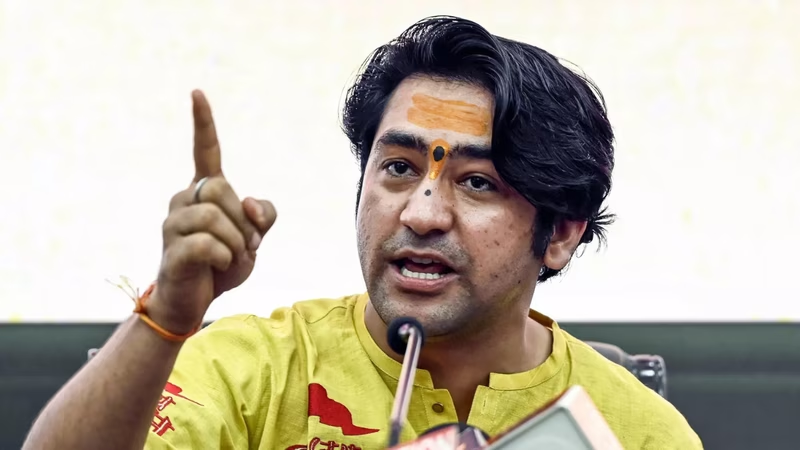
A short video has reignited India’s long-simmering debate over the intersection of religion, state power, and public funds. It shows Dhirendra Krishna Shastri—the head of Bageshwar Dham, a controversial spiritual figure known for his ‘divya darbar’ healing sessions—stepping off a government aircraft. In another clip, a uniformed police officer is seen touching Shastri’s feet in a gesture of reverence. The footage, now widely circulated on social media, has triggered sharp criticism from the Congress party, which calls it a textbook case of the Bageshwar Dham controversy—a symbol of the ruling BJP’s alleged preferential treatment of certain religious personalities at taxpayer expense.
The Viral Video That Sparked a Storm
The video, reportedly shot in late December 2025, shows Shastri disembarking from what appears to be a BSF or state government aircraft, accompanied by aides and local officials. The second clip—showing a police officer prostrating and touching the seer’s feet—quickly went viral, drawing both devotion from followers and outrage from critics.
While Shastri has millions of devotees who credit him with spiritual and even miraculous interventions, he has also faced repeated scrutiny. In 2024, he was summoned by the Madhya Pradesh High Court to explain claims of supernatural powers—a case that remains sub judice . Despite controversies, his political access appears to be growing.
Bageshwar Dham Controversy: Congress Raises Alarm
The Congress party wasted no time in condemning the incident. Senior leader Jairam Ramesh called it “a gross misuse of public resources” and demanded a probe into who authorized the use of a government aircraft for a “private religious figure” .
“When crores are spent on subsidizing flights for spiritual influencers while ordinary citizens struggle to afford train tickets, it shows where the government’s priorities lie,” Ramesh stated. The party emphasized that government aircraft are meant for official duties—not for ferrying godmen or facilitating darshan tours .
They also questioned the optics of a police officer—a public servant sworn to uphold secular law—performing a religious act in uniform. “This blurs the line between state and religion, violating the spirit of our Constitution,” another Congress spokesperson added.
BJP’s Defense and the Politics of Faith
The BJP has hit back, dismissing the criticism as “pseudo-secularism.” Party leaders argue that Shastri was invited to attend a “cultural and spiritual event” sanctioned by the state government, making the air travel legitimate under official hospitality protocols.
“Why should spiritual leaders be denied the same respect given to film stars or cricketers?” asked a BJP MP, highlighting that other celebrities have used government transport for official functions .
However, critics point out a key difference: while a sports icon might be invited for a state-sponsored youth event, Shastri’s appearances are inherently religious—and his organization, Bageshwar Dham, is not a registered cultural body but a faith-based institution with commercial ventures, including merchandise and paid darshans.
Rules on Government Aircraft: Who Can Fly?
According to the Ministry of Home Affairs’ 2021 guidelines, government aircraft (operated by BSF, IAF, or state aviation wings) can only be used by:
- Constitutional authorities (President, Governors, etc.)
- Union and state ministers on official duty
- Foreign dignitaries on state visits
- “Exceptional circumstances” with written approval from the Chief Secretary or Cabinet Secretary
Private citizens—including religious leaders—can only be flown if part of an officially sanctioned delegation, and even then, must pay commercial charter rates. No such payment or approval documentation has been made public in this case .
[INTERNAL_LINK:misuse-of-government-resources-india] This isn’t the first time such allegations have surfaced—but the scale of visibility makes it politically potent.
Symbolism of the ‘Feet-Touching’ Gesture
Beyond the aircraft issue, the image of a police officer touching Shastri’s feet has sparked intense debate. In Indian culture, touching feet is a mark of deep respect—usually reserved for elders or gurus in private settings.
When performed by a public official in uniform, however, it sends a message that the state endorses or venerates a particular religious figure. Legal experts note that while not illegal, it violates service conduct rules that require neutrality and secular conduct .
Broader Trend: BJP and Spiritual Influencers
This incident fits into a larger pattern. Over the past decade, the BJP has cultivated close ties with a new generation of “digital sadhus”—tech-savvy, media-friendly spiritual leaders who command massive online followings.
From Morari Bapu to now Dhirendra Shastri, these figures often echo nationalist narratives and enjoy access to high-level platforms. Critics argue this symbiosis helps the party consolidate the “Hindu vote,” while supporters see it as reclaiming India’s spiritual heritage.
Public Reaction and Ethical Questions
Public opinion is deeply divided. On X (formerly Twitter), hashtags like #BageshwarDham and #StopMisuseOfGovtFunds trended with millions of views. Devotees defended Shastri as a “modern-day saint,” while others asked: “If my father-in-law can’t get a govt plane for cancer treatment, why can a seer?”
Ethically, the core question remains: should public infrastructure be used to elevate private religious figures—no matter how popular?
Conclusion: Where Faith Meets Governance
The Bageshwar Dham controversy is more than a viral moment—it’s a litmus test for India’s commitment to secular governance. While faith is personal, state resources are public. Using taxpayer-funded assets to honor one religious figure risks alienating millions of others and undermines the neutrality expected of public institutions. As political parties trade barbs, the real issue isn’t just about one flight or one gesture—it’s about who the state serves in a diverse democracy.
Sources
- The Times of India: Congress Targets Bageshwar Dham Head’s Govt Plane Use
- Ministry of Home Affairs – Guidelines on Use of Govt Aircraft (2021)
- Constitution of India – Article 25–28 (Freedom of Religion & Secularism)
- The Hindu: MP High Court Summons Bageshwar Dham Head
- Centre for Civil Society – India Governance Report 2024