Table of Contents
- A Tale of Two Billionaires
- Robert Kraft: From Paper to Patriots
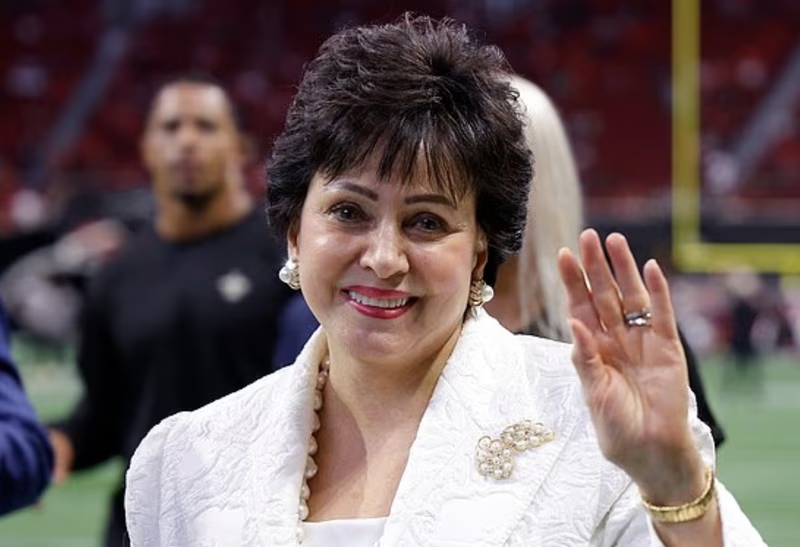
- Gayle Benson: Inheriting a Legacy, Forging Her Own Path
- NFL Owners Net Worth: Comparing the Fortunes
- Ownership Styles and Community Impact
- What the Future Holds
- Conclusion: Two Paths, One League
- Sources
In the high-stakes world of professional sports, ownership isn’t just about trophies—it’s about billions. Among the NFL’s elite, Robert Kraft (New England Patriots) and Gayle Benson (New Orleans Saints and NBA’s Pelicans) stand out not just for their wealth, but for how they got it. One is a self-made industrialist who turned packaging into a sports dynasty. The other inherited a franchise and became a rare female powerbroker in male-dominated leagues. Their contrasting journeys offer a fascinating lens into the evolving landscape of American sports ownership—and the true meaning of NFL owners net worth.
A Tale of Two Billionaires
At first glance, Kraft and Benson share little beyond their billionaire status and team logos. Kraft, 83, built his fortune through relentless entrepreneurship. Benson, 82, stepped into leadership after the death of her husband, Tom Benson, in 2018. Yet both have defied expectations—Kraft by transforming a middling franchise into a six-time Super Bowl champion, and Benson by proving women can steward major sports empires with grace and authority.
Their stories reflect two archetypes in American capitalism: the builder and the steward. And in today’s NFL, both models are not just viable—they’re essential.
Robert Kraft: From Paper to Patriots
Robert Kraft’s rise reads like a classic American success story. After graduating from Harvard Business School, he bought a small Boston-based packaging company in the 1970s. Through savvy acquisitions and vertical integration, he grew it into International Forest Products (IFP), one of the largest paper and packaging firms in the U.S.
His big break came in 1985 when he purchased the mortgage on Foxboro Stadium—the home of the struggling New England Patriots—for $22 million. A decade later, in 1994, he bought the team itself for a then-record $172 million .
Under Kraft’s leadership, the Patriots became the NFL’s most dominant franchise of the 21st century, winning six Super Bowls with Tom Brady and Bill Belichick. His business acumen extended beyond football: he co-founded the Kraft Group, which includes real estate, private equity, and even a Major League Soccer team (New England Revolution).
Today, Forbes estimates Kraft’s net worth at **$12.5 billion**—most of it self-made .
Gayle Benson: Inheriting a Legacy, Forging Her Own Path
Gayle Benson’s path began much later in life. She married Tom Benson—a car dealership magnate and owner of the Saints and Pelicans—in 2004, decades after his business empire was established. When Tom passed away in 2018, he left full control of both franchises to Gayle, making her the NFL’s only female principal owner at the time.
Initially met with skepticism, Gayle quickly proved her mettle. She retained key executives, maintained stability, and became a vocal advocate for New Orleans—especially during crises like Hurricane Ida and the pandemic. She also championed diversity, hiring the NFL’s first female team president, Rita Benson LeBlanc (her stepdaughter), and later supporting initiatives for women in sports leadership.
While her wealth is largely inherited, Gayle has actively shaped the franchises’ culture. The Saints and Pelicans have remained competitive, and she’s invested heavily in community programs, from youth sports to mental health awareness.
Her net worth is estimated at **$3.6 billion**, tied primarily to the value of the Saints ($4.7 billion) and Pelicans ($2.4 billion), which have appreciated significantly since Tom Benson’s death .
NFL Owners Net Worth: Comparing the Fortunes
When it comes to NFL owners net worth, Kraft leads by a wide margin—but context matters:
| Owner | Team(s) | Net Worth (Est.) | Wealth Origin |
|---|---|---|---|
| Robert Kraft | New England Patriots | $12.5B | Self-made (paper, packaging, real estate) |
| Gayle Benson | New Orleans Saints, New Orleans Pelicans | $3.6B | Inherited (auto dealerships, sports franchises) |
While Kraft’s empire is larger, Benson’s dual-sport ownership is rare. Only a handful of individuals own teams in both the NFL and NBA—and she’s the only woman to do so .
Ownership Styles and Community Impact
Kraft’s approach is analytical and brand-focused. He’s leveraged the Patriots’ success into global merchandise, media deals, and even philanthropy through the Kraft Foundation—donating over $30 million to combat antisemitism and support education .
Benson, meanwhile, prioritizes local loyalty. She kept the Saints in New Orleans after Hurricane Katrina—a move that saved the city’s spirit—and continues to fund local hospitals, schools, and cultural institutions. Her leadership style is consensus-driven, emphasizing continuity over disruption.
Both models work. Kraft built a dynasty; Benson preserved a community institution.
What the Future Holds
As both owners approach their 80s, succession planning looms. Kraft’s son, Jonathan, is CEO of the Kraft Group and likely heir. Gayle Benson has not named a successor, but her family trust controls the teams long-term.
What’s clear is that their legacies won’t just be measured in wins, but in how they redefined what it means to own a team in modern America.
Conclusion: Two Paths, One League
Robert Kraft and Gayle Benson embody the duality of the American dream in sports: one through creation, the other through stewardship. Their contrasting routes to becoming among the wealthiest NFL owners net worth holders reveal that success in franchise ownership isn’t just about money—it’s about vision, values, and connection to community. Whether you admire the builder or the guardian, their impact on the NFL is undeniable.