Table of Contents
- Congress Declares War to ‘Save MGNREGA’
- What Is the ‘Unilateral Decision’?
- Why MGNREGA Matters to India’s Poor
- Political Battle Over Gandhis’ Legacy
- BJP’s Stance and Broader Policy Shifts
- What to Expect from the Nationwide Protest
- Conclusion: A Scheme or a Symbol?
- Sources
In a dramatic escalation of political tensions, the Indian National Congress has launched a nationwide movement to Save MGNREGA, the Mahatma Gandhi National Rural Employment Guarantee Act. The party claims the Prime Minister’s Office (PMO) has taken a unilateral decision to dilute or restructure the flagship rural jobs scheme—without consulting stakeholders or even Parliament. With emotional rhetoric about protecting the legacy of the Gandhi family and the livelihoods of millions, Congress is framing this as not just a policy dispute, but a battle for India’s social conscience.
Congress Declares War to ‘Save MGNREGA’
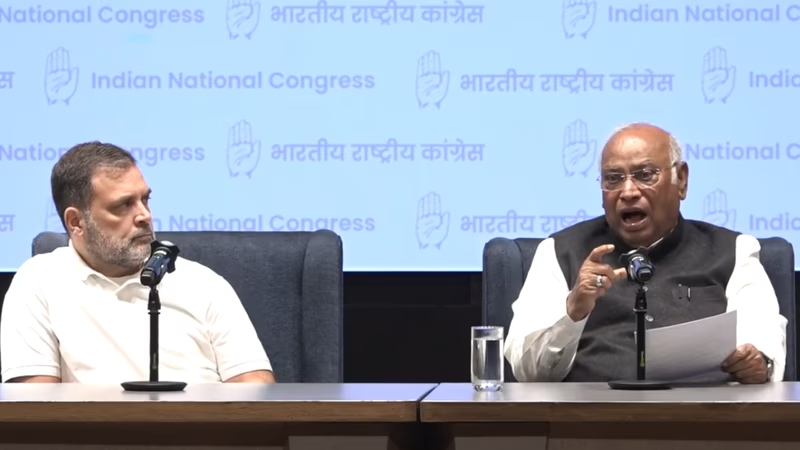
On December 27, 2025, senior Congress leaders announced a nationwide agitation under the banner “Save MGNREGA.” The movement, they say, is a direct response to what they describe as a “conspiracy” by the ruling BJP government to dismantle one of India’s most vital social safety nets.
“We will not allow the PMO to erase the name of Mahatma Gandhi from this historic Act,” declared a Congress spokesperson, alleging that the government is attempting to rebrand or depoliticize the scheme by subtly removing its association with the Gandhi name—a move they see as both symbolic and strategic .
The party has called on its state units, youth wings, and allied civil society groups to mobilize mass protests in villages, district headquarters, and state capitals starting next week. The slogan “We’ll fight” has become the rallying cry of this new campaign.
What Is the ‘Unilateral Decision’?
While the Congress has not provided full documentation of the alleged decision, it claims the PMO recently issued confidential internal directives to modify how MGNREGA is implemented—potentially reducing wage rates, limiting work days, or changing fund allocation mechanisms without public announcement or legislative approval .
Notably, the Ministry of Rural Development has not officially confirmed any such changes. However, recent budget allocations and implementation reports have shown a steady decline in MGNREGA funding and a backlog in wage payments—issues that civil society groups like the Right to Food Campaign have been highlighting for months .
Congress leaders argue that bypassing Parliament and stakeholder consultations violates democratic norms. “This is not governance—it’s diktat,” said one senior MP, accusing the PMO of centralizing policy-making in an opaque manner.
Why MGNREGA Matters to India’s Poor
Enacted in 2005 under the UPA government led by Prime Minister Manmohan Singh—and championed by then-UPA Chairperson Sonia Gandhi—MGNREGA guarantees 100 days of wage employment per year to every rural household whose adult members volunteer to do unskilled manual work.
The scheme has been a lifeline for over 80 million households annually, especially during economic shocks like droughts, floods, or pandemics. Key impacts include:
- Income security for landless laborers and marginalized communities
- Reduction in distress migration from villages to cities
- Asset creation like ponds, roads, and water conservation structures
- Empowerment of women, who constitute nearly half of all workers under the scheme
According to World Bank evaluations, MGNREGA has played a measurable role in poverty reduction and rural wage stabilization . To many, it’s not just a program—it’s a right enshrined in law.
Political Battle Over Gandhis’ Legacy
The Congress is framing the issue as more than administrative—it’s symbolic. By naming the act after Mahatma Gandhi, the UPA government linked the scheme to India’s founding values of dignity of labor and rural self-reliance.
Now, Congress leaders allege that the BJP is systematically trying to “de-Gandhify” national institutions and programs. This follows earlier controversies over statues, textbooks, and public commemorations. “This is a conspiracy to remove the Gandhis’ name from every public good they helped create,” a party leader claimed .
For the BJP, distancing from the Gandhi name may be part of a broader ideological project to assert a new nationalist narrative. But for the Congress, defending MGNREGA is about defending its own historical contribution to social welfare—and its political identity.
BJP’s Stance and Broader Policy Shifts
While the BJP has not officially responded to the latest Congress allegations, its past statements suggest a different vision for rural development. Party leaders have often criticized MGNREGA as a “dole culture” and advocated for skill-based employment and private-sector-led growth instead .
Recent government initiatives like the Pradhan Mantri Kaushal Vikas Yojana (PMKVY) and expansion of micro-irrigation schemes reflect this shift. Critics argue, however, that these cannot replace MGNREGA’s role as a demand-driven, legally guaranteed safety net.
[INTERNAL_LINK:mgnrega-vs-skill-india-rural-employment-policy] This tension between universal entitlements and targeted upskilling defines the current ideological clash in rural policy.
What to Expect from the Nationwide Protest
The Congress’s ‘Save MGNREGA’ movement is likely to include:
- Rural rallies in MGNREGA-active districts across Bihar, Jharkhand, Odisha, Rajasthan, and Tamil Nadu
- Social media blitz using hashtags like #SaveMGNREGA and #GandhisNameIsOurPride
- Parliamentary disruptions during the winter session if the issue isn’t addressed
- Alliances with farmer and labor unions to amplify grassroots pressure
The success of the movement will depend on its ability to resonate beyond party lines—especially among the rural poor who rely on the scheme regardless of political affiliation.
Conclusion: A Scheme or a Symbol?
At its core, the ‘Save MGNREGA’ campaign is both a political maneuver and a genuine defense of a critical welfare program. Whether the PMO has truly made a unilateral decision remains to be independently verified. But the controversy underscores a deeper truth: MGNREGA is not just a government scheme—it’s a social contract with India’s rural workforce.
As the Congress vows to fight, the real test will be whether this movement can shift public discourse back to the needs of the vulnerable—and whether the government will engage transparently on the future of one of the world’s largest public works programs.