A single video clip. A shouted claim of a threat. And within hours, Pakistan’s military-judicial machinery roared into action—summoning a British diplomat, launching a national security probe, and forcing the opposition PTI party to delete the incendiary footage.
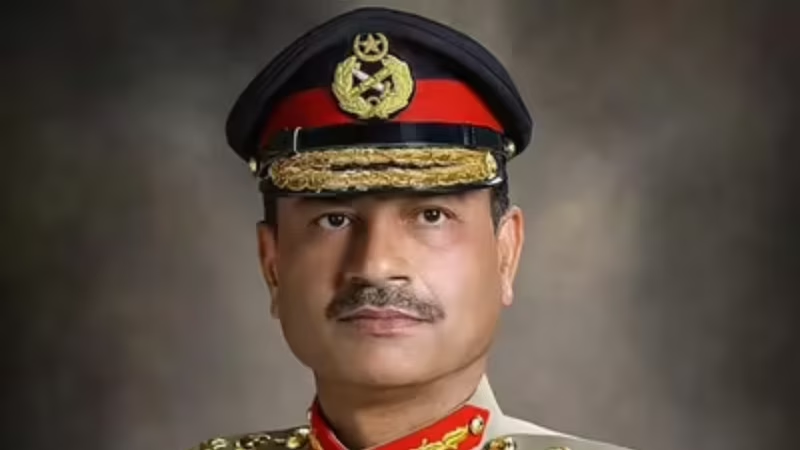
The target? General Asim Munir, Pakistan’s powerful Chief of Army Staff. The accusation? That someone in the crowd at a recent Imran Khan-backed rally had openly threatened his life. Though no direct threat was visible in the widely circulated clip, the mere suggestion—broadcast to millions—was enough to trigger a full-blown crisis.
Now, Pakistan has officially summoned the UK Deputy High Commissioner in Islamabad, citing concerns that the rally—held in London—may have violated British laws on incitement. The move has escalated tensions between Rawalpindi and London, even as PTI scrambles to distance itself from the fallout.
This isn’t just about a video. It’s about the fragile balance of power in Pakistan, where any perceived challenge to the military is treated as an existential threat.
Table of Contents
- What Happened: The Viral Video Explained
- Asim Munir Threat: Pakistan Reacts
- Why the UK Was Summoned
- PTI’s Response and Video Takedown
- Broader Implications for Pakistan Politics
- UK-Pakistan Relations at a Crossroads
- Conclusion: When Rhetoric Meets National Security
- Sources
What Happened: The Viral Video Explained
On December 24, 2025, supporters of Pakistan Tehreek-e-Insaf (PTI) held a large rally in Walthamstow, East London—a regular gathering point for the Pakistani diaspora. During the event, speaker after speaker criticized Pakistan’s military establishment, a common theme since Imran Khan’s 2023 ouster.
At one point, a man in the crowd reportedly shouted something inaudible. Moments later, a speaker on stage claimed, “Someone just threatened General Asim Munir!” The crowd erupted. The clip—though showing no clear threat or individual—was rapidly edited and shared across X (Twitter), WhatsApp, and TikTok with captions like “Open call to kill army chief!”
Within 12 hours, the video had amassed over 2 million views. By the next morning, Pakistan’s Inter-Services Public Relations (ISPR) issued a stern statement: “Any threat to the Chief of Army Staff will be dealt with under the full might of the law.”
Asim Munir Threat: Pakistan Reacts
The reaction from Pakistan’s security apparatus was swift and severe:
- The Federal Investigation Agency (FIA) launched a cybercrime probe to trace the origin of the video and identify the speaker.
- The Ministry of Interior placed General Munir under enhanced security protocol, though officials insist no credible intelligence threat exists.
- Most significantly, the Foreign Office summoned the UK Deputy High Commissioner to demand an investigation into whether UK event laws were breached .
“Pakistan expects its strategic partners to prevent the use of their soil for activities that endanger its national security,” a Foreign Office spokesperson stated.
Why the UK Was Summoned
Pakistan’s decision to summon a UK diplomat is highly unusual—and politically loaded.
Under the UK’s Public Order Act 1986, it’s illegal to use threatening, abusive, or insulting words “with intent to cause harassment, alarm, or distress.” If the speaker did indeed issue a direct threat—even once—it could constitute a criminal act.
But experts question whether Pakistan’s move is about law—or messaging.
“This is less about jurisprudence and more about deterrence,” says Dr. Ayesha Siddiqa, a senior fellow at King’s College London and author of Military Inc. “The Pakistani military wants to signal that even overseas rallies must stay within red lines. Summoning a diplomat amplifies that message globally.”
The UK Foreign Office has acknowledged the summons and stated it “takes all reports of threats seriously,” but stopped short of confirming any investigation .
PTI’s Response and Video Takedown
Facing intense pressure, PTI moved quickly to contain the damage.
The party’s official YouTube channel and X account deleted the rally video within 24 hours of its circulation. Senior PTI leader Shah Mahmood Qureshi issued a statement: “PTI condemns any form of violence or threat against any individual, including General Munir. The party adheres to peaceful protest.”
However, critics argue this is damage control, not principle. “PTI knows crossing the military red line means instant blacklisting,” notes Islamabad-based analyst Hasan Askari. “They’ll say anything to survive.”
Notably, Imran Khan—currently in Adiala Jail—has not commented, likely to avoid further legal entanglement under Pakistan’s strict cybercrime and sedition laws.
Broader Implications for Pakistan Politics
This incident underscores a harsh reality: in Pakistan, the military remains the ultimate arbiter of political legitimacy.
Since 2023, PTI has been systematically dismantled—its candidates barred from elections, its offices sealed, its leaders jailed. Yet, it retains massive public support, especially among youth and the diaspora. Rallies like the one in London are among its few remaining platforms.
But as this episode shows, even overseas dissent carries risk. The military’s reach now extends beyond borders, leveraging diplomacy, media, and legal channels to silence perceived threats.
For ordinary Pakistanis, the message is clear: criticize policy, but never the person of the army chief.
UK-Pakistan Relations at a Crossroads
The diplomatic row comes at a sensitive time. The UK is home to over 1.5 million people of Pakistani origin—the largest diaspora outside the Middle East. It’s also a key partner in counterterrorism and defense training.
Yet tensions have simmered over London’s perceived leniency toward anti-military activism. In 2024, Pakistan recalled its envoy temporarily after a similar rally featured banners calling for “Army Chief to step down.”
If the UK refuses to act on this latest incident, it could strain defense cooperation and visa policies. But if it cracks down on free speech, it risks backlash from its own citizens.
It’s a diplomatic tightrope—one that may define the next chapter of UK-Pakistan relations.
Conclusion: When Rhetoric Meets National Security
The Asim Munir threat controversy may have started with an ambiguous shout in a London park. But its fallout reveals much deeper fault lines: between free speech and national security, diaspora activism and state power, and the enduring shadow of Pakistan’s military over its democracy.
Whether the video contained an actual threat may never be proven. But in Pakistan’s political calculus, perception is reality. And right now, the perception is that any challenge to the army chief—real or imagined—is a line that cannot be crossed.
[INTERNAL_LINK:pakistan-army-chief-role-explained] | [INTERNAL_LINK:pti-political-crisis-2025]
Sources
- The Times of India. “Pakistan summons UK deputy HC over protest video claiming attack on army chief Asim Munir.” Link
- UK Foreign, Commonwealth & Development Office. “Statement on Pakistan Diplomatic Engagement,” December 26, 2025.
- Dr. Ayesha Siddiqa, Military Inc.: Inside Pakistan’s Military Economy, Pluto Press, 2007.