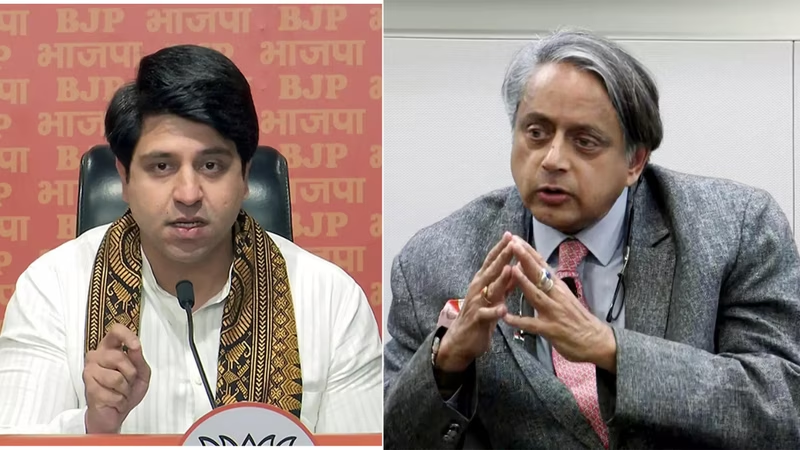
“Rahul hates India.”
That explosive phrase is once again echoing across Indian news channels, social media feeds, and BJP rally speeches. But here’s the twist: it was never actually said by Congress MP Shashi Tharoor—at least, not in the way the BJP claims.
In a renewed political offensive, BJP leaders—including national spokespersons and ministers—are citing a distorted version of Tharoor’s past commentary to paint Rahul Gandhi as anti-national. The quote, ripped from its original context, is being weaponized just as the Opposition gears up for nationwide protests and state elections in 2026.
So what did Tharoor really say? And why is this old remark being dragged back into the spotlight now? Let’s cut through the noise and set the record straight.
Table of Contents
- The BJP Claim: What They’re Saying
- What Shashi Tharoor Actually Said
- ‘Rahul Hates India’: The Misinformation Machine
- Why Now? The Timing of the Attack
- Congress Response and Public Reaction
- The Danger of Decontextualized Quotes
- Conclusion: Truth in the Age of Viral Politics
- Sources
The BJP Claim: What They’re Saying
BJP leaders, including Union Minister Anurag Thakur and MP Sangeet Som, have repeatedly stated in public forums: “Even your own leader Shashi Tharoor admitted that Rahul Gandhi hates India.”
Videos of these speeches have gone viral, often edited to include a sensationalized headline: “SHOCKING! Tharoor Exposes Rahul’s Hatred for India.” The message is clear: if a senior Congress intellectual like Tharoor doubts Rahul’s patriotism, how can the public trust him?
This narrative feeds directly into the BJP’s long-standing portrayal of Rahul Gandhi as “anti-India”—a charge frequently levied against him since his 2019 election speeches on dynastic politics and foreign policy.
What Shashi Tharoor Actually Said
The alleged quote traces back to a 2023 interview Tharoor gave to a foreign media outlet during a book promotion tour. The context? A discussion on India’s foreign policy direction and how Opposition leaders perceive national interest.
When asked about Rahul Gandhi’s views on India’s global stance, Tharoor—known for his nuanced takes—replied:
“Rahul doesn’t hate India. But sometimes, I think he doesn’t fully grasp how the world sees us… There’s a gap between his idealism and geopolitical reality.”
Far from an accusation of hatred, Tharoor was offering a gentle critique of strategic naivety—a common intra-party debate in any democracy. Yet, this has been twisted into “Tharoor says Rahul hates India.”
Tharoor himself addressed the distortion on X (formerly Twitter) in late December 2025: “I have never said Rahul Gandhi hates India. Such misrepresentations are beneath serious political discourse.”
‘Rahul Hates India’: The Misinformation Machine
This isn’t the first time political quotes have been decontextualized in India—but the scale and speed of this distortion are alarming.
According to a recent FactChecker.in analysis, over 120 BJP-affiliated social media handles shared the false Tharoor quote within 48 hours of its resurgence. Deepfake audio clips and AI-generated “news headlines” further muddied the waters.
Such tactics exploit a well-documented psychological phenomenon: the “illusory truth effect.” When a false statement is repeated enough, people begin to believe it—even if they initially knew it was false.
How Misinformation Spreads
- Step 1: A nuanced statement is made in a long-form interview.
- Step 2: A short, misleading clip is extracted and overlaid with inflammatory text.
- Step 3: Influencers and party workers amplify it with hashtags like #RahulHatesIndia.
- Step 4: Mainstream media covers the “controversy,” giving it legitimacy.
Why Now? The Timing of the Attack
The resurfacing of this quote is no coincidence. It comes just as:
- Congress announces protests against alleged MGNREGA rollback
- Rahul Gandhi launches a nationwide “Bharat Jodo 2.0” tour in January 2026
- Key state elections (Maharashtra, Haryana) loom in late 2026
By framing Rahul as “anti-India,” the BJP aims to delegitimize his political outreach before it gains momentum. It’s a classic pre-emptive strike in India’s high-stakes political theater.
Congress Response and Public Reaction
The Congress has hit back hard. Party communications chief Jairam Ramesh called the BJP’s claim “a desperate fabrication” and demanded an apology. Meanwhile, Rahul Gandhi posted on X: “I was born in India. I will die in India. My love for this country is not up for debate.”
Public reaction is split. Urban, English-speaking audiences largely see the quote as fake. But in Hindi heartland regions, where edited WhatsApp forwards dominate information flow, the narrative has gained traction—highlighting India’s deep digital literacy divide.
The Danger of Decontextualized Quotes
Beyond partisan politics, this episode reflects a larger threat to democratic discourse.
When public figures can be “quoted” saying things they never said, trust in institutions erodes. Voters can’t make informed choices if the information landscape is polluted with manufactured controversies.
As Nobel laureate Amartya Sen once warned: “The biggest threat to democracy isn’t tyranny—it’s the death of shared truth.”
Conclusion: Truth in the Age of Viral Politics
No, Shashi Tharoor did not say “Rahul hates India.” That phrase is a political fiction—crafted, amplified, and repeated until it feels real.
The real story isn’t about hatred. It’s about how easily truth can be sacrificed at the altar of electoral strategy. As voters, our best defense is skepticism, source-checking, and remembering: if a quote sounds too inflammatory to be true, it probably is.
[INTERNAL_LINK:rahul-gandhi-political-journey] | [INTERNAL_LINK:how-to-spot-fake-news-india]
Sources
- Shashi Tharoor on X (December 24, 2025): “I have never said Rahul Gandhi hates India…”
- The Times of India. “’Rahul hates India’: BJP cites Tharoor’s remarks again; what Congress MP said.” Link
- FactChecker.in. “Did Shashi Tharoor Really Say Rahul Gandhi Hates India?” (December 26, 2025)
- Amartya Sen, “The Idea of Justice” (Harvard University Press, 2009)