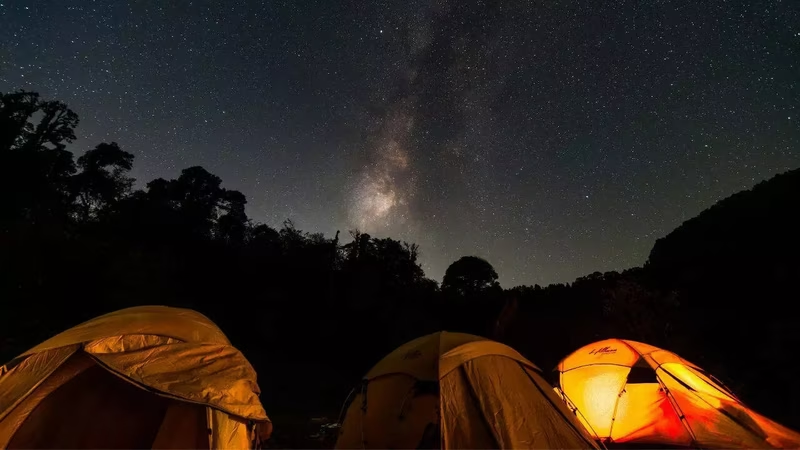
Look up. Because in 2026, the sky isn’t just the limit—it’s the main event.
Get ready for a celestial blockbuster year packed with jaw-dropping phenomena: a dramatic ‘ring of fire’ annular solar eclipse, a deep blood-red total lunar eclipse, a rare calendrical oddity known as a Blue Moon, and—just when you think it can’t get any better—a total solar eclipse that coincides with the Perseid meteor shower. Oh, and did we mention the supermoon on Christmas Eve? Or that NASA will send humans around the Moon for the first time in over 50 years with Artemis II?
Whether you’re a seasoned astrophotographer or someone who just loves gazing at the stars from your backyard, skywatching 2026 promises moments you’ll remember for a lifetime. And the best part? Most of these events are visible from India and across large swaths of the globe—with zero telescope required.
Table of Contents
- January to June: Celestial Warm-Ups
- The Main Event: August 2026 Total Solar Eclipse + Perseids
- Skywatching 2026: Rare Blue Moon & Christmas Supermoon
- Artemis II: The Human Return to Lunar Orbit
- How to Prepare for 2026 Astronomy Events
- Conclusion: Don’t Blink in 2026
- Sources
January to June: Celestial Warm-Ups
Don’t wait for summer—2026 kicks off strong.
February 17: Annular Solar Eclipse (‘Ring of Fire’)
Visible across parts of South America and the southern Atlantic, this eclipse won’t be seen from India—but it’s worth streaming live. During an annular eclipse, the Moon is too far from Earth to fully cover the Sun, leaving a brilliant ring of sunlight around its edges.
March 3: Total Lunar Eclipse
This blood moon will be fully visible across India, Europe, Africa, and the Americas. The Moon will pass through Earth’s umbra, turning a deep coppery red due to Rayleigh scattering—the same effect that makes sunsets red. Best viewing: after midnight IST.
April–May: Planetary Alignments
Jupiter, Mars, and Saturn will form a loose triangle in the pre-dawn sky. While not a tight conjunction, it’s a beautiful sight for early risers with a clear eastern horizon.
The Main Event: August 2026 Total Solar Eclipse + Perseids
Mark your calendars: **August 12, 2026** could go down as one of the most spectacular skywatching days in modern history.
That’s when a **total solar eclipse** will sweep across Greenland, Iceland, Spain, and northern Africa. While mainland India won’t see totality, parts of the western coast (like Kerala and Goa) may catch a partial phase just after sunrise—weather permitting.
But here’s the magic: the **Perseid meteor shower** peaks that very night.
The Perseids—debris from comet Swift-Tuttle—typically deliver 60–100 meteors per hour under dark skies. In 2026, the Moon will be in a waning crescent phase, meaning minimal light pollution. This creates near-perfect conditions for a meteor storm, especially in rural India away from city lights.
Pro tip: Watch after midnight on August 12–13. Lie flat, let your eyes adjust for 20 minutes, and enjoy the cosmic fireworks.
Skywatching 2026: Rare Blue Moon & Christmas Supermoon
2026 delivers not one, but two lunar oddities—both emotionally and astronomically potent.
May 31: Blue Moon
Despite the name, the Moon won’t turn blue. A “Blue Moon” refers to the second full moon in a single calendar month. This is rare—hence the phrase “once in a blue moon.” May 2026 has full moons on May 1 and May 31. Visible globally, including all of India.
December 24: Christmas Eve Supermoon
A supermoon occurs when the full moon coincides with lunar perigee (its closest point to Earth), making it appear up to 14% larger and 30% brighter. In 2026, this supermoon falls on Christmas Eve—a poetic celestial gift for holiday skywatchers. Expect stunning views across India, weather permitting.
Artemis II: The Human Return to Lunar Orbit
While not a naked-eye event, NASA’s Artemis II mission—scheduled for **September 2026**—will be a historic milestone in human spaceflight .
For the first time since Apollo 17 in 1972, humans will travel to the Moon. The crew of four (including the first woman and first person of color on a lunar mission) won’t land—but they will orbit the Moon, testing life-support systems and paving the way for Artemis III’s 2027 landing.
Though you can’t see the spacecraft with the naked eye, NASA will stream the launch live from Kennedy Space Center. Given India’s growing interest in space (thanks to ISRO’s successes), this mission will likely draw massive global attention—and inspire a new generation of Indian astronomers.
[INTERNAL_LINK:isro-chandrayaan-4-mission] | [INTERNAL_LINK:how-to-photograph-a-solar-eclipse]
How to Prepare for 2026 Astronomy Events
Don’t just hope—you prepare. Here’s your action plan:
- Get eclipse glasses NOW: For any solar event, certified ISO 12312-2 glasses are non-negotiable. Order from reputable vendors like Rainbow Symphony or American Paper Optics.
- Download sky apps: Use Stellarium, SkySafari, or NASA’s App to track real-time positions of planets and eclipses.
- Find dark skies: Use light pollution maps (like LightPollutionMap.info) to locate viewing spots near you.
- Join local astronomy clubs: Groups like the JAA (Jyotirvidya Parisanstha) in Pune or the Amateur Astronomers Association Delhi host public viewing events.
Conclusion: Don’t Blink in 2026
Skywatching 2026 isn’t just about astronomy—it’s about awe. In a world of screens and noise, these celestial events offer rare moments of collective wonder. Whether you’re watching the Moon blush red in March, counting Perseids in August, or gazing at a supermoon on Christmas Eve, you’re part of a global audience witnessing the universe’s grandeur.
And with Artemis II reminding us that human exploration is far from over, 2026 may very well reignite our shared dream of reaching beyond the stars.
So grab a blanket, find a dark field, and look up. The sky’s got a show you won’t want to miss.